

$1 Billion on the Line as Supreme Court Could Rewrite US–Cuba Lawsuits
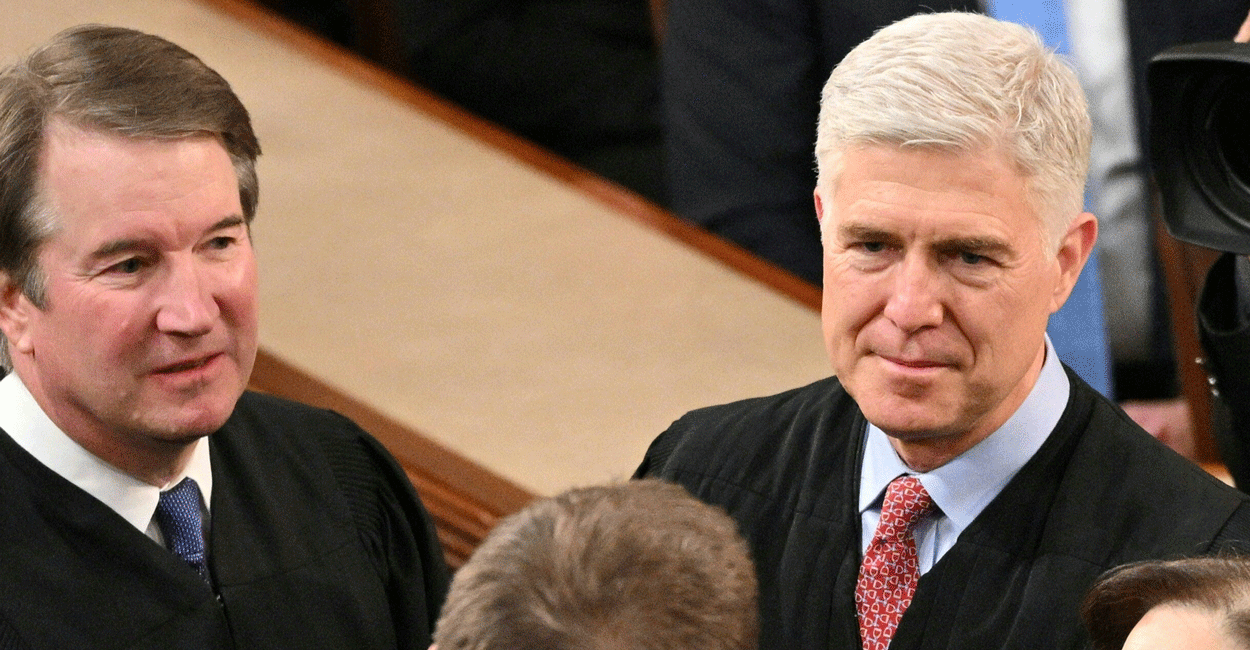
Justices heard arguments Monday in two disputes involving U.S.-Cuba relations that could be worth more than $1 billion.
Live Your Best Retirement
Fun • Funds • Fitness • Freedom
Oil giant ExxonMobil is a plaintiff in one of the cases, while major cruise lines, led by Royal Caribbean, are defendants in the other. A majority of justices seemed poised to side with ExxonMobil, while both conservative and liberal justices seemed skeptical about the claim against the cruise companies.
The cases are based on the Cuban Liberty and Democratic Solidarity Act of 1996, also known as the Helms-Burton Act, which formalized the U.S. trade embargo against Cuba. Title III of the law allows for lawsuits in U.S. courts against entities that traffic in property confiscated by the Cuban government after the communist revolution of 1959.
However, only recently did a president allow for lawsuits to proceed under the law. President Donald Trump lifted the suspension of lawsuits in 2019 that led to about 40 complaints.
Presidents Bill Clinton, who signed the law, George W. Bush, and Barack Obama all suspended Title III, seeking to avoid diplomatic conflicts with U.S. allies such as Canada and Spain that are heavily invested in Cuba. Obama also expanded relations with Cuba during his second term.
This is the first time the high court has ruled on the 30-year-old law.
ExxonMobil is seeking more than $1 billion in compensation for oil and gas assets seized by a Cuban state-owned company CIMEX. It filed the lawsuit in federal court in 2019 in the District of Columbia, CNBC reported.
ExxonMobil wants the high court to reverse a 2024 lower court ruling that this was a foreign sovereign immunity matter, meaning a foreign government could not be sued.
CIMEX has countered that the lower court ruling safeguards congressional intent for a sensitive foreign issue. The defense referred to the Foreign Sovereign Immunities Act, or FSIA.
Justice Neil Gorsuch noted the 1996 law seemed to defer such questions to the president.
“Why would Congress have put that toggle switch in giving the president the opportunity to turn on and off liability if it weren’t concerned there would be international law possible concerns, and it was essentially saying, we’re not doing the FSIA?” he asked.
CIMEX lawyer Jules Lobel argued that “Title III violated international law, extended U.S. territorial jurisdiction in many different controversial ways.”
Justice Brett Kavanaugh later followed: “The president has a huge role in the statute. That’s looking at the text. Then you look at the real world of what’s happened since the enactment of the statute, and the president has been front and center. That effect was that those suits couldn’t go forward. The president is the person who can weigh all of that.”
The second case, with the cruise lines as the defendants, is entirely a dispute among private companies, lacking any sovereign immunity questions.
The question is whether a plaintiff must establish a present-day property interest if the assets in question were not monetized. The plaintiff is Havana Docks, a U.S. company that built docks in Havana’s port before the Cuban revolution. The Castro regime revoked the company’s legal right to the docks.
In 2019, the docks company sued four cruise companies that used the confiscated docks from 2016 through 2019; these companies were Royal Caribbean, Carnival, Norwegian Cruise Line, and MSC Cruises.
A lower court found the cruise companies were liable for $440 million. The companies appealed, arguing that they followed the U.S. government’s lead on reopening travel to Cuba, part of the Obama administration’s overtures to Cuba.
Justices both liberal and conservative expressed skepticism toward the docks company, since it was talking about a lease rather than property as traditionally defined.
Justice Clarence Thomas asked what property the plaintiffs were claiming.
“We’re treating it as essentially ownership of a leasehold,” the company’s lawyer Richard Klingler responded. “The facilities themselves are what was seized and are set off limits, but that’s the underlying property. We don’t own the docks other than in the sense of having held a leasehold interest in relation to them.”
Thomas asked, “But you normally don’t think of someone as confiscating a lease.”
Justice Ketanji Brown Jackson followed, “It seems to me that property is a defined term here and that the statute itself includes the kinds of interests that you’re talking about.”
The post $1 Billion on the Line as Supreme Court Could Rewrite US–Cuba Lawsuits appeared first on The Daily Signal.
What's Your Reaction?
 Like
0
Like
0
 Dislike
0
Dislike
0
 Love
0
Love
0
 Funny
0
Funny
0
 Wow
0
Wow
0
 Sad
0
Sad
0
 Angry
0
Angry
0

I am just an average American. My teen years were in the late 70s and I participated in all that that decade offered. Started working young, too young. Then I joined the Army before I graduated High School. I spent 25 years in, mostly in Infantry units. Since then I've worked in information technology positions all at small family owned companies. At this rate I'll never be a tech millionaire. When I was young I rode horses as much as I could. I do believe I should have been a cowboy. I'm getting in the saddle again by taking riding lessons and see where it goes.








Comments (0)