

How Justices Reacted to Arguments in Women’s Sports Case
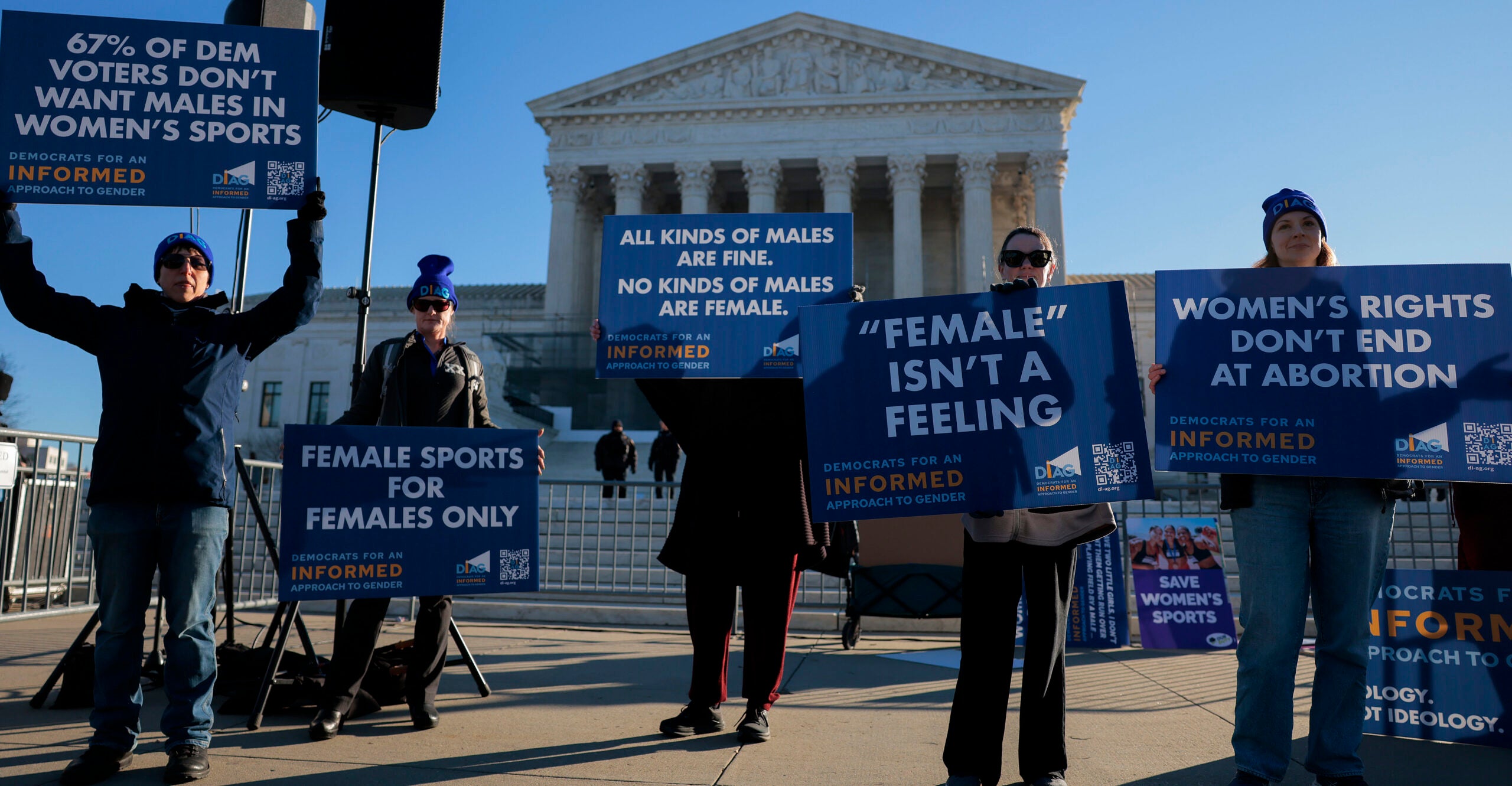
The Supreme Court heard two cases out of Idaho and West Virginia on Tuesday that could determine the future of state laws banning males from playing female sports.
Live Your Best Retirement
Fun • Funds • Fitness • Freedom
Chief Justice John Roberts, seen as a swing vote in the case, hinted that he would side with the states. He said allowing a male identifying as a female to compete in women’s sports could make federal Title IX statutes difficult to enforce.
“How we approach the situation of looking at it not as boys versus girls, but whether or not there should be an exception,” Roberts said during questioning. “If we adopted that, that would have to apply across the board and not simply to the area of athletics.”
Lindsay Hecox, a self-identified “transgender” athlete who wanted to be on the women’s track and cross-country teams at Boise State University, sued the state. The 9th U.S. Circuit Court of Appeals imposed an injunction.
In the West Virginia case, the plaintiff, Becky Pepper-Jackson wanted to compete on the middle school girls’ cross country team. The 4th U.S. Circuit Court of Appeals ruled West Virginia’s Save Women’s Sports Act violates Title IX, the federal law that prohibits sex discrimination in educational programs and school athletics.
The high court heard the cases back-to-back on Tuesday.
Roberts said the question before the court is different from the 2020 Bostock ruling, where the court determined the Civil Rights Act protections against sex-based employment discrimination also extended to gender identity and sexual orientation.
West Virginia Solicitor General Michael Williams agreed with that view.
“The law is indifferent to gender identity because sports are indifferent to gender identity,” Williams said.
However, plaintiff lawyer Joshua Block argued that West Virginia’s law “takes a wrecking ball to Title IX.”
“Unlike the exclusion of a cisgender boy, excluding BPJ doesn’t advance any interest in ensuring overall fairness and safety,” Block said. “Unlike the case of the cisgender boy, excluding BPJ from the girls’ teams excludes her from all athletic opportunity while stigmatizing and separating her from her peers.
Justice Elena Kagan, in the court’s liberal wing, acknowledged there could be instances where individuals have not had the same hormone treatments as others who want to join a girls’ team.
She asked Idaho Solicitor General Alan Hurst why schools could not determine on a case-by-case basis if an athlete has an unfair advantage.
Hurst answered with a detailed hypothetical as to why that would not work, in practice.
If “only 10% of males who identify as transgender take the testosterone suppression,” Hurst noted, the other side would argue, “the [protected] class is just the males who take the testosterone suppression.”
However, if the state argued that, of males who take testosterone suppression, 75% still have an athletic advantage, plaintiffs would change their definition of who is in the protected class, Hurst argued. They would say, “our class is males who identify as transgender, who suppress their testosterone… and are able to get it down to where they don’t have a competitive advantage.”
“That is going to be enormously burdensome for everyone, and the state can never win because whenever the state points to the fit and the statute, they just redefine their class,” Hurst said.
Justice Brett Kavanaugh pushed Hecox’s attorney Kathleen Hartnett to address the harm for female athletes, noting the NCAA and the Olympic Committee have acted to keep men out of women’s sports.
“For the individual girl who does not make the team or doesn’t get on the stand for the medal, or doesn’t make all-league, there’s a harm there, and I think we can’t sweep that aside,” Kavanaugh said. “The NCAA, the Olympic Committee, a lot of state governments, that’s a lot of people who are concerned about women’s sports.”
Hartnett argued that her client had medical procedures that mitigated any sex-based advantage. She said the Idaho statute shouldn’t apply to her client.
“The question is: is there an unfair biological advantage?” Hartnett argued. She added, “That’s why we are here, not proposing a rule of absolute inclusion, but saying that in the case, people like our client, who have mitigated their advantage, don’t match the statutory interest.”
Justice Neil Gorsuch is also considered a swing vote in the case since he voted with the liberal wing in Bostock, but then, in 2025, voted to uphold state bans on trans surgeries for minors.
Gorsuch said the question at hand is what advantage a male who identifies as a female would have in an athletic competition.
“That’s the kind of question we’re going to ultimately have to answer, not the science question, but the percentage question,” Gorsuch said.
Hartnett responded that someone with hormone treatment could be at a disadvantage when competing in female sports.
“Being a transgender woman, actually, to the extent you’ve repressed your testosterone, you’re at somewhat of a disadvantage in many ways, because you have this larger frame with weaker muscles and no testosterone,” Hartnett said.
The post How Justices Reacted to Arguments in Women’s Sports Case appeared first on The Daily Signal.
What's Your Reaction?
 Like
0
Like
0
 Dislike
0
Dislike
0
 Love
0
Love
0
 Funny
0
Funny
0
 Wow
0
Wow
0
 Sad
0
Sad
0
 Angry
0
Angry
0

I am just an average American. My teen years were in the late 70s and I participated in all that that decade offered. Started working young, too young. Then I joined the Army before I graduated High School. I spent 25 years in, mostly in Infantry units. Since then I've worked in information technology positions all at small family owned companies. At this rate I'll never be a tech millionaire. When I was young I rode horses as much as I could. I do believe I should have been a cowboy. I'm getting in the saddle again by taking riding lessons and see where it goes.





















Comments (0)