

Kavanaugh Lays Out How Trump Could Recreate Tariffs Through Other Laws
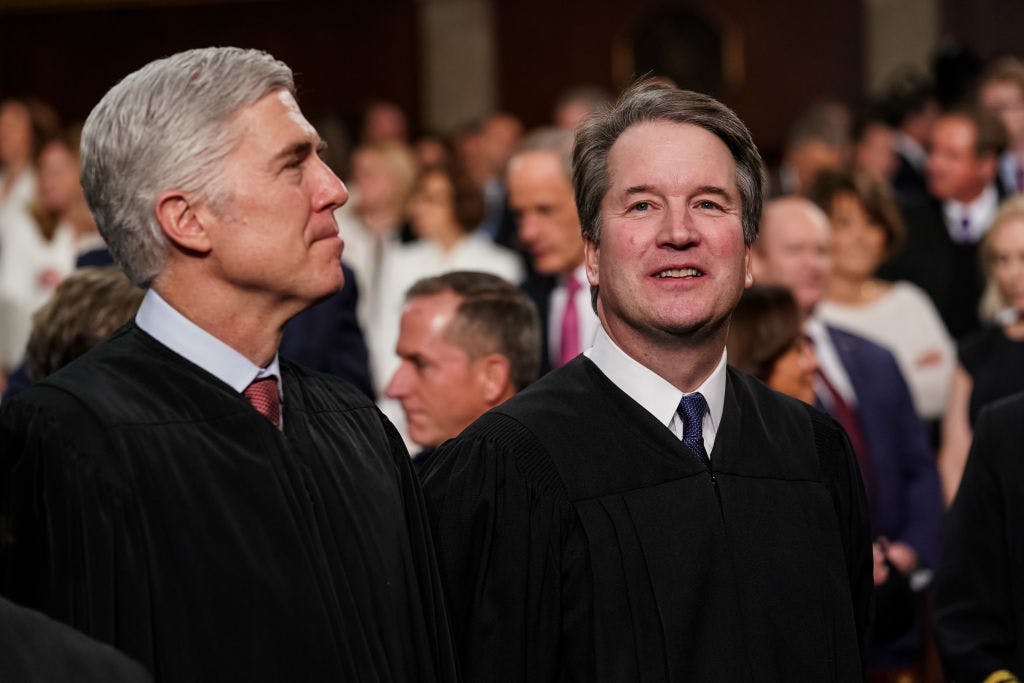
Justice Brett Kavanaugh said Friday that President Donald Trump could likely preserve most of his “Liberation Day” tariffs despite the Supreme Court’s decision striking them down.
Live Your Best Retirement
Fun • Funds • Fitness • Freedom
Writing in dissent, Kavanaugh argued that while the Court rejected Trump’s reliance on the International Economic Emergency Powers Act (IEEPA), other federal statutes could authorize most of the tariffs.
“Although I firmly disagree with the Court’s holding today, the decision might not substantially constrain a President’s ability to order tariffs going forward,” he wrote. “That is because numerous other federal statutes authorize the President to impose tariffs and might justify most (if not all) of the tariffs at issue in this case—albeit perhaps with a few additional procedural steps that IEEPA, as an emergency statute, does not require.”
Kavanaugh pointed specifically to the Trade Expansion Act of 1962, the Trade Act of 1974, and the Tariff Act of 1930 as alternative statutory bases that could authorize the tariffs Trump sought to impose.
“IEEPA merely allows the President to impose tariffs somewhat more efficiently to deal with foreign threats during national emergencies,” he said. “In essence, the Court today concludes that the President checked the wrong statutory box by relying on IEEPA rather than another statute to impose these tariffs.”
Kavanaugh’s position mirrors one previously articulated by Treasury Secretary Scott Bessent. In December, Bessent said multiple sections of the Trade Expansion Act of 1962 could be used to “recreate the exact tariff structure” Trump imposed through IEEPA.
In his dissent, Kavanaugh argued that both history and law were on Trump’s side. Specifically, Kavanaugh pointed to the global tariffs imposed by former President Richard Nixon in 1971 as an example of a president imposing broad trade restrictions during an economic crisis.
“Statutory text, history, and precedent demonstrate that the answer is clearly yes: Like quotas and embargoes, tariffs are a traditional and common tool to regulate importation,” he said.
Kavanaugh also argued that it would be illogical to allow the president to block all trade with China while barring him from imposing tariffs on Chinese imports.
“As [the plaintiffs] interpret the statute, the President could, for example, block all imports from China but cannot order even a $1 tariff on goods imported from China,” Kavanaugh said. “That approach does not make much sense.”
Kavanaugh also warned that the ruling could raise questions about whether the government must issue refunds for tariffs already collected and potentially affect trade deals negotiated under those tariffs.
Justices Clarence Thomas and Samuel Alito joined Kavanaugh’s dissent. Thomas also wrote a separate opinion arguing that Congress had delegated tariff authority to the president.
What's Your Reaction?
 Like
0
Like
0
 Dislike
0
Dislike
0
 Love
0
Love
0
 Funny
0
Funny
0
 Wow
0
Wow
0
 Sad
0
Sad
0
 Angry
0
Angry
0

I am just an average American. My teen years were in the late 70s and I participated in all that that decade offered. Started working young, too young. Then I joined the Army before I graduated High School. I spent 25 years in, mostly in Infantry units. Since then I've worked in information technology positions all at small family owned companies. At this rate I'll never be a tech millionaire. When I was young I rode horses as much as I could. I do believe I should have been a cowboy. I'm getting in the saddle again by taking riding lessons and see where it goes.














Comments (0)