

Make your own record player: A simple project with a profound lesson
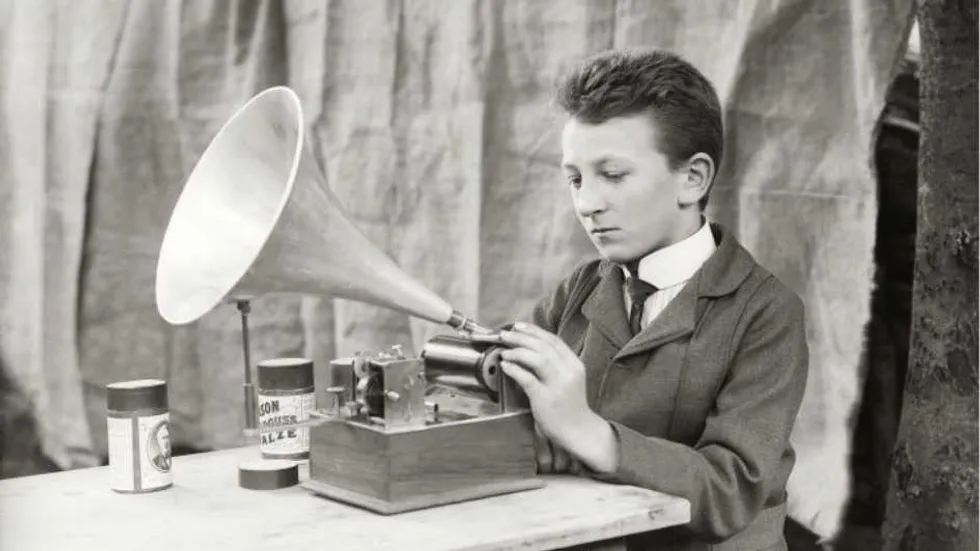
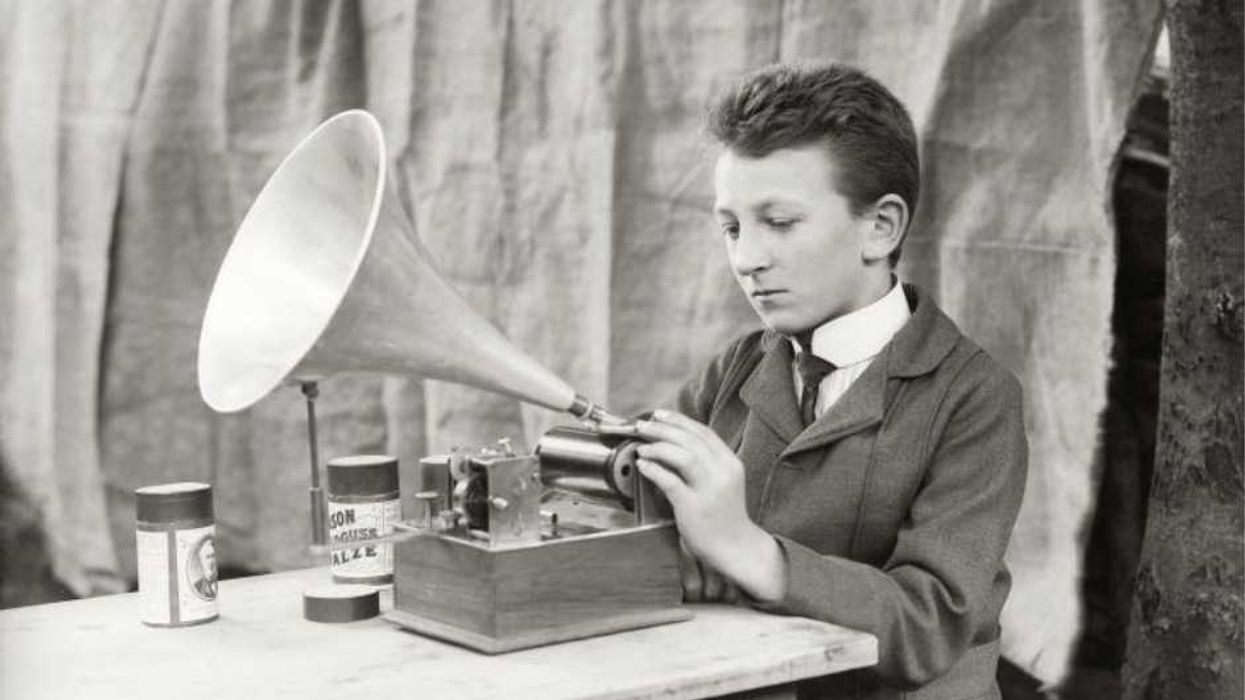
We live in a scaled-up, real-world version of the classic children’s board game “Mousetrap.” The built world is over-engineered, too interdependent, and so precarious that a slight disturbance might bring the whole thing down.
Live Your Best Retirement
Fun • Funds • Fitness • Freedom
The interconnected, precarious Rube Goldberg contraption that is modern society has more than just rolling balls and baskets and levers. Our real, physical-world interdependencies include reliance on digital algorithms and computing devices that no one can intuitively understand. It’s the worst of both worlds, physical and electronic.
This is a real-world lesson in physics and mechanics that teaches universal principles that can never be altered by whim or historical vogue.
A friend’s internet service went out recently. Even though she was able to get a human staff member on the phone, that human wouldn’t talk to her to even confirm that the company recognized that she was a paying customer.
Why? Because she couldn’t log in to her email on another device and recite a “one-time code.” Remember, she was calling because she didn’t have internet access. Cell signals in rural states are often insufficient for internet use. You see the problem.
Everything is like this, but everyone is acting like this is the way things have always been. It’s not true. There is no reason to live this way. It is not a natural law. The overcomplicated world is not something that just “happened.”
This setup is a result of choices. Disconnected choices, yes. There’s no central mind that has created our society. There’s no single controlling cabal that has engineered the way we live, communicate, procure food, or any of that. There are powerful interests, legal and commercial, that influence our society more than you and I as individuals can influence it. But it’s not a conspiracy in the classic sense. It’s a result of accumulated errors. We need a reset.
Memories of the analog world
1979. My family slipped away from Tully, New York, in the dead of night by means of my grandmother’s silver Buick Electra. The Buick told you that she had a V-8 through the distinctive muffled bass rumble from twin tailpipes. She was what I call an “honest mechanical.”
We boarded the Amtrak to cross the country so my stepfather, a glassblower who specialized in making electrodes, could find a job. There was nothing left for a working-class man in Upstate New York in the 1970s.
On arrival in Los Angeles, my Uncle Lee and Aunt Sherry were waiting in a 1979 lemon-yellow Cadillac Coupe de Ville. A Cadillac. I was going to ride in a Cadillac!
The trunk mechanism on my Uncle Lee’s Cadillac was my first introduction to what I would later think of as overcomplicated or dishonest mechanicals. It did this amazing thing I had never seen before. The trunk lid raised and lowered all by itself, untouched by human hands. After my mother loaded the last suitcase into the cavernous trunk, the enormous yellow deck lid silently, slowly crept downward. When the lid reached the latch, the mechanism slowed down to a crawl to give you a “soft and silent” latch.
Today, my base-model Toyota has all those bells and whistles plus more. The “more” is the irritating part. Nothing in the car is controlled mechanically or directly. Everything is drive-by-wire. The car decides when to spin the wheels when stuck in snow, even though I could do a better job if I were allowed to control the traction. Even the heater fan and lights are programmed to slowly, softly ramp up and ramp down, as if a too-sudden onset of sound or light would strike the driver with apoplexy.
Man and machine
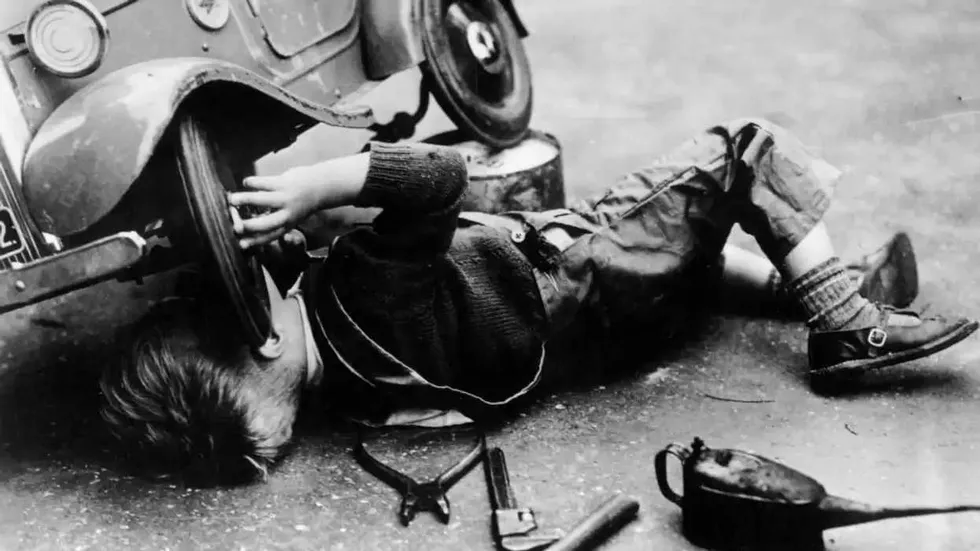
The legend of John Henry both horrified and fascinated me as a child. The steel-driving man of folklore tried to prove he was as good as the new-fangled steam drill at chipping out a tunnel to lay track. John Henry swung his sledgehammer until his muscle fibers broke and he died exhausted on the ground, while the steam piston kept reciprocating.
I understood that this tale from America's railroad age was really about our present. It was obvious to me even as a kid in the 80s: Machines were crowding out the men. The mechanization of work inverted our values; humans had to live up to the demands and preferences of machine logic, not the other way around.
John Henry’s last act was a way of saying, “I am a man, and I live.”
RELATED: America needs mechanics; here's where to apply
 Getty Images/Heritage Images
Honest mechanicals
Honest mechanicals are machines that can be observed, understood, and intuited. They show their works; nothing is hidden from the hands or the eyes. Compare honest mechanicals to modern digital devices. Call those devices “black boxes” whose function cannot be observed, understood, intuited, or reverse-engineered by human senses alone.
Black boxes (computers of various sorts) are not mechanicals at all. They don’t have levers or pulleys or counterweights, or sprockets, or escapements. They have invisible states of magnetic orientation. You cannot see the works with your eyes, and the complexity of a chipset is beyond the human mind’s ability to grasp.
A piece of photographic film with a light-sensitive emulsion that forms an image is an honest mechanical. The image is readable by the human eye.
A .jpg picture file is a black box. The image cannot be read or intuited by humans without another black box we call a computer.
A steam locomotive is an honest mechanical. Observe that you can understand how the machine turns heat into steam, turns steam pressure into lateral force, and then translates lateral force into rotary motion, thus moving the train and its passengers along.
You can intuit an honest mechanical. And if you have children, especially boys, I recommend that you introduce them to honest mechanicals. Show them how steam engines work. Show them a cutaway of an internal-combustion automobile engine. Let them take apart a blender or a stand mixer to see how electric motors produce rotary motion.
Here’s an easy hands-on lesson you can and should do with your kids, starting at about age 4. It doesn’t matter that the lesson uses “obsolete” technology. That is a benefit. This is a real-world lesson in physics and mechanics that teaches universal principles that can never be altered by whim or historical vogue.
Make your own record player
Materials:
- 1 33 and 1/3 long-playing record album — one that’s scratched that you don’t care about
- 1 #2 pencil
- construction paper
- Scotch tape
- 1 sewing needle
Instructions:
Form the construction paper into a cone and tape together. Tape the sewing needle securely to the small end of the cone. Think of an old gramophone with a needle attached to a brass horn — that’s what you’re doing.
Put the pencil inside the center hole of the record. Spin the record like a toy top, and help your kid lower the needle-in-a-cone onto the guide groove at the edge of the record.
Magically, you’ll hear the sound on the record, slightly amplified by the paper cone. Sure, it’ll be at the wrong speed, and maybe you won’t be able to parse the words. But you and your kid will immediately understand basic sound recording and reproduction. You will understand that sound can be transcribed as a wave form that can take real-world, physical form in the bumps and pits of a piece of material.
Most importantly, your child will understand that the material world actually exists and that it is analog.
This matters. It matters more than you probably know. Modern young people have grown up in a world of portable computers and phone screens that appear to show them reality, but that do nothing but arrange points of light into virtual simulations. Have you noticed that young Millennials and younger seem not only put off and frightened by simple mechanical technology — mechanical telephones, cars that use a clutch and a gear shift — but almost disgusted and embarrassed by devices from just a generation ago?
This is not merely the universal plaint of the old about the shortcomings of the young. The world today is different to an extreme degree from the world of just one or two generations ago. Young people don’t know how to get around town without GPS, they’re frightened to get driver’s licenses at 16, and few can even whip up a basic meal on a stovetop. Why would they know these things when they’ve been reared to believe that food and transportation just “happen” by sliding your fingers along an iPhone touchscreen?
Do what you can to ground yourself (first) and your kids and grandkids back inside the real, physical, material, analog world. Remember what John Henry knew: We are men and women, and we live.
What's Your Reaction?
 Like
0
Like
0
 Dislike
0
Dislike
0
 Love
0
Love
0
 Funny
0
Funny
0
 Wow
0
Wow
0
 Sad
0
Sad
0
 Angry
0
Angry
0

I am just an average American. My teen years were in the late 70s and I participated in all that that decade offered. Started working young, too young. Then I joined the Army before I graduated High School. I spent 25 years in, mostly in Infantry units. Since then I've worked in information technology positions all at small family owned companies. At this rate I'll never be a tech millionaire. When I was young I rode horses as much as I could. I do believe I should have been a cowboy. I'm getting in the saddle again by taking riding lessons and see where it goes.

























Comments (0)