

Rubio’s Muscular Defense Of Western Civilization
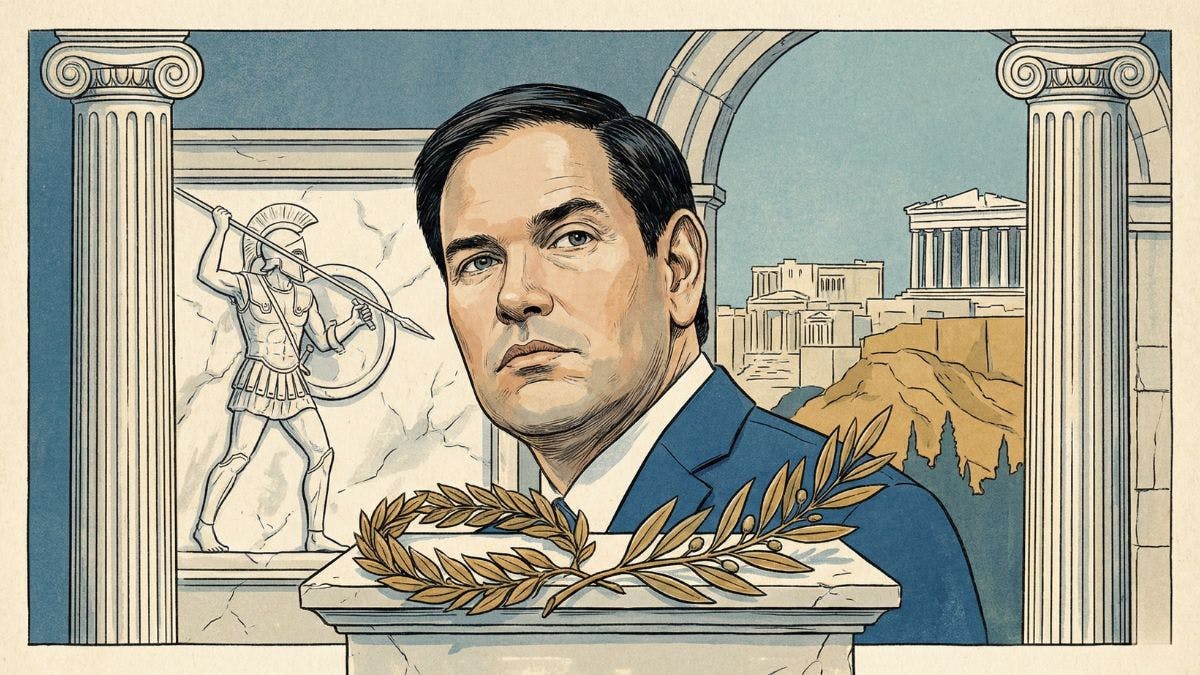
Secretary of State Marco Rubio spoke at the Munich Security Conference in Germany on Saturday. It was attended by a wide variety of politicos, both from the Trump administration and from the Democratic side of the aisle.
Live Your Best Retirement
Fun • Funds • Fitness • Freedom
He was the adult in the room.
Marco Rubio is the most well-spoken member of the Trump administration. And when it comes to foreign policy, it’s not even close.
He gave a truly tremendous speech about the relationship between America and Europe.
If you recall, last year, Vice President JD Vance also went to Europe. In Davos, he proceeded to give a speech blistering the Europeans: some parts for good reasons, some parts that weren’t so great.
His speech appeared to draw the hackles of a bunch of Europeans because it was basically saying, “Guys, you seem to be on your own. America is drawing back.”
That is not what Rubio said. What Rubio said is that we have strong bonds, centuries-long bonds with the many European countries, and we also are going to have common interests with those countries, but we need strong allies to stand up for themselves.
He attempted to draw out a definition of what it meant to be in consonance with Europe in a way that Vance, in some ways, failed to advance.
Rubio received a standing ovation for this, which is a good thing because his defense of the Trump administration policy was quite muscular over at the Munich Security Conference.
Rubio suggested that the United States and Europe have a great history of cooperation:
Together we rebuilt a shattered continent in the wake of two devastating world wars. When we found ourselves divided once again by the Iron Curtain, the free West linked arms with the courageous dissidents struggling against tyranny in the East to defeat Soviet communism. We have fought against each other, then reconciled, then fought, then reconciled again. And we have bled and died side by side on battlefields from Kapyong to Kandahar.
Rubio said we definitely need strong allies, that it can’t just be the United States picking up the check for everybody else. You can’t build gigantic welfare states on the back of American taxpayers. You need to be strong, because strong alliances require strong allies, and those strong allies are capable of providing deterrence against, for example, a wayward Russia.
“We do not want our allies to be weak, because that makes us weaker,” he said. “We want allies who can defend themselves so that no adversary will ever be tempted to test our collective strength. This is why we do not want our allies to be shackled by guilt and shame. We want allies who are proud of their culture and of their heritage, who understand that we are heirs to the same great and noble civilization, and who, together with us, are willing and able to defend it.
Rubio noted problems that the continent has brought upon itself, ranging from subjecting itself to the Green Revolution,, to the mass migration that it brought upon itself largely through a bizarre sort of blood-guilt, the idea that Europe, because it had destroyed so much of the world during World War II, somehow owed it to the rest of the world to open its borders and bring everyone in.
In the key section of his speech, he talked about the values that are supposed to bring together the United States and Europe.
The fundamental question we must answer at the outset is what exactly are we defending, because armies do not fight for abstractions. Armies fight for a people; armies fight for a nation. Armies fight for a way of life. And that is what we are defending: a great civilization that has every reason to be proud of its history, confident of its future, and aims to always be the master of its own economic and political destiny.
What are the ideas that unite that civilization? He said, “Armies don’t fight for abstractions.” I beg to differ a little; armies do fight for abstractions. Armies have fought for communism; there are armies that fight for Islamic fundamentalism; there are armies that are fought for Catholicism and for Protestantism. There are armies all over the world that fight for ideas.
The question is, what are the ideas of Western civilization that are worth upholding and preserving? Because if you don’t know what it is you are defending, it is very difficult to fight for it.
The truth is that Europe itself is a bit of an idea. There are times when members of the European continent have been fighting each other tooth and nail in bloody, centuries-long wars.
What exactly is the concept of Europe? What is the common ideological heritage that actually counts between America and Europe? If you’re going to talk about Europe as a holistic concept, you have to define your terms. If you’re going through the history of Europe all the way back to the Roman Empire, what you’d see is that the Roman Empire was its own civilization. It considered the outlying areas to be barbarians. The word barbarian comes from a Latin root, which means people who speak gibberish. At that time, it applied to the Germans. The Germans were the barbarians. Now they are considered part of European civilization.
After the fall of the Roman Empire, what rose in its wake was Christendom, which was basically the idea of Catholic dominance of the European continent. That grew over the course of the Carolingian Empire and over the course of the subsequent centuries, up until the Protestant Reformation.
The Protestant Reformation ushered in an era of religious warfare that lasted well over 100 years, and ended with the Peace of Westphalia when the medieval concept of Christendom was replaced by the modern system of nation-states. There was a new concept of Europe that was formed in the aftermath.
The question is always in opposition to what? Whenever you are defining a civilization, civilizations have an internal definition, and then they have a definition with regard to others.
The reality is that the Roman Empire was not only defined as that which was under the sway of Rome, but also in opposition to other empires and armies, German armies, Assyrian armies, Persian armies, or whatever the case may have been.
Christendom was largely forged in opposition to Islam in the aftermath of the fall of the Roman Empire, because Islam was actually a dire threat to Europe and had spread deep into Europe, all the way into France, after the Peace of Westphalia.
About a century later, we saw the rise of the Enlightenment, and then the West became identified with these Enlightenment ideas, a history of Christianity that bled over into a sort of secularized version of many of the key values of Christianity, but with a critical eye toward the idea that religion could answer all questions, and therefore a sort of Aristotelian approach towards science that looked at evidence first.
You got the separation of church and state in many of these countries. You got the rise of the scientific revolution, the rise of the industrial Revolution, the rise of free economies, and all the rest.
And then the West tore itself apart, enduring two world wars.
We saw a West redefined in opposition to Soviet communism and in the aftermath of Soviet communism.
So what is the West? What are these values that we hold dear? It is not just a matter of “common heritage.” It is not just a matter of “common language.” It is not “cultural inheritance” because there are similarities in culture, but also pretty significant differences in these cultures.
To pretend that Europe doesn’t exist as a concept or as a civilization is silly. It has a shared Christian history that grew out of Christendom, but it also has an Enlightenment history, and it has shared values.
And if those values wane, so too will the alliance between the old world and the new.
Those values include the rule of law, freedom of speech, freedom of religion, property rights, democracy, and small republicanism.
This is one reason among many why Russia has never quite ever entered the world of Europe, and has always sort of existed on the fringes of Europe. Integrating the Russian Empire into Europe has always been a failed experiment.
All of this means Europe needs to uphold its own values. It means the United States needs to uphold its own values, and we all need to understand that a shared history, a shared experience, and a shared set of values are all necessary in order to have an increasingly powerful alliance.
He concluded:
I am here today to leave it clear that America is charting the path for a new century of prosperity, and that once again we want to do it together with you, our cherished allies and our oldest friends. We want to do it together with you, with a Europe that is proud of its heritage and of its history; with a Europe that has the spirit of creation of liberty that sent ships out into uncharted seas and birthed our civilization; with a Europe that has the means to defend itself and the will to survive.
We should be proud of what we achieved together in the last century, but now we must confront and embrace the opportunities of a new one – because yesterday is over, the future is inevitable, and our destiny together awaits.
This is the right approach for the Trump administration to take.
And Rubio did a phenomenal job of expounding it.
What's Your Reaction?
 Like
0
Like
0
 Dislike
0
Dislike
0
 Love
0
Love
0
 Funny
0
Funny
0
 Wow
0
Wow
0
 Sad
0
Sad
0
 Angry
0
Angry
0

I am just an average American. My teen years were in the late 70s and I participated in all that that decade offered. Started working young, too young. Then I joined the Army before I graduated High School. I spent 25 years in, mostly in Infantry units. Since then I've worked in information technology positions all at small family owned companies. At this rate I'll never be a tech millionaire. When I was young I rode horses as much as I could. I do believe I should have been a cowboy. I'm getting in the saddle again by taking riding lessons and see where it goes.

















Comments (0)