

The Olympics Controversy That’s Suddenly About America Itself
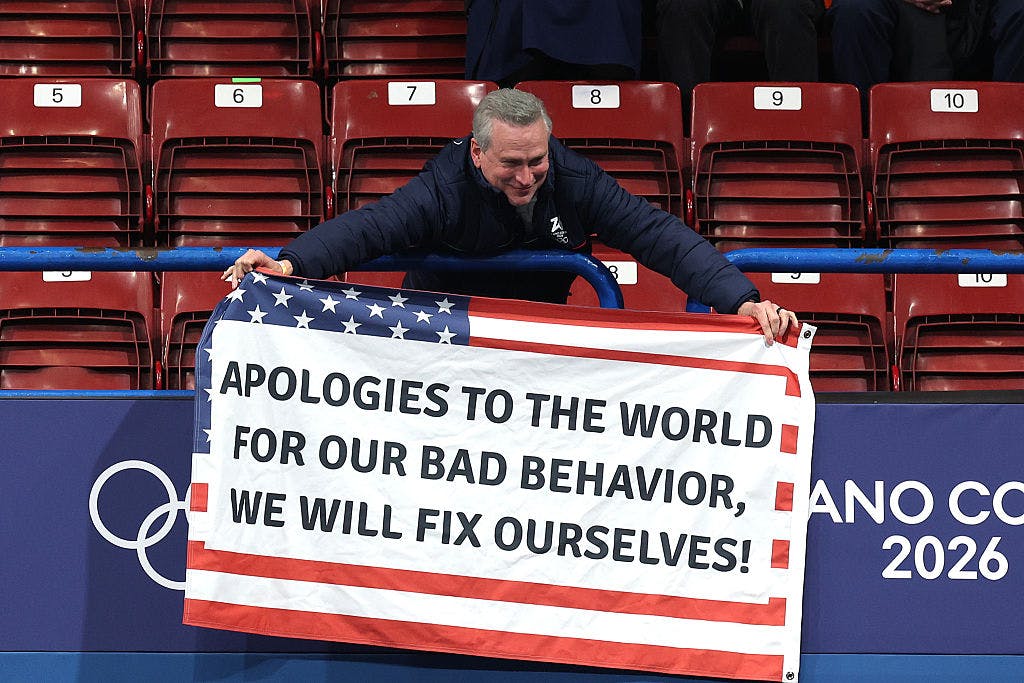
It is perhaps inevitable that a major global event such as the Olympic Games will become politicized. From the Nazi appropriation of the 1936 Berlin Games to the long Cold War rivalry between the United States and the Soviet Union, competition has always taken on what Al Michaels once called a “nationalistic sense.” But at the 2026 Milan Cortina Games happening now, the media have pushed things to a whole new level. Journalists seem intent on turning Olympians into politicians.
Live Your Best Retirement
Fun • Funds • Fitness • Freedom
The real flashpoint was an interview with Team USA skier Hunter Hess. During a press conference, he was goaded into expressing his personal disagreements with certain Trump administration policies. “Just because I’m wearing the flag doesn’t mean I represent everything that’s going on in the U.S.,” he said. President Donald Trump himself shot back, calling Hess a “real loser.” The whole thing has turned into a media circus, distracting from the excellence all Team USA athletes have been pursuing.
To some extent, the media’s agenda here is pretty straightforward; politicization and incendiary headlines drive clicks and social media views. But there is also a real double standard that ought to outrage all Olympics fans and American citizens. Eileen Gu, a freestyle skier born and educated in the United States but competing for the People’s Republic of China, has mostly escaped questions about the Chinese Communist Party’s totalitarian atrocities. NBC, which broadcasts the Olympics in the United States, has even tried making Gu into a star. The Today show did not ask her about the persecution of Jimmy Lai or the genocide of the Uyghur people, even while NBC has covered statements American athletes have made about U.S. immigration policy or social issues.
Unlike China, the U.S. government does not pay our athletes. The United States Olympic Committee is a federally chartered nonprofit and funded entirely by private sources. American Olympians may receive corporate sponsorships, but putting on the red, white, and blue and competing for our people is a sacrifice in a way that is not the case for other countries. These athletes are not hirelings; they find a way to turn the pursuit of personal excellence into an act of genuine patriotism. Authoritarian regimes can try buying themselves medals by recruiting mercenaries such as Gu, but they will never be able to purchase that genuine Olympic spirit.
There have been plenty of inspiring stories about American athletes at these games, but none provides a starker contrast with Gu than Team USA figure skater Alysa Liu. She was a star as a teenager, but she retired at the age of 16 to focus on living a normal life. Liu made a triumphant return to the world of figure skating in 2024, and she often explains that her sport has become a kind of art. Already a gold medalist in the team event, Liu is currently positioned to medal again in the individual competition. Her skating is remarkably beautiful, a true wonder to behold.
Equally fascinating, though, is the political backdrop of Liu’s young career. Like Gu, she is the daughter of a Chinese immigrant to the United States. But unlike the skier, her family holds no illusions about the CCP’s tyranny. Liu’s father Arthur was deeply involved with the Chinese Democracy Movement in the 1980s, joining the protests at Tiananmen Square and witnessing the subsequent massacre firsthand. He has always been a vocal critic of the communist regime and is, in no uncertain terms, a political refugee.
The CCP initially tried recruiting Liu to skate for it under the same “naturalization program” that sponsored Gu’s defection. Given her family’s firsthand experience of communist oppression, though, she understandably rebuffed the effort. The CCP, however, would not take no for an answer. In 2022, the Department of Justice charged Chinese agents with conducting an intimidation campaign against the Liu family and other Chinese Americans critical of the regime. Apparently, one spy even pretended to be a USOC official to steal information from the Lius. The State Department even had to take special precautions to protect Alysa Liu when she competed in the 2022 Beijing Winter Olympics.
Perhaps the most American part of the story, though, is that Liu has used her massive platform as a figure skating star to shine the light on her father’s sacrifices and the fight for human rights. “Honestly I would just have the main focus be my dad’s story because his story is so cool and also everything … happened because of what he did,” she said at a media summit in 2025. “So, like I feel like we got to start with the roots.”
“We represent the people,” she said in another interview when asked about patriotism at the games. Liu is only 20 years old, but already she understands that the flag she competes under means something more than nationalistic pride; it symbolizes the hope of freedom for millions worldwide.
Authoritarian regimes in places such as China, Iran, and Russia have always sought to use the Olympic Games to promote their ideologies, and the commercial media are all too willing to turn a blind eye or even become complicit. But stories such as Liu’s, and those of other patriotic American athletes, demonstrate in no uncertain terms how incompatible that goal is with the true Olympic spirit. The freedom American athletes enjoy — even to criticize their own country — is in fact the reason why we consistently embody such excellence at the games. And that’s nothing to apologize for.
***
Michael Lucchese is the founder of Pipe Creek Consulting, an associate editor of Law & Liberty, and a contributing editor to Providence.
The views expressed in this piece are those of the author and do not necessarily represent those of The Daily Wire.
What's Your Reaction?
 Like
0
Like
0
 Dislike
0
Dislike
0
 Love
0
Love
0
 Funny
0
Funny
0
 Wow
0
Wow
0
 Sad
0
Sad
0
 Angry
0
Angry
0

I am just an average American. My teen years were in the late 70s and I participated in all that that decade offered. Started working young, too young. Then I joined the Army before I graduated High School. I spent 25 years in, mostly in Infantry units. Since then I've worked in information technology positions all at small family owned companies. At this rate I'll never be a tech millionaire. When I was young I rode horses as much as I could. I do believe I should have been a cowboy. I'm getting in the saddle again by taking riding lessons and see where it goes.











Comments (0)