

Trump v. Slaughter exposes who really fears democracy


In the recently argued Trump v. Slaughter case, most of the U.S. Supreme Court seemed to affirm what should be obvious: The president has a constitutional right under Article II to dismiss federal employees in the executive branch when it suits him.
Live Your Best Retirement
Fun • Funds • Fitness • Freedom
That conclusion strikes many of us as self-evident. Executive-branch employees work under the president, who alone among them is chosen in a nationwide election. Bureaucrats are not. Why, then, should the chief executive’s subordinates be insulated from his control?
When the Roberts Court overturned Roe in 2022 and returned the issue to the states, many voters responded with fury. The electorate did not welcome responsibility. It resented it.
A vocal minority on the court appears to reject that premise. Justices Ketanji Brown Jackson and Sonia Sotomayor warned that allowing a president — implicitly a Republican one — to control executive personnel would unleash political chaos. Jackson suggested Trump “would be free to fire all the scientists, the doctors, the economists, and PhDs” working for the federal government. Sotomayor went further, claiming the administration was “asking to destroy the structure of government.”
David Harsanyi, in a perceptive commentary, identified what animates this view: “fourth-branch blues.” The administrative state now exercises power that rivals or exceeds that of the constitutional branches. As Harsanyi noted, nothing in the founders’ design envisioned “a sprawling autonomous administrative state empowered to create its own rules, investigate citizens, adjudicate guilt, impose fines, and destroy lives.”
Yet defenders of this system frame presidential oversight as a threat to “democracy.” Democrats, who present themselves as democracy’s guardians, warn that allowing agency officials to answer to the elected president places the nation in peril. The argument recalls their reaction to the Dobbs case, when the court returned abortion policy to voters and was accused of “undermining democracy” by doing so.
RELATED: This Supreme Court case could reverse a century of bureaucratic overreach
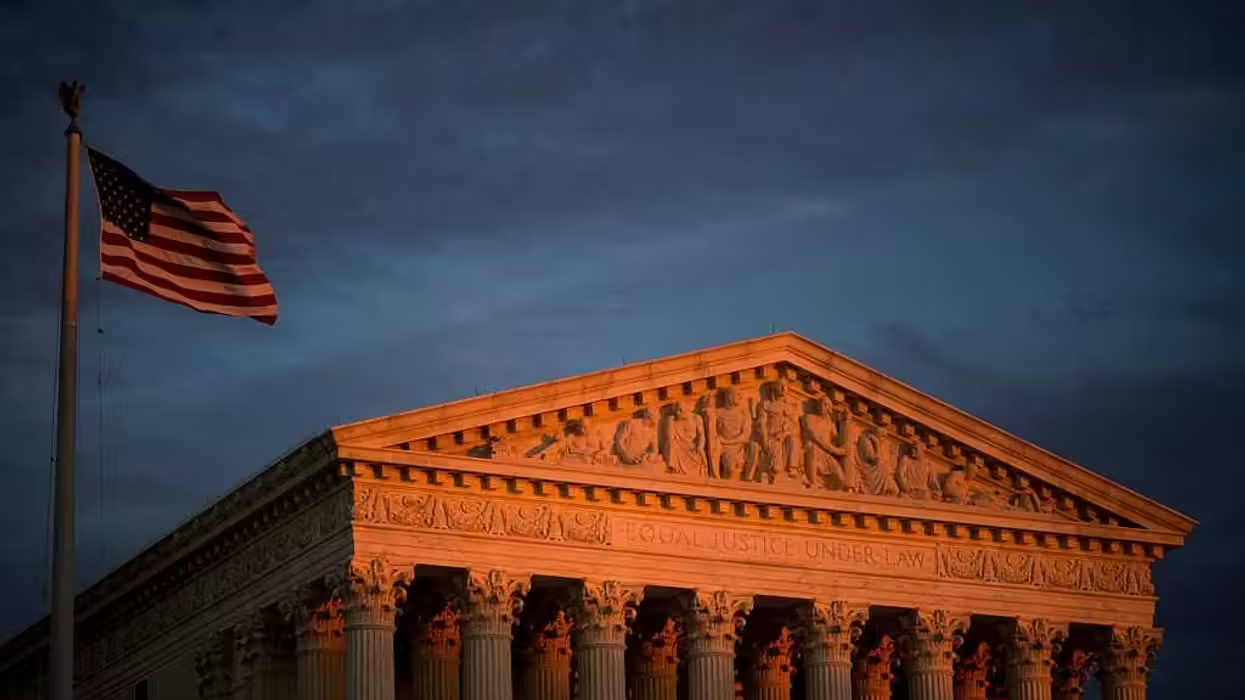 Photo By Bill Clark/CQ Roll Call
On that point, Harsanyi and I agree. Judicial and bureaucratic overreach distort constitutional government. The harder question is whether voters object.
From what I can tell, most do not. Many Americans seem content to trade constitutional self-government for managerial rule, provided the system delivers benefits and protects their expressive preferences. The populist right may bristle at this arrangement, but a leftist administrative state that claims to speak for “the people” may reflect the electorate’s will.
Recent elections reinforce that suspicion. Voters showed little interest in reclaiming authority from courts or bureaucracies. They appeared far more interested in government largesse and symbolic rights than in the burdens of republican self-rule.
Consider abortion. Roe v. Wade rested on shaky legal ground, yet large segments of the public enthusiastically embraced it for nearly 50 years. When the Roberts Court overturned Roe in 2022 and returned the issue to the states, many voters responded with fury. States enacted expansive abortion laws, and Democrats benefited from unusually high turnout. The electorate did not welcome responsibility. It resented it.
This reaction should not surprise anyone familiar with history. In 1811, Spaniards rejected the liberal constitution imposed by French occupiers, crying “abajo el liberalismo” — down with liberalism. They did not want abstract rights. They wanted familiar authority.
At least half of today’s American electorate appears similarly disposed. Many prefer guided democracy administered by judges and managers to the uncertainties of self-government. Their votes signal approval for continued rule by the administrative state. Republicans may slow this process at the margins, but Democrats expand it openly, and voters just empowered them to do so.
RELATED: Stop letting courts and consultants shrink Trump’s signature promise
 Yuri Gripas/Abaca/Bloomberg via Getty Images
I anticipated this outcome decades ago. In “After Liberalism” (1999), I argued that democracy as a universal ideal tends to produce expanded managerial control with popular consent. Nineteenth-century fears that mass suffrage would yield chaos proved unfounded. Instead the extension of the franchise coincided with more centralized, remote, and less accountable government.
As populations lost shared traditions and common authority, governance shifted away from democratic participation and toward expert administration. The state grew less personal, less local, and less answerable, even as it claimed to act in the people’s name.
Equally significant has been the administrative state’s success in presenting itself as the custodian of an invented “science of government.” According to this view, administrators form an enlightened elite, morally and intellectually superior to the unwashed masses. Justice Jackson’s warnings reflect this assumption.
I would like to believe, as Harsanyi suggests, that Americans find such attitudes insulting. I am no longer sure they do. Many seem pleased to be managed. They want judges and bureaucrats to make decisions for them.
That preference should trouble anyone who still cares about constitutional government.
What's Your Reaction?
 Like
0
Like
0
 Dislike
0
Dislike
0
 Love
0
Love
0
 Funny
0
Funny
0
 Wow
0
Wow
0
 Sad
0
Sad
0
 Angry
0
Angry
0

I am just an average American. My teen years were in the late 70s and I participated in all that that decade offered. Started working young, too young. Then I joined the Army before I graduated High School. I spent 25 years in, mostly in Infantry units. Since then I've worked in information technology positions all at small family owned companies. At this rate I'll never be a tech millionaire. When I was young I rode horses as much as I could. I do believe I should have been a cowboy. I'm getting in the saddle again by taking riding lessons and see where it goes.




















Comments (0)