

Trump’s SOTU: The Golden Age as Its Own Evidence
On Sept. 26, 1960, something strange and irreversible happened to American politics: Richard Nixon and John F. Kennedy faced each other in the first televised presidential debate, and two entirely different realities emerged from the same event.
Live Your Best Retirement
Fun • Funds • Fitness • Freedom
Those who listened to the debate on the radio believed Nixon won: his arguments were sharper, his command of policy superior.
Those who watched on television saw something else: a pale, sweating man effortlessly outshone by a bronzed, perfectly tailored vision of American vitality.
Same event. Two media. Two completely different truths.
That night, the country discovered something it has never been able to unlearn: the image does not illustrate the argument; the image is the argument.
Substance does not precede its representation; the representation is the substance. Once you understand this, you cannot unknow it, and those who fail to understand it tend to lose.
No event in American civic life makes this clearer than the State of the Union. Before a single word is spoken, the meaning is already fully present. The cabinet processes in first—in this case, Marco Rubio, then Scott Bessent, then Pete Hegseth—a grammar of power made flesh, the executive branch literally assembling itself into legibility before the nation’s eyes.
Then the president appears framed between the vice president and the speaker on the elevated dais, a visual trinity.
And then the clapping—rhythmic, metronomic, tribal—the percussion of a nation manufacturing its own consensus in real time.
The State of the Union does not report on America. It performs America into being, briefly, in that room, and the performance is the reality.
This is precisely why Biden’s 2024 State of the Union, widely celebrated as a success, was actually the opening act of his destruction. He exceeded expectations. He projected energy. Democrats exhaled. A special counsel had recently described him as an “elderly man” with a “poor memory,” and the speech seemed to refute that verdict.
The Democratic Party convinced itself that the image had been corrected. But this is the trap the image always sets for those who think they control it: you can curate the sign, but you cannot own what it means to the people who receive it.
The State of the Union chamber is a terrarium: a sealed, perfected environment where teleprompters, lighting, and exhaustive rehearsal produce a controlled simulacrum of presidential vitality. Democrats saw the simulation and mistook it for the real. They forgot the Nixon lesson entirely.
When Biden met Trump on the debate stage—uncontrolled, unscripted, the terrarium gone—the real reasserted its authority: The frozen pauses; the sentence that dissolved into silence; the vacant eyes. No policy position survives that image.
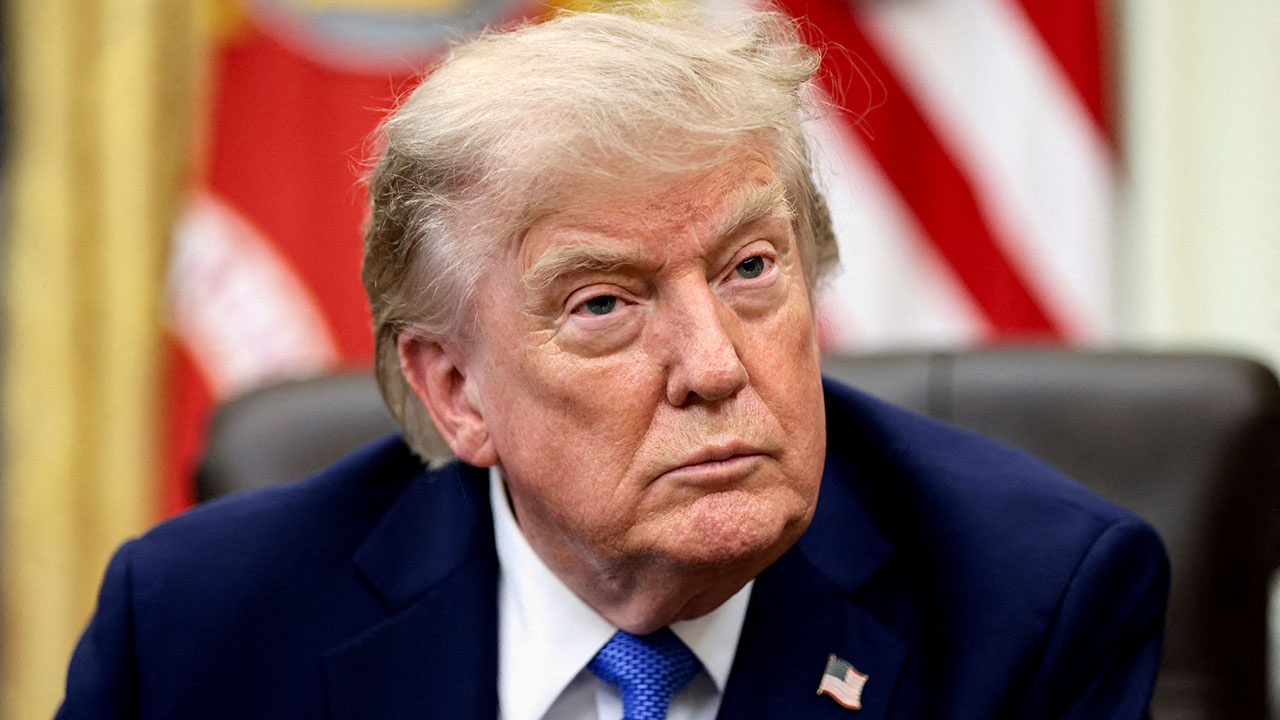
Trump entered the chamber last night in a dark suit, American flag pin anchored to the lapel, the flag wall behind him a studied field of red, white, and blue—repeating, stacking, layering until the eye receives it as the texture of the room itself, nationalism become wallpaper, the nation made into its own backdrop.
And the tie: that specific arterial red, blazing against the darkness of the suit.
This is not fashion only: Red is blood still moving, fire still burning, vitality made visible and worn at the throat.
When Trump declared that America was “the hottest country in the world,” the room had already made that argument in color before his words arrived. The sign preceded the statement; the statement confirmed the sign. This is the complete circuit.
The camera, on Fox News at least, cut to Secretary of War Hegseth the moment Trump said, “The state of our union is strong.”
Hegseth: The most bitterly contested cabinet member, the man whose confirmation had been the loudest battle, a video having recently circulated of his bench-pressing.
The word and the image thus arrived simultaneously, each completing the other, collapsing the distance between the claim and its evidence until they occupied the same second of television.
The State of the Union, at its most potent, does not argue. It demonstrates; it arranges the room so that what’s said and what’s seen become a single, indivisible event.
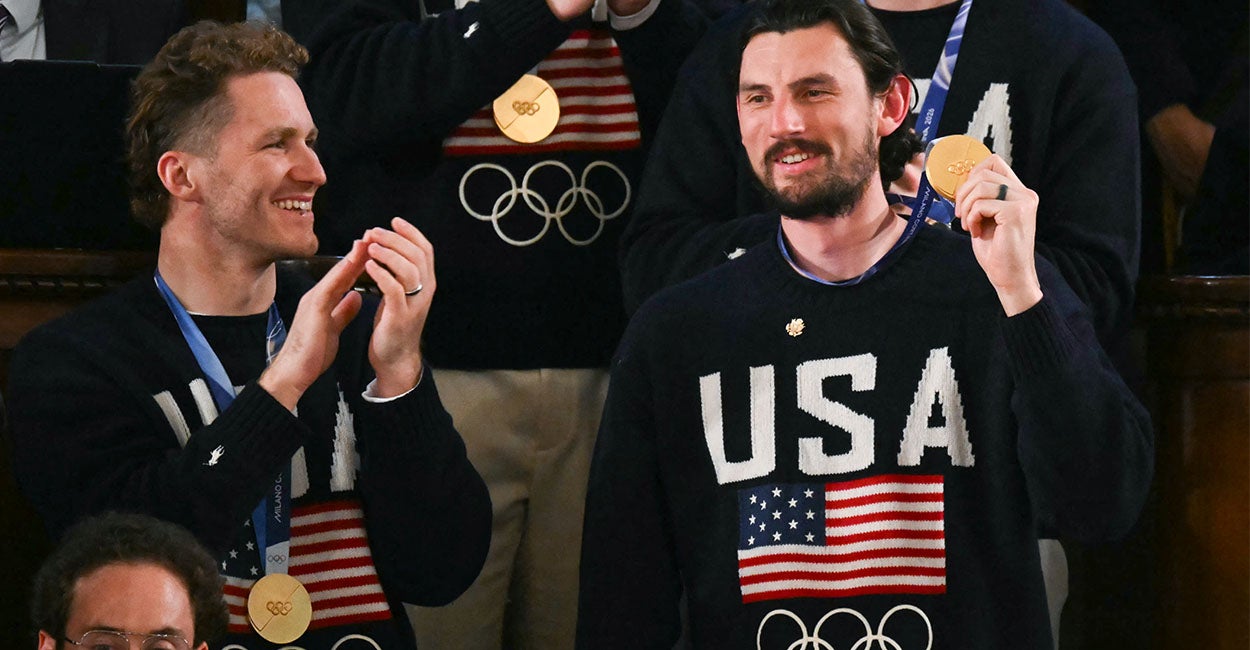
The Olympic hockey team entered the gallery directly above the president—khaki pants, blue sweaters with white USA font, gold medals catching the light—and the chamber roared: USA. USA. USA.
That chant is not a political argument. It’s the nation saying its own name out loud and recognizing, in the act of saying it, that it exists, that it is one thing, that it is here. The gold medalists stood above the president like knights in a medieval gallery, their medals gleaming, their presence a physical ratification of everything being claimed below.
When Trump announced that the goalie—the last line of defense, the man whose singular function is to hold the line—would receive the nation’s highest civilian honor, the room did not need to decode the symbolism. The symbolism decoded itself.
The awards that followed were the speech’s most honest text. Capt. Royce Williams, the Medal of Honor. Petty Officer Scott Ruskan, who pulled 165 people from Texas floodwaters on the Fourth of July—the nation’s own birthday, 165 strangers saved because help was possible and so help was given.
These men are not ornaments to the speech. They are the speech. They are the answer to the question the whole ritual asks: What is the state of our union? The state of our union is a rescue swimmer who jumped into the flood repeatedly. Everything else—the tariff debates, the budget lines, the executive orders—is preface to this.
Alas, what refused to rise? Not a single Democrat stood when Trump affirmed that the government’s first obligation is to protect its citizens. Not a single Democrat stood for the mother of a murdered daughter sitting in the gallery above them. No framing, no surrogate, no press release issued the following morning can rehabilitate the image of a chamber full of seated people in the presence of a grieving mother.
The body’s refusal to rise is its own sign system, and it communicates with a clarity that language cannot match and cannot undo. Every American watching read it—not as political analysis, but viscerally, the way the senses read threats or coldness or contempt, through channels older than rhetoric.
The Democratic Party had calculated that standing would hand Trump an image he didn’t deserve. What they failed to calculate was that not standing would hand him a far more powerful one. They thought they were withholding a sign. They were, in fact, producing one.
A nation’s story does not require unanimous participation to become real. Every Golden Age in history was contested while it was happening. The chant doesn’t need every voice. The image doesn’t need every body. It needs only to be sufficient—enough people standing, enough medals gleaming, enough red blazing against the flag wall—for the representation to harden into reality, to become the ground on which everyone must subsequently stand, whether they helped lay it or not.
Trump said “Golden Age,” and the crowd roared, and the hockey players stood gleaming above him, and a rescue swimmer rose to his feet for 165 lives. In that convergence, something was produced that is more durable than any policy or news cycle: an image of America that America recognized as itself. Not as it is in every particular, but as it insists on being, as it reaches toward, as it knows itself when it says its own name out loud in a crowded room.
The Golden Age is not a promise about the future. It’s a claim about the present, staked entirely in the image. And the image, as Nixon learned too late and Biden’s party forgot too soon, does not wait for the facts to catch up. It arrives first. It arrives as reality.
And then everything else arranges itself around it.
The post Trump’s SOTU: The Golden Age as Its Own Evidence appeared first on The Daily Signal.
What's Your Reaction?
 Like
0
Like
0
 Dislike
0
Dislike
0
 Love
0
Love
0
 Funny
0
Funny
0
 Wow
0
Wow
0
 Sad
0
Sad
0
 Angry
0
Angry
0

I am just an average American. My teen years were in the late 70s and I participated in all that that decade offered. Started working young, too young. Then I joined the Army before I graduated High School. I spent 25 years in, mostly in Infantry units. Since then I've worked in information technology positions all at small family owned companies. At this rate I'll never be a tech millionaire. When I was young I rode horses as much as I could. I do believe I should have been a cowboy. I'm getting in the saddle again by taking riding lessons and see where it goes.





Comments (0)