

Congress fights Trump admin to keep more US troops in Europe and Korea
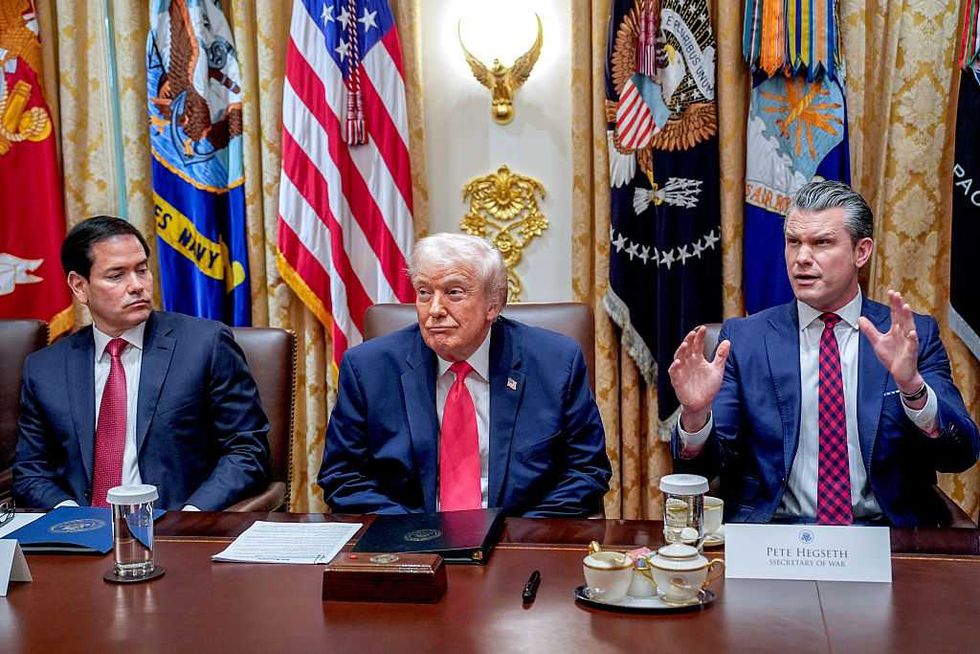
The Trump administration indicated in its newly released National Security Strategy that "the days of propping up the entire world order like Atlas are over" — that American allies will have to "take more responsibility for security in their neighborhoods," especially as America orients its focus to the Western Hemisphere and hardens its presence in the Western Pacific.
Live Your Best Retirement
Fun • Funds • Fitness • Freedom
The strategy document specifically called for "Europe to stand on its own feet and operate as a group of aligned sovereign nations, including taking primary responsibility for its own defense."
It appears, however, that members of Congress want America to shoulder the burden of European defense indefinitely.
In order to withdraw US forces past the 76,000 mark, the Trump administration would have to demonstrate to Congress that such a move would not adversely impact American or NATO security interests.
The version of the 2026 National Defense Authorization Act finalized by both House and Senate negotiators and released on Sunday — a budget that exceeds President Donald Trump's $892.6 billion budget request for the Pentagon by $8 billion — would block the Pentagon both from reducing the number of troops "stationed in or deployed to the area of responsibility of the United States European Command below 76,000 for longer than a 45-day period" and from using any funds appropriated under the act to move any Pentagon equipment originally valued at $500,000 out of Europe.
In order to withdraw U.S. forces past the 76,000 mark, the Trump administration would have to demonstrate to Congress that such a move would not adversely impact American or NATO security interests. The number of U.S. troops stationed in Europe fluctuates between around 80,000 and 100,000.
Citing five sources familiar with the discussion, including a U.S. official, Reuters reported that Pentagon officials told European diplomats during a recent meeting that Washington expects Europe to take over most of NATO's conventional defense capabilities such as troops and missile defense by 2027. Failure to do so might prompt America to end its participation in certain NATO defense coordination mechanisms, said the sources.
 American troops and attack helicopters in Germany. Photo by Sean Gallup/Getty Images.
Pentagon press secretary Kingsley Wilson said in a statement, "We've been very clear in the need for Europeans to lead in the conventional defense of Europe. We are committed to working through NATO coordination mechanisms to strengthen the alliance and ensure its long-term viability as European allies increasingly take on responsibility for conventional deterrence and defense in Europe."
U.S. Deputy Secretary of State Christopher Landau added on X that "Europe must take primary responsibility for its own security."
"Successive US Administrations have been saying this in one form or another pretty much my whole life — look up the 1969 'Nixon doctrine' — but our Administration means what it says," added Landau.
The current version of the NDAA would also prohibit the administration from letting the head of U.S. European Command — Air Force Gen. Alexus Grynkewich — relinquish his role as NATO supreme allied commander in Europe.
Thanks to Democratic Sen. Dick Durbin (Ill.), the NDAA as written would also codify the Baltic Security Initiative, hamstringing any efforts on the part of the administration to suspend the program, which uses American funds to bankroll Baltic states' defense capabilities. Billions of U.S. dollars have been poured into the BSI in recent years even as Lithuania, Latvia, and Estonia began investing more into their own defense.
In addition to ensuring that America remains bogged down in Europe, the 2026 NDAA as written has other provisions that might hamper the administration's ability to realize its national security strategy in full.
The legislation states that it is "the sense of Congress that the Secretary of Defense should continue efforts that strengthen United States defense alliances and partnerships in the Indo-Pacific region so as to further the comparative advantage of the United States in strategic competition with the People's Republic of China."
To this end, the legislation would prohibit obligating or expending any funds to reduce the total number of troops that are permanently stationed in or deployed to Korea below 28,500 or "to complete the transition of wartime operational control of the United States-Republic of Korea Combined Forces Command from United States-led command to Republic of Korea-led command" unless War Secretary Pete Hegseth provides an assessment and certification to Congress showing that doing so is in America's national interest and is being undertaken only after consulting with several foreign nations, including Korea and Japan.
Like Blaze News? Bypass the censors, sign up for our newsletters, and get stories like this direct to your inbox. Sign up here!
What's Your Reaction?
 Like
0
Like
0
 Dislike
0
Dislike
0
 Love
0
Love
0
 Funny
0
Funny
0
 Wow
0
Wow
0
 Sad
0
Sad
0
 Angry
0
Angry
0

I am just an average American. My teen years were in the late 70s and I participated in all that that decade offered. Started working young, too young. Then I joined the Army before I graduated High School. I spent 25 years in, mostly in Infantry units. Since then I've worked in information technology positions all at small family owned companies. At this rate I'll never be a tech millionaire. When I was young I rode horses as much as I could. I do believe I should have been a cowboy. I'm getting in the saddle again by taking riding lessons and see where it goes.




















Comments (0)