

GM’s $7 billon loss exposes gap between EV optimism and market reality


General Motors’ fourth-quarter earnings were widely framed as a show of confidence in an electric future. The company absorbed billions in losses and reaffirmed its strategy, and analysts largely applauded its resolve.
Live Your Best Retirement
Fun • Funds • Fitness • Freedom
Beneath the optimistic headlines, however, was a less reassuring reality: The all-electric transition is proving significantly more expensive, more fragile, and more politically exposed than automakers originally promised.
What stands out most is GM’s refusal to abandon the all-electric narrative, even after acknowledging the scale of the financial setback.
EV shock
In the report, released January 27, GM disclosed $7.1 billion in EV-related losses tied primarily to reshaping its electric-vehicle production plans. While much of the charge is non-cash, it represents real losses on capital GM invested in EV plans that are now being abandoned or restructured.
These figures are not a minor course correction. They are an acknowledgment that even the industry’s most experienced players misjudged the pace, cost, and risk of electrification.
The disclosure followed Ford’s admission that its EV push has resulted in roughly $20 billion in losses. The contrast between the two companies is not the size of the miscalculation but the response. Ford has slowed timelines and reset expectations. General Motors, under CEO Mary Barra, has chosen to absorb the hit and continue forward.
According to GM, roughly $6 billion stems from changes to its EV manufacturing strategy, including canceled supplier contracts and unused equipment originally intended for electric-vehicle production.
Another $1.1 billion reflects the restructuring of its China joint venture. Combined with an October 2025 filing tied to abandoned EV plans, GM has now recognized approximately $7.6 billion tied to its EV strategy in 2025 alone.
Full speed ahead?
Despite those numbers, coverage of GM’s earnings leaned positive. Reports emphasized the company’s balance-sheet strength, its ability to manage the charges, and its position as a leading EV seller in the United States. In that framing, the financial setback was treated as a painful but manageable step toward an inevitable electric future.
CEO Mary Barra reinforced that narrative, saying she has no regrets about GM’s EV strategy, which remains the automaker's “north star.” She cited regulatory changes in 2025 as more disruptive than tariffs and argued that GM’s rapid production reorganization limited the damage.
That explanation is telling. It underscores how policy-driven the EV transition has become, with automakers increasingly responding to regulations, incentives, and geopolitical shifts rather than consumer demand alone.
Facing facts
While GM’s long-term direction may remain the same, what has changed is the implicit acknowledgment that the transition will take longer and cost more than originally forecast, particularly as incentives fade and infrastructure gaps remain unresolved.
That tension is visible in the sales data. GM’s fourth-quarter EV sales fell 43% year over year, totaling just 25,219 vehicles. That decline complicates claims that the financial hit reflects only temporary turbulence. It points instead to continued consumer hesitation driven by price, charging access, and concerns over long-term ownership costs.
The full-year picture is more mixed. GM’s EV sales for 2025 rose 48% to 169,887 vehicles, making it the second-largest EV seller in the U.S. behind Tesla. Those figures support claims of progress, but they also highlight how uneven adoption remains — often buoyed by incentives and fleet purchases rather than steady, organic demand.
China adds another layer of uncertainty. Once expected to anchor global EV growth, the market has become far less predictable due to regulatory shifts, fierce local competition, and rising geopolitical tension. GM’s decision to restructure its joint venture there reflects a broader reassessment of international exposure, not simply EV headwinds.
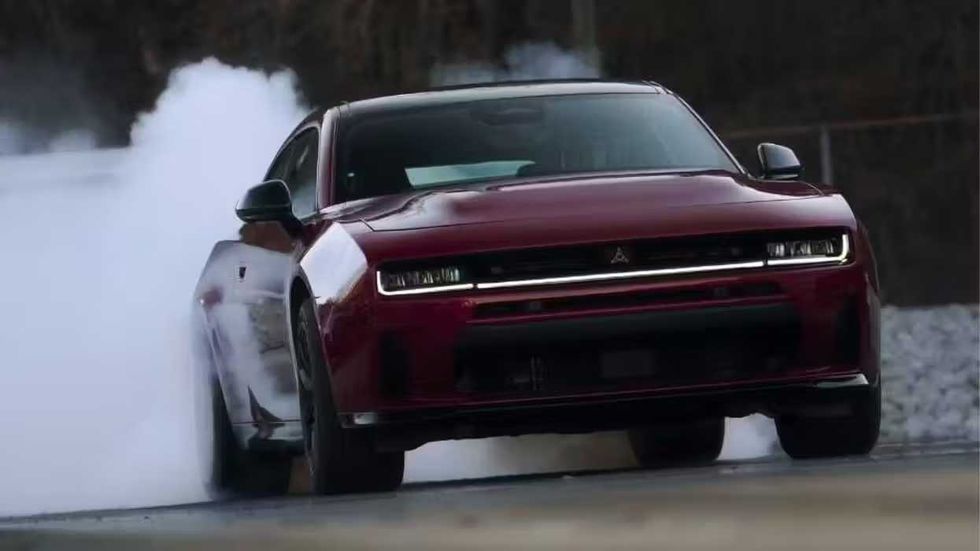
RELATED: Test drive: 2026 Dodge Charger Sixpack Plus
 Stellantis
Stand by your plan
What stands out most is GM’s refusal to abandon the all-electric narrative, even after acknowledging the scale of the financial setback. Barra has argued that adoption will accelerate as charging infrastructure improves. That may prove true, but it assumes infrastructure expansion will continue without the level of government support that initially fueled growth — and that consumers will remain patient as prices stay high and technology continues to evolve.
From an industry standpoint, GM’s experience is less about failure than timing. Automakers were pushed — politically and culturally — to commit early and publicly to electrification. Those that hesitated were criticized. Now, the cost of being first is coming into focus. Retooling factories, securing battery supply chains, retraining workers, and complying with shifting regulations require enormous capital, and those investments do not disappear when demand softens.
There is also a credibility question. When executives express no regrets after multibillion-dollar setbacks, investors and consumers are justified in asking whether earlier forecasts were grounded in market realities — or shaped more by political alignment than consumer readiness.
Cautionary tale
GM’s experience should also serve as a cautionary tale for policymakers. Mandates and incentives can accelerate innovation, but they cannot force consumer acceptance on a fixed timetable. The EV transition will happen, but not on command and not without detours.
For General Motors, the challenge now is alignment. The company has the scale, engineering talent, and brand equity to compete in an electrified future. What it cannot afford is a prolonged mismatch between production plans and real-world demand. The $7 billion reckoning is more than an accounting event. It is a reminder that the road to an all-electric future is longer, bumpier, and far more expensive than advertised.
Consumers are watching closely. They are not rejecting electric vehicles outright — but they are demanding better value, better infrastructure, and more honest timelines. If those signals are ignored, this reckoning may be only the beginning.
What's Your Reaction?
 Like
0
Like
0
 Dislike
0
Dislike
0
 Love
0
Love
0
 Funny
0
Funny
0
 Wow
0
Wow
0
 Sad
0
Sad
0
 Angry
0
Angry
0

I am just an average American. My teen years were in the late 70s and I participated in all that that decade offered. Started working young, too young. Then I joined the Army before I graduated High School. I spent 25 years in, mostly in Infantry units. Since then I've worked in information technology positions all at small family owned companies. At this rate I'll never be a tech millionaire. When I was young I rode horses as much as I could. I do believe I should have been a cowboy. I'm getting in the saddle again by taking riding lessons and see where it goes.





















Comments (0)