

How Maduro’s Arrest Could Slow Migration From Venezuela, Ramp Up Deportation Raids
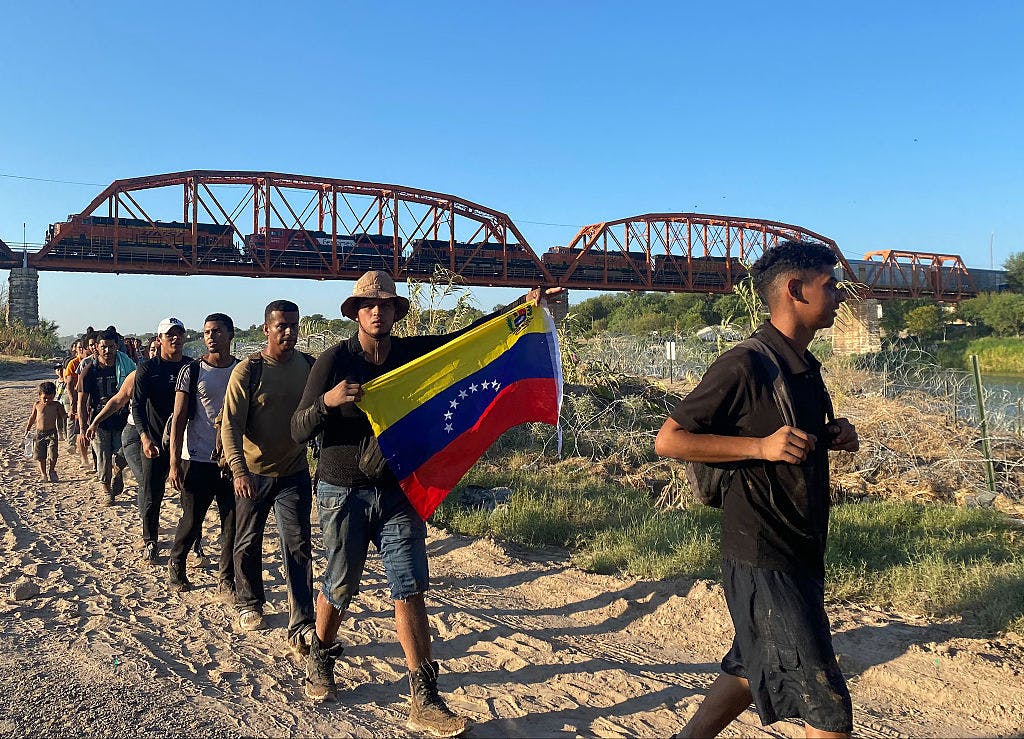
The Trump administration’s recent arrest of Venezuelan dictator Nicolás Maduro marks the ousting of an authoritarian whose rule triggered a mass exodus of his own people to the United States.
Live Your Best Retirement
Fun • Funds • Fitness • Freedom
With Maduro sitting in a federal prison in New York, the fate of the country remains uncertain. On Monday, Maduro’s second-in-command, Delcy Rodríguez, was sworn in as Venezuela’s interim president.
Rodríguez claimed that she plans to work with the United States in the coming months.
President Donald Trump, however, has said that the United States is “in charge” of Venezuela and that elections would be held “at the right time.”
(Photo by Jose Zamora/Anadolu Agency via Getty Images)
If Trump can get a democratically-elected government in place in Venezuela that is more willing to work with the United States, it could both boost his mass deportation effort and thwart the possibility of a surge in mass migration, experts told The Daily Wire.
“A lot of these people were given parole into the U.S. because of the conditions in Venezuela … well, that’s no longer going to be necessary, so a lot more people can be sent back. And they’ll have lesser claims to say, ‘If I go back, I’ll be tortured’ … assuming another government is in place,” former acting Immigration and Customs Enforcement director Jonathan Fahey said.
“Lots of people are going to be going home, and quickly, and there will not be pushback from whoever’s in charge of Venezuela,” Fahey said.
Venezuelan departures from the United States “will accelerate some” if and when the country sees stability, according to Jessica Vaughan, the director of policy studies at the Center for Immigration Studies, who said it’s “only going to happen if the Trump administration succeeds in being able to end TPS [Temporary Protected Status] and people’s asylum claims don’t succeed.”
Following Maduro’s capture, the Trump administration has encouraged the roughly 500,000 Venezuelans whose Temporary Protected Status it revoked to leave the United States on their own.
Andrés Martínez-Fernández, senior policy analyst for Latin America at The Heritage Foundation, warned that it could potentially take years to get to a point where there is a significant change in migration patterns.
“We may have more cooperation as far as repatriation, but as far as people voluntarily going back, which I think many people would under the right circumstances, we’re pretty far away still from those circumstances,” Martínez-Fernández said.
“We still have all of the elements really of the regime in place, the repressive apparatus, the economic crisis, and I think many will be rightfully concerned that not enough has changed to really at all change the situation on the ground for people,” he said.
If elections were held and resulted in “the full transition out of this regime,” it could be “a trigger event for a lot of people to return,” Martínez-Fernández said.
Vaughan also pointed to the possibility of better information sharing with Venezuela if there is a more American-aligned government in place. The Maduro regime refused to share any information on the criminal histories of its citizens who were crossing the border under the Biden administration.
As a result, border agents were left to release them en masse without knowing who they really were. One of those Venezuelan border jumpers was Jose Ibarra, who went on to brutally murder Georgia nursing student Laken Riley in February 2024 while she was out for a run.
“If we can again have a functioning relationship with the government of Venezuela, that enables us to share information and do some appropriate vetting on people who are coming in,” she said.
Martínez-Fernández, however, said that the next leader of Venezuela would have to create criminal databases from scratch since previous regimes, like Maduro’s, likely didn’t even keep such records.
“It’s very unlikely that the Venezuelan government has that in any substantial way,” he said.
“That would have to be something that they build up, which I think would be a monumental task for this skeletal regime,” he added.
With Maduro out of power, the Trump administration also hasn’t stopped deportations to the South American country, the Department of Homeland Security told The Daily Wire Monday.
That will likely roll on at an even greater pace if and when there is a new leader.
“I fully expect Venezuela will be very cooperative with ICE [Immigration and Customs Enforcement] and the U.S. government, considering how things went with Maduro, so I actually expect it to be a lot smoother … or more voluminous than it was before,” Fahey said.
What's Your Reaction?
 Like
0
Like
0
 Dislike
0
Dislike
0
 Love
0
Love
0
 Funny
0
Funny
0
 Wow
0
Wow
0
 Sad
0
Sad
0
 Angry
0
Angry
0

I am just an average American. My teen years were in the late 70s and I participated in all that that decade offered. Started working young, too young. Then I joined the Army before I graduated High School. I spent 25 years in, mostly in Infantry units. Since then I've worked in information technology positions all at small family owned companies. At this rate I'll never be a tech millionaire. When I was young I rode horses as much as I could. I do believe I should have been a cowboy. I'm getting in the saddle again by taking riding lessons and see where it goes.










Comments (0)