

Professor Tells Congress Why Judea and Samaria Rightfully Belong To Israel
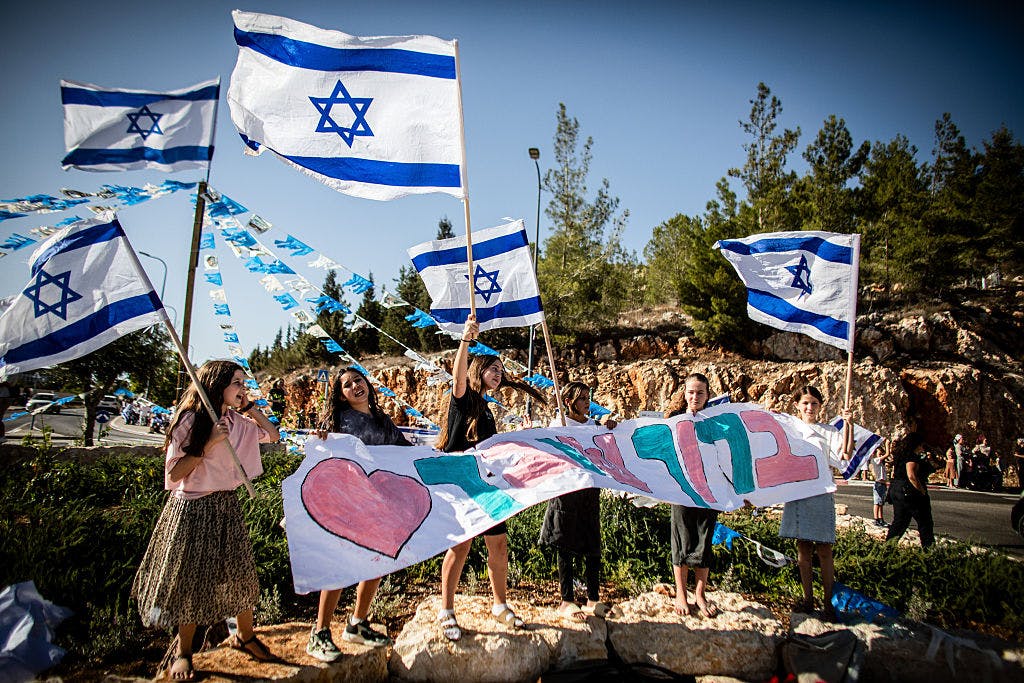
Speaking before the House Foreign Affairs Middle East and North Africa Subcommittee, Prof. Eugene Kontorovich, senior research fellow at the Heritage Foundation, contended that, under widely applied principles of international law, Israel has a strong sovereign claim to Judea and Samaria, the Biblical lands historically known as the central highlands north and south of Jerusalem.
Live Your Best Retirement
Fun • Funds • Fitness • Freedom
Kontorovich cited specifically uti possidetis juris, which states that newly-formed states should inherit the administrative boundaries that existed at the moment they gained independence.
He noted that the term “West Bank” was introduced only after Jordan conquered and annexed the area in 1950; prior to that, the region was simply part of the British (League of Nations) Mandate for Palestine — given its name by the Romans in vengeance for their war against the Jews, by naming it after the Jews’ ancient enemy, the Philistines — which included all of Judea, Samaria, and Gaza.
According to Kontorovich, when the Mandate ended in 1948 and Israel declared independence, it inherited the borders of the last highest-level administrative unit. Therefore, he contended that Israel’s borders initially extended to the entirety of what was called Mandatory Palestine, because no separate administrative subdivision existed for Judea, Samaria, or Gaza.
Kontorovich emphasized that the doctrine of uti possidetis juris has been applied consistently worldwide — in Latin America, Africa, the post-Soviet space, and the Balkans — often producing borders that include minorities or groups with competing historical or demographic claims. He cited examples such as Crimea and Nagorno-Karabakh to argue that actual control or demographic ties do not override inherited administrative borders. Thus, he maintains that Jordan’s 1948–67 occupation of Judea and Samaria, which he described as unlawful and accompanied by the expulsion of Jews, did not alter Israel’s underlying sovereign rights. Israel’s 1967 capture of the territory, he argued, therefore did not constitute the occupation of foreign land. Kontorovich concluded that while international law does not mandate a Palestinian state or 1949 armistice lines as borders, Israel remains free to negotiate and cede territory if it chooses.
Rep. Randy Fine (R-FL) presented a historical-political narrative emphasizing repeated Arab rejection of partition. He noted that when Britain withdrew in 1948, a Jewish state (Israel) and an Arab state (Jordan) effectively emerged, but Arab actors sought to eliminate Israel, fueling the ongoing conflict. Fine stated that the distinct Palestinian national identity arose later to justify a third state and criticized expectations that Israel relinquish territory gained in defensive wars, contrasting this with American and broader historical practice. He cited Israel’s 2005 disengagement from Gaza as an example of territorial concessions leading to intensified violence. Turning to Judea and Samaria, he stressed the area’s deep Jewish historical significance and highlighted security concerns, while dispelling the idea of Israeli “apartheid,” as he pointed out:
We hear about the apartheid state of Israel, and it is partly true. There is apartheid in Israel. I want to tell you, as I was driving through Judea and Samaria, a sign that I saw … basically said, “In this area, Jews may not enter.” … And the sign literally says, in English, in Hebrew, and in Arabic, Jews may not go here. I’m not aware of anywhere that is controlled by Israel where they say Arabs cannot go, where they say Christians cannot go.
In December of 2024, Senator Tom Cotton (R-AR) introduced a bill in the Senate to require all official U.S. documents and materials to use the historically accurate term “Judea and Samaria” instead of the “West Bank.”
Referring to Judea and Samaria as the ‘West Bank’ is a slap in the face to historical truth.
It’s time to call this region by its rightful name and stop playing into anti-Israel propaganda.https://t.co/tYwYMZkGMJ
— Tom Cotton (@SenTomCotton) December 5, 2024
The bill, titled the “Retiring the Egregious Confusion Over the Genuine Name of Israel’s Zone of Influence by Necessitating Government-use of Judea and Samaria (RECOGNIZING Judea and Samaria) Act,” matched legislation in the House sponsored by Reps. Claudia Tenney (R-NY), Randy Weber (R-TX), and Anthony D’Esposito (R-NY).
“The Jewish people’s legal and historic rights to Judea and Samaria goes back thousands of years. The U.S. should stop using the politically charged term West Bank to refer to the biblical heartland of Israel,” Cotton stated.
“The Israeli people have an undeniable and indisputable historical and legal claim over Judea and Samaria, and at this critical moment in history, the United States must reaffirm this,” Tenney echoed. “This bill reaffirms Israel’s rightful claim to its territory. I remain committed to defending the integrity of the Jewish state and fully supporting Israel’s sovereignty over Judea and Samaria.”
The bill states that the U.S. government should “refer to the land annexed by Israel from Jordan during the 1967 Six-Day War by its historical names of ‘Judea and Samaria,’ with the land south of Jerusalem being considered ‘Judea’ and the land north of Jerusalem being considered ‘Samaria.’”
The great historian Flavius Josephus wrote, “Now as to the country of Samaria, it lies between Judea and Galilee.”
As for Judea, Josephus explained, “In the limits of Samaria and Judea lies the village Anuath, which is also named Borceos. This is the northern boundary of Judea. The southern parts of Judea, if they be measured lengthways, are bounded by a Village adjoining to the confines of Arabia; the Jews that dwell there call it Jordan. However, its breadth is extended from the river Jordan to Joppa.”
Josephus also explained how Jerusalem was central in Judea, writing, “The city Jerusalem is situated in the very middle; on which account some have, with sagacity enough, called that city the Navel of the country. Nor indeed is Judea destitute of such delights as come from the sea, since its maritime places extend as far as Ptolemais: it was parted into eleven portions, of which the royal city Jerusalem was the supreme, and presided over all the neighboring country, as the head does over the body.”
Virtually all of the events in the Old Testament occurred in Judea and Samaria; Hebron is considered the burial place of the Biblical patriarchs Abraham, Isaac, and Jacob and where King David was crowned; Shiloh was where the Tabernacle rested for roughly 370 years; Joseph, who became the Egyptian pharaoh’s right-hand man, is buried in Shechem; Elon Moreh is where the Bible says God promised the Land of Israel to Abraham; and David fought Goliath in the Valley of Elah. These are just some of the Jewish biblical connections to Judea and Samaria.
What's Your Reaction?
 Like
0
Like
0
 Dislike
0
Dislike
0
 Love
0
Love
0
 Funny
0
Funny
0
 Wow
0
Wow
0
 Sad
0
Sad
0
 Angry
0
Angry
0

I am just an average American. My teen years were in the late 70s and I participated in all that that decade offered. Started working young, too young. Then I joined the Army before I graduated High School. I spent 25 years in, mostly in Infantry units. Since then I've worked in information technology positions all at small family owned companies. At this rate I'll never be a tech millionaire. When I was young I rode horses as much as I could. I do believe I should have been a cowboy. I'm getting in the saddle again by taking riding lessons and see where it goes.

























Comments (0)