

Smartwatches: The WORST gift of Christmas 2025


More Americans than ever are buying smartwatches. Some are even gifting them in the run-up to Christmas, as if the spirit of the season is best expressed through a vibrating shackle.
Live Your Best Retirement
Fun • Funds • Fitness • Freedom
I know, because I used to be shackled. A few months ago, I bought a Garmin Venu Sq 2. It’s a sleek little square that promises peace, progress, and a better VO₂ max.
I finally snapped the day the watch informed me that my stress was 'very high' while I was literally sitting still reading a book.
I’m an avid long-distance runner. I’ve run through heat waves, torrential rain, and entire breakups. A watch is supposed to free you, to only respond when you actually want information. Instead, mine turned into a digital probation officer, gleefully reporting every “weakness” it spotted. And it spotted plenty.
Passive-aggressive presence
At first, it was comfortable. A GPS-connected companion with the battery life of a camel. Then, slowly, it tightened its grip — not physically, but mentally. A passive-aggressive presence. A tiny narc. You only slept five hours. Your heart rate variability is low. Your stress is elevated.
No kidding. My stress was elevated because my watch wouldn’t shut up.
What began as a fitness tool became a full-time critic. Every step judged. Every pause logged. Every slight deviation from perfection recorded with the clinical joy of a bureaucrat stamping a form. The absurdity peaked on a Saturday morning when my wrist buzzed to announce that my “body battery” was low. This was a new level of shame: being scolded by a device I literally have to plug in to keep alive.
Mastered by metrics
The paradox at the heart of wearables is simple but worth spelling out. They sell serenity, yet they manufacture unrest. They promise control, yet they cultivate dependence. A smartwatch doesn’t enhance your intuition. Quite the opposite. It replaces it. Instead of listening to your breathing, you listen to a beep. Instead of feeling your cadence, you consult an algorithm. Before long, you become a servant to metrics you never asked for, chasing numbers that never stop multiplying.
Even worse, these trackers harvest every moment — your movement, your pulse, your snoring, your stumbles. Every second is sucked into some server farm, where it becomes a profit stream. A surveillance scheme disguised as self-improvement. Freedom isn’t a wearable. It’s the feeling that hits you the moment you rip the thing off.
Toxic timepiece
And then comes the part that feels almost satirical. Not only do smartwatches poison your mind, but they also poison your body. Recent studies show that many premium wristbands, especially the fancy fluorinated rubber ones, contain staggering concentrations of PFHxA, a “forever chemical” that sticks around longer than most New Year’s resolutions and certainly longer than any of my attempts at Dry January.
One band clocked in at over 16,000 parts per billion, making it less an accessory and more a portable toxic-waste site. To put that number in perspective, if a river tested that high, the EPA would show up in hazmat suits and politely ask the fish to evacuate.
These PFHxA compounds don’t just sit on the surface. They can seep, inch by inch, through the skin — our largest organ, the one we naïvely assume is busy protecting us instead of actively absorbing industrial runoff from a glorified pedometer.
Researchers say a significant percentage of this stuff can pass through human skin under normal conditions. To be clear, normal conditions simply mean you’re doing absolutely nothing unusual. Sitting at a desk, walking through Target, standing in line for coffee, trying to watch a show that isn’t drowning in homoerotic tension.
To make things worse, the more you sweat, strain, and move (the whole reason you bought a fitness tracker), the more efficiently the band can deliver its toxic little cocktail into your bloodstream. A device that poisons you precisely when you’re trying to be healthy. It’s as poetic as it is perverse.
RELATED: Your smart watch is poisoning you — and your children
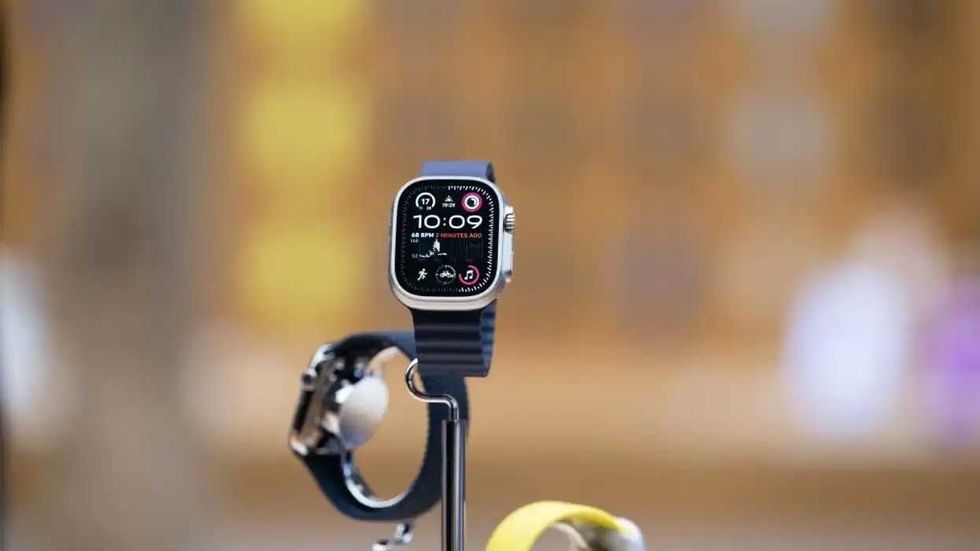 Getty Images
'Heeeeeeere's Johnny!'
I finally snapped the day the watch informed me that my stress was “very high” while I was literally sitting still reading a book. That was the moment I had an awakening. The device wasn’t documenting my life. Instead, it was dictating it. I felt like Jack Nicholson in "The Shining," pacing the hallway and giving my smartwatch the same look he gave the door before smashing it in.
So I tossed it. Straight into the trash, like a cursed ring. And the strangest thing happened, almost instantly: peace. Pure, analog peace. I went for a run relying only on my own rhythm, my own breath, and my own internal clock — which has never once asked me to update its firmware. My pace felt smoother. My shoulders loosened. I remembered what running is supposed to feel like.
Your smartwatch needs you far more than you need it. Without you, it’s just a blinking brick. With you, it becomes a constant companion that collects your life, critiques your choices, and sells your data — all while constantly reminding you that you’re not enough without it.
If you’re wearing one right now, consider ripping it off. If you’re thinking of buying one, maybe don’t. And if you’re planning to gift one, absolutely stop. Your loved ones deserve better than a wrist-mounted tattletale. Give them socks. Give them chocolate. Give them a gift card they’ll use happily and mock you for later (because yes, you absolutely phoned that one in). Anything but a smartwatch.
What's Your Reaction?
 Like
0
Like
0
 Dislike
0
Dislike
0
 Love
0
Love
0
 Funny
0
Funny
0
 Wow
0
Wow
0
 Sad
0
Sad
0
 Angry
0
Angry
0

I am just an average American. My teen years were in the late 70s and I participated in all that that decade offered. Started working young, too young. Then I joined the Army before I graduated High School. I spent 25 years in, mostly in Infantry units. Since then I've worked in information technology positions all at small family owned companies. At this rate I'll never be a tech millionaire. When I was young I rode horses as much as I could. I do believe I should have been a cowboy. I'm getting in the saddle again by taking riding lessons and see where it goes.




















Comments (0)