

Who Decides Whether an Illegal Immigrant Gets Asylum for ‘Persecution?’ Supreme Court Weighs Arguments
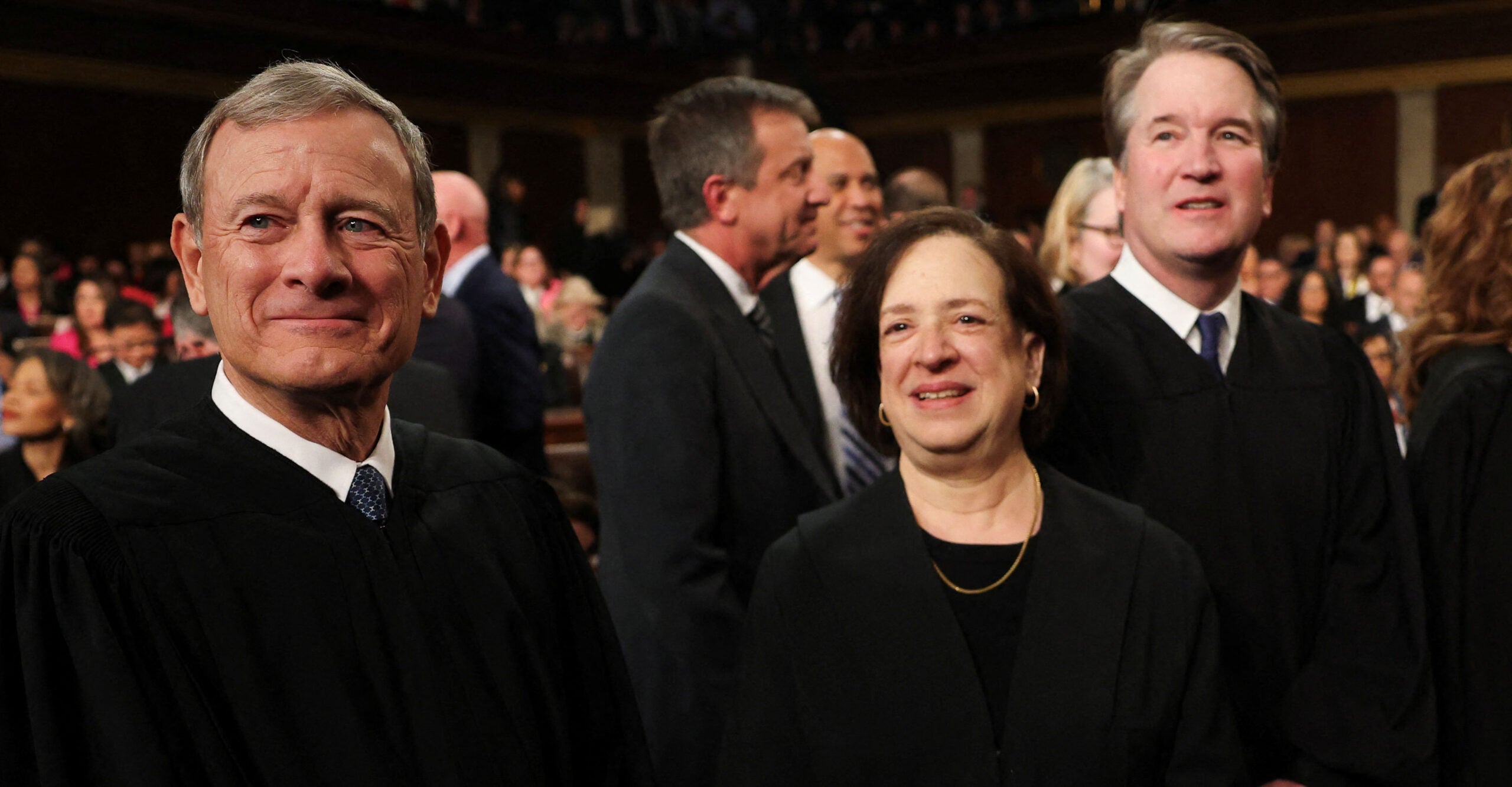
Should the Trump administration or the courts determine whether an illegal alien qualifies for asylum due to threats of persecution, when the facts are not in dispute?
Live Your Best Retirement
Fun • Funds • Fitness • Freedom
Supreme Court justices pressured a Justice Department lawyer on that issue Monday.
The case involves Salvadoran national Douglas Humberto Urias-Orellana, who claims he faced threats to his life from a hitman in his country. He illegally entered the United States in June 2021 during the Biden administration’s border surge.
The question before the justices is whether federal courts should defer to the executive branch’s judgment on immigration deportation cases when facts are not in dispute. In this case, the federal court deferred to the Justice Department’s determination that the case did not constitute persecution. Plaintiffs argue the courts should make that interpretation.
For this reason, the plaintiffs did not focus on the hitman’s threat in the legal arguments, which seemed to perplex Justice Sonia Sotomayor.
“I actually don’t understand why a credible death threat would not always cause suffering or harm,” Sotomayor said. “Are you arguing something quite different?”
Nicholas Rosellini, arguing for the plaintiffs, said, “We did not make that argument explicitly before the First Circuit.”
He added in the appellate court arguments, the government argued entirely for judicial deference to the Bureau of Immigration Appeals.
“Deciding whether undisputed facts qualifies persecution under the law involves legal interpretation, not fact finding,” Rosellini told the court. “Courts have repeatedly established legal principles on things like sexual violence, religious persecution, economic deprivation, and beyond. The court did not establish those principles by pondering the term ‘persecution’ in the abstract. They interpret the law by applying the persecution standard to particular sets of undisputed facts.”
Arguing for the government, Justice Department lawyer Joshua Dos Santos said the Supreme Court has spoken to the issue in the 1992 case of Immigration and Naturalization Service v. Elias-Zacarias. In that case, the high court found a Guatemalan man could not seek asylum in the United States because an anti-government guerrilla group sought to force him into military service.
Dos Santos added that Congress passed reforms of the Office of Information and Regulatory Affairs, which reviews rules adopted by federal agencies, and the government’s standard for “persecution” is thoroughly reviewed by the executive branch.
“There’s no way, no realistic chance, that when Congress was overhauling standards of review, in OIRA, … that it was either unaware of that practice, or silently departing from it,” Dos Santos said.
Justice Brett Kavanaugh questioned giving too much deference to the executive branch without judicial review, and pressed Dos Santos.
Dos Santos replied that the Bureau of Immigration Appeals and federal immigration judges “have expertise in looking at recurring fact patterns, and seeing all kinds of different versions of these cases, far more cases than any court of appeals is ever going to see.”
Immigration judges are Justice Department officials, and not members of the federal judiciary. The same is true of the Board of Immigration Appeals, which upheld the immigration judge’s decision in this case.
After the Department of Homeland Security sought removal of Urias-Orellana and his family, the family applied for asylum based on persecution. Urias-Orellana also sought protection under the United Nations’ “Convention Against Torture.”
Urias-Orellana contends his association with his half-brother Juan puts his life in danger. Under the Immigration and Naturalization Act, asylum seekers who have been denied relief by the Board of Immigration Appeals can appeal to federal courts.
A federal immigration judge denied the family’s applications for asylum, and determined this did not amount to persecution, or demonstrated reasonable fear of future persecution if they returned to El Salvador. As for the U.N. anti-torture claim, the judge found he didn’t report his harassment to the police. The BIA upheld the judge’s determination.
After that, the plaintiffs appealed the case to the First Circuit Court of Appeals, which found it should defer to the Board of Immigration Appeals’ decision since facts were not in dispute.
The post Who Decides Whether an Illegal Immigrant Gets Asylum for ‘Persecution?’ Supreme Court Weighs Arguments appeared first on The Daily Signal.
What's Your Reaction?
 Like
0
Like
0
 Dislike
0
Dislike
0
 Love
0
Love
0
 Funny
0
Funny
0
 Wow
0
Wow
0
 Sad
0
Sad
0
 Angry
0
Angry
0

I am just an average American. My teen years were in the late 70s and I participated in all that that decade offered. Started working young, too young. Then I joined the Army before I graduated High School. I spent 25 years in, mostly in Infantry units. Since then I've worked in information technology positions all at small family owned companies. At this rate I'll never be a tech millionaire. When I was young I rode horses as much as I could. I do believe I should have been a cowboy. I'm getting in the saddle again by taking riding lessons and see where it goes.



















Comments (0)