

Why I Don’t Buy The Charlie Kirk Conspiracy Theories
A great deal of evil in the world can be described (and has been described) as banal. It happens constantly — often without us realizing it, without thrusting itself in our faces, and without making its perpetrators known to the world. Think of the routine executions that are conducted by the anonymous butchers working on behalf of Planned Parenthood, or MAID clinics in Canada. Think of the many fraud schemes that are currently being hatched by unknown Somalis in Minneapolis, or the crimes against humanity that are taking place, as we speak, in far-off African countries. These are all horrific acts. But we also don’t see them happening. We just know that they happen. And they happen so often that, to a certain extent, we take them for granted. And therefore, whether we realize it or not, we can discuss these acts of evil with a certain clarity and calm.
Live Your Best Retirement
Fun • Funds • Fitness • Freedom
The brutal murder of Charlie Kirk was not a banal act of evil. There was nothing routine or mundane about it. Footage of Charlie’s public execution was beamed to hundreds of millions of people across the world. His death was far more gruesome than any depiction in a film could ever be. And it was streamed in far higher-resolution than any other documented political assassination in the history of this country. Outside of military veterans — many of whom suffer for the rest of their lives because of what they’ve seen on the battlefield — it’s highly unlikely that any of us had ever witnessed the devastating and immediate effects of a sniper shot to a man’s neck. I know that I had never seen such a thing. And I certainly had not seen it happen to a friend. But whether you were a friend of Charlie or not — whether you agreed with his politics or not — the point is that you had never seen anything like this event. On September 10th, that changed. And what you saw, if you have a conscience at all, changed you.
How do normal human beings respond when they’re confronted, against their will, with a sight like that? There is no playbook to follow. There’s no precedent to guide us. There’s no research, or peer-reviewed study that can walk us through it. The honest answer is: We have no idea. We’re all figuring it out as we go. Some have preferred not to talk about what happened. Others have spoken up, as often as they possibly can. And, we can now say with some certainty, a very large number of people have concocted (or come to believe) highly incredible theories to explain Charlie’s death — theories that, if true, would defy any semblance of common sense and cause more international incidents than both World Wars put together.
These kinds of theories can, in many cases, perhaps be plausibly explained as a psychological defense mechanism — a way for many people, who are effectively in a state of shock, to make sense of something horrible and unprecedented. Conspiracy theories always pop up around tragedies of this sort — think of the Sandy Hook theories, and many other examples. I believe this happens, at least in part, because people are trying to take something ghastly and shocking and make it comprehensible by turning it into a kind of cinematic storyline. But over time, as we all know, shock wears off. Eventually, the perpetrators of even the most grotesque acts of evil, through the passage of time and the arrival of more information, begin to remind us of the perpetrators of banal acts of evil — the ones we’re all familiar with.
Especially when they’re caught, these killers lose the mystique that they had when they were on the run, or when they were squirreled away in solitary confinement somewhere. The reason people still talk about “Jack the Ripper,” while no one knows the name “Gary Ridgway” anymore, is that Ridgway was identified, arrested, and put on trial. There was a public catharsis. And when something like that happens, we have an opportunity to regain our senses, to understand the threat we face, and to proceed with clear heads and restrained emotions as we work to eliminate that threat and move on with our lives.
Yesterday, just over three months after Charlie Kirk was murdered, one of those moments of public catharsis took place in a courtroom in Utah. The man alleged to be responsible for Charlie’s death, Tyler Robinson, appeared in-person, in court, for the first time since the assassination. Note that I say the word “alleged” only in the journalistic sense that we traditionally use it to describe accused criminals before they are convicted in a court of law. But in reality, from my point of view, Tyler Robinson is not just alleged to be the killer. He is the killer. His guilt is plain as day. And I will explain why in a moment.
During his appearance, Robinson repeatedly grinned and smiled, as if he was enjoying himself.
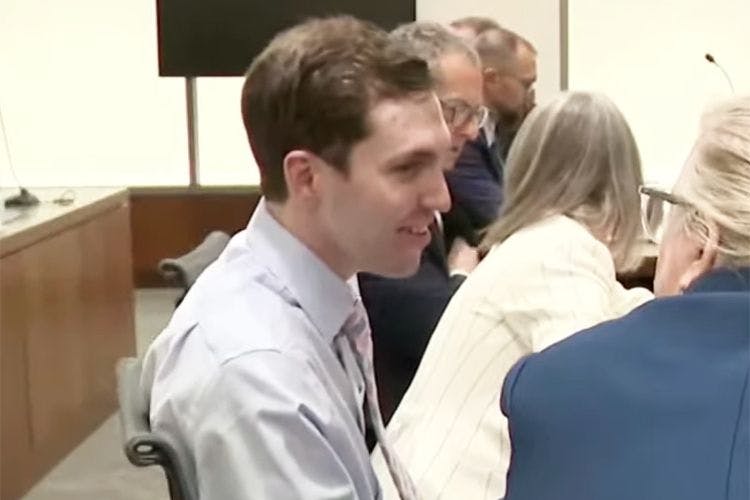
This is a man who has clearly benefited from the many fanciful stories that have been told about Charlie’s death. His expression is the demonic grin of a sociopath. It’s a grin that we’ve seen from many other sociopaths over the years, from Luigi Mangione to Brian Kohberger. It’s familiar. And therefore, the images from the courtroom yesterday are not confounding or shocking. They are sobering. And they aren’t particularly difficult to decode.
Tyler Robinson laughs and smiles during hearing on media access to the trial on Charlie Kirk’s killing. pic.twitter.com/QbiUa7l7qO
— The Post Millennial (@TPostMillennial) December 11, 2025
At the risk of understatement, this does not look like footage of a man who’s being framed for murder, or someone who’s terrified and confused. He looks a lot like many other narcissistic, sociopathic murderers who have been in the exact same position. There’s been a lot of conversation about “vibes” and “feelings” — people claiming that various figures involved in this saga give off bad vibes or give them a weird feeling. Needless to say, vibes and feelings do not constitute evidence of anything. But it’s worth asking anyway: what kind of vibe does Tyler Robinson give off? Can anyone honestly say you get the vibe that this is an innocent man being railroaded by powerful forces involved in a global conspiracy? To say nothing of his parents, who certainly are not giving off the vibes of parents who know that their son is being used as a patsy for a crime he didn’t commit.
This footage should have the effect of focusing your mind and strengthening your resolve after three months of speculation and paranoia. It should also motivate you to evaluate, with as much precision and seriousness as possible, the strength of the case against Tyler Robinson. Justice in this case depends on it. And so does, perhaps, the survival of the conservative political movement, and therefore our country. The time for wild theorizing is over.
Of course, as we all know, Candace Owens has been by far the most prominent person to push alternative theories of the case. Candace has been my friend for many years now. But I strongly disagree with her theories about this case, and I’ve told her that in our private conversations. I won’t — and would never— say anything about the content of those conversations, except that we’ve had them.
But many millions of other people in the general public have come to believe these theories — and there are plenty of other people online who are pushing them — which means that there is a conversation to be had with the general public as well, which is what I want to do today. If you are in that camp — if you are someone who believes that Charlie’s death was the result of some kind of vast conspiracy implicating foreign governments, our own government, and even TPUSA — I ask you to listen to what I have to say. I am not going to insult or condemn you. I’m just going to tell you plainly that I think you’re wrong, and why. Guilt is established through evidence. And the evidence — all of the evidence — points in one direction. Which isn’t to say that there aren’t unanswered questions. And it’s not even to dismiss the possibility of a conspiracy. There may indeed be a conspiracy of sorts, but it’s a conspiracy — if there is one — among left-wing militants in Utah. I’ll get to all of that. I just ask that you listen. We’ll start with the evidence. And here it is.
DNA recovered at the crime scene from a screwdriver, as well as a towel that was wrapped around the rifle used in the shooting, both match Tyler Robinson. His DNA was also found on the trigger of the rifle. This is evidence that mathematically excludes any other suspect. It’s also evidence that’s subject to independent testing by the defense team, and which the state crime lab has reviewed, separately from the FBI. It’s evidence that, even if it were the only evidence, would likely be enough to convict anyone in any court. But it’s not the only evidence.
Additionally, in a text message after the shooting, Robinson said he wanted to take out Charlie Kirk because he’s been spreading “hate.” He also wrote a note stating, “I have the opportunity to take out Charlie Kirk, and I’m going to take it.” The FBI has a photograph of that note.
Hearing all this, you might say, “Well, I don’t trust the FBI. Maybe they faked the text messages and planted the DNA.” And it’s certainly not unreasonable to distrust the FBI. After all, we’ve been lied to so many times, about virtually everything — from Russiagate to COVID to George Floyd to the assassination attempt in Butler and so on. The FBI, as an institution, historically, has very little credibility.
But here’s the thing: The case doesn’t hinge on the credibility of the FBI. Not even close. Tyler Robinson’s father and mother both recognized their son in the surveillance images from UVU’s cameras. Robinson’s father also recognized the rifle as the same type of rifle that had been given to his son as a gift.

But Robinson didn’t provide a photo of the rifle when his father requested one, after the shooting. He didn’t tell his parents where the rifle was. He also didn’t deny committing the crime when his parents asked about it. Nor did Robinson say that the FBI had faked the surveillance images somehow, as a way of setting him up as a patsy.
Instead, when asked why he had killed Charlie, he wondered aloud about whether he should kill himself, and stated that Charlie was responsible for spreading “evil.” Then, before going to the sheriff’s office, Robinson also posted this message to a group of his friends on Discord: “It was me at UVU yesterday. im sorry for all of this.”
So we have three confessions here — one to his parents, one to his roommate, and one on Discord. And the confessions weren’t obtained by the FBI, or coerced in an interrogation room, or anything like that. Robinson turned himself in at a sheriff’s office, not an FBI field office. A retired deputy sheriff and family friend brought him there. Those local sheriffs were the ones who took the first statements from Robinson’s parents, which identified Robinson as the shooter, and provided the motive. In literally any other case, for literally any other defendant, if there is DNA evidence and a confession — they will be convicted. To say that this kind of evidence is not enough — indeed to say that this evidence doesn’t even point vaguely to the suspect — is to essentially say that guilt can never be proven in a court of law.
And by the way, a police officer at Utah Valley University was the first person to identify where the shooter was located. The FBI wasn’t on scene at the time. This officer immediately identified where the shot had come from, and he ran to the sniper’s nest.
According to charging documents, which were prepared by Utah’s County Attorney, “At the moment of the shot, a UVU police officer was watching the crowd from an elevated vantage point. As soon as he heard the shot, he began to scan the area for threats. Believing the shot came from a rifle because of its sound, he looked for potential sniper positions. He noted a roof area approximately 160 yards away from Mr. Kirk as a potential shooting position and rushed there to look for evidence.”
When the UVU officer arrived at that position, he “noticed markings in the gravel rooftop consistent with a sniper having lain on the roof – impressions in the gravel potentially left by the elbows, knees, and feet of a person in a prone shooting position. Police reviewed surveillance from the camera covering the roof and discovered that it recorded an individual dressed in dark clothing cross the railing from the public walkway and drop onto the roof at approximately 12:15 p.m. … After a short time, which matches the known time of the shot, the individual arose and ran across the roof to the northeast. This discovery led to an intensive review of UVU surveillance recordings to attempt to track and identify the suspect.”
Notably, this UVU police officer — an unlikely participant in a grand FBI conspiracy, by any measure — did not think a mysterious second shooter on a grassy knoll had taken the shot. He zeroed in on the shooting location right away. They checked the cameras. And the cameras provided images of the shooter climbing the steps, who was then identified by his parents.
There’s also the fact that, according to a former co-worker, Robinson always walked around with his fists clenched. This is not the kind of evidence that would convict Robinson on its own, obviously. It’s circumstantial. Not hard evidence. But we have hard evidence. And we have circumstantial evidence. So both the hard evidence and the circumstantial evidence point in one direction.
This is from the New York Post, quoting an electrician that Tyler Robinson worked with.
“Tyler walked around with clenched fists all the time – like, super hard clenched fists. I remember making a joke to him one time when he had his fists like that, I was like, ‘Are you angry, Tyler?’ And he was like…’That’s just what I do.’ He was always soft-spoken but his fists were always like that,” he said. “Even in the security footage from UVU, you can see he’s got his fists clenched tight.”
Here’s that security footage:
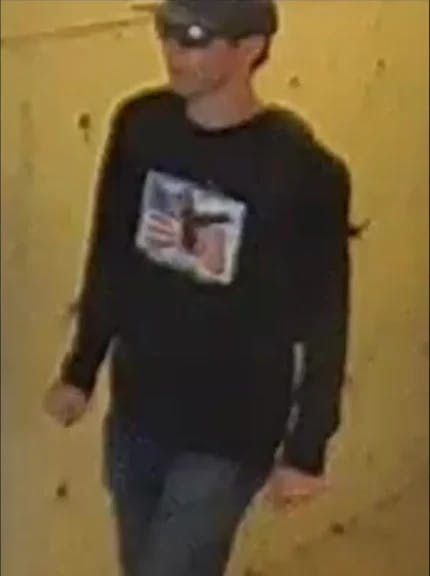
So that detail from an independent witness is obviously incriminating. So is the fact that, after the shooting, Robinson didn’t answer his phone or show up to work. The Post continues:
“‘I was shocked when I heard the news yesterday — I was like, ‘It can’t be that Tyler’ — so I called my old coworker at Wilde Electric and I was like, ‘Hey, did Tyler show up to work today?’ He was like, no, he was supposed to but maybe he’s at a different site. … “And I was like, ‘Dude, I think Tyler was the one who did the shooting.’ And he didn’t believe me,” the man said, adding that his subsequent phone call to Robinson went straight to voicemail.”
In no uncertain terms, the evidence against Tyler Robinson, which comes from multiple independent sources, is overwhelming. It’s easily enough for a reasonable jury to convict him ten times over.
By contrast, the alleged evidence implicating the U.S. military, a dozen foreign assassins with their personal cellphones, Egyptian air force planes, Turning Point USA, and the French Foreign Legion, is nonexistent. It’s not that there aren’t any weird details about that day, or some of the people tangentially connected to the event, that you could point to. But there are two important points about those weird details: First of all, a lot of those details are based on hearsay and anonymous reports. You have no way to know if they’re even true. Second, even if they are all true — even if it’s true that Egyptian planes have been following Erika Kirk around, for example — they do not constitute any kind of evidence at all. You could take any murder that has ever happened in the history of the world, look at all of the stuff surrounding it, and all of the people connected in some way to it, and point to any number of “weird” things. But there is a reason why no competent defense attorney would ever try to get his client off the hook simply on the basis that weird stuff happened on the same day that the murder happened. That is not exculpatory. That is not evidence of anything, except that weird things happen. And in that very important respect, the conspiracy theory claims are the exact opposite of the witness testimony and DNA evidence that will be presented at Robinson’s trial — all of which will be subjected to cross-examination and independent testing.
None of the weird details presented by conspiracy theorists, on the other hand, constitutes evidence even remotely. More to the point, the conspiracy theories make LESS sense of these facts than the so-called “official narrative” does. So the conspiracy theorists are positing random circumstantial points as evidence of a theory that itself does a worse job of explaining the points than the theory they’re trying to debunk. All of the weird details — again, assuming they’re all true, which we cannot assume — actually make the conspiracy theory LESS plausible, not more. If this whole thing was the work of powerful actors at the highest levels of government across the world — who plotted, planned, and carried it out — it would be much cleaner, and there would be far fewer weird details for people on the internet to home in on.
For example, the conspiracy theories suggest that various powerful governmental forces across the globe conspired to kill Charlie Kirk and rather than just having him die mysteriously in his home of a heart attack or “suicide,” which they could have easily arranged, or sniping him while he checked the mail one day and making sure the assassin was never found, which they also could have arranged, they decided to carry out this plot on stage, on camera, using Robinson as a patsy, who they allowed to be captured alive for some inexplicable reason, when they could have just made it a murder-suicide and tied up the loose ends. And on top of all of that, we’re told they used the wrong ammunition in the official story (we’ll get to that in a second), along with leaving a trail of various other bread crumbs that the internet could follow. And on top of that, they somehow convinced Robinson’s own parents to go along with this charade, persuading them to offer their innocent son up to be executed, while also letting them stay alive to tell their tale if they ever chose to. There have been many mass shootings where the shooter kills his family members before turning his gun on the public and then himself. The hypothetical conspirators could have — and obviously would have — arranged all of that in this case, tidily closing the loop and getting rid of anyone who could blow the whistle. Indeed, the whole reason why everyone (I think rightly) assumes that Epstein didn’t kill himself is that we know that powerful conspirators aren’t just going to leave someone alive to blow the lid off the whole thing. Admittedly, I’m speaking hypothetically about what these government assassins would do. But the conspiracy theorists are also speaking hypothetically. And I’m saying that the facts on the ground don’t match their hypothetical. At all.
A theory is not just an educated guess. A theory, in a scientific sense, is a system meant to explain the facts we observe. We observe objects falling to the ground when we drop them. Gravity is the “theory” — the system — that explains that fact. This is why we say theories should be predictive. A theory should predict what we observe in reality. If you listen to someone explain the theory of gravity, you would predict, based on the theory, that things would fall to the ground when you drop them. And they do. But the conspiracy theory surrounding Charlie’s assassination does not make sense of, or predict, any of the details that it was designed to explain. If you did not know anything about Charlie or his murder, and someone told you the conspiracy theory — they told you the tale of militaries, and intelligence agencies, and multi-million dollar organizations conspiring to kill this man in a highly coordinated and well funded scheme carried out by specialized and highly trained killers — you would have in your head a picture of this case that would not even slightly resemble the reality. When you finally read up on the case itself, and the actual real-life details, you would be utterly shocked to see the clumsiness, the “weirdness,” the apparent inconsistencies, and most especially, you would be shocked that all of the people who are being used as patsies in this murder were somehow left alive. You would be shocked that Charlie’s murder very much resembles, in every way, the work of an untrained radical whack job, and not the work of nefarious global elites. Now you could argue that nefarious global elites would want it to look like the work of an untrained radical whack job. But the whole reason you formulated this theory is because you say it doesn’t look like the work of an untrained radical whack job, even though it does. Your theory collapses in on itself. It eats its own tail.
And on that point, we need to talk about one specific insinuation, which comes up quite often and which the conspiracy theorists are hanging much of their theory on, which is that Robinson’s rifle may not have killed Charlie Kirk, because a bullet from that rifle would have decapitated him. This is an insinuation that claims to rely on actual, scientific evidence, so it’s worth discussing in some detail. Again, even if it’s true that the ammunition doesn’t match the type of injury Charlie sustained, that inconsistency makes EVEN LESS SENSE under the theory that this was all plotted by militaries and governments. Would they not have known this fact about the ammunition? Is it even plausible that they would make such an obvious mistake?
But we’re supposed to believe this claim about the rifle because of demonstrations like this one, which Candace presented on her show recently. Watch:
Candace Owens responds to ballistics test:
I agree with her and I’m sorry to inform you, but a 30/06 WAS NOT used in Charlie Kirk’s assassination! pic.twitter.com/JaopgiIcZn
— FromConvict2Conservative (@YaakovRenewed) December 9, 2025
One of the many obvious problems here is that this demonstration does not account for any of the actual variables of the assassination, beyond the round that was used. And the most important missing variable is that the actual shooter was at an elevated position, roughly 40 feet above the ground. He shot Charlie at an angle. They don’t account for that, in any way, in this demonstration.
Take a look at this diagram that was uploaded by Fenix Ammunition, which is a credible source on the topic because they manufacture precision ammo.
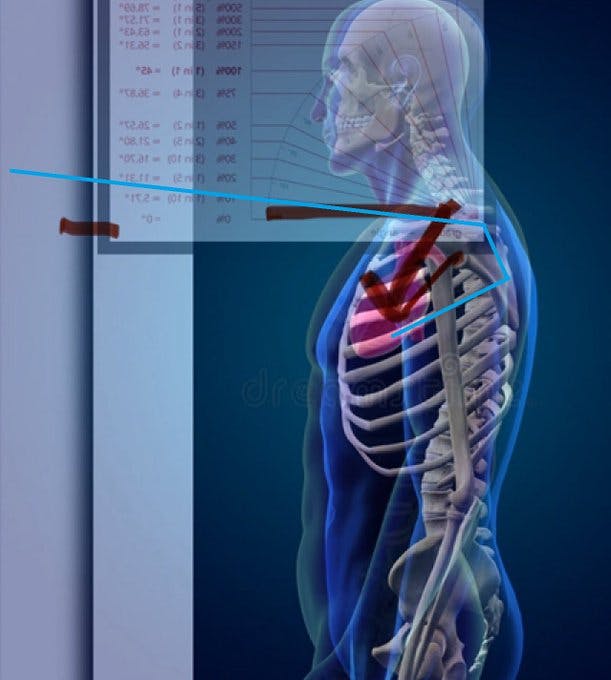
The blue line is the bullet trajectory that they assess is plausible. It gives you an idea of how the bullet may have deflected once it hit Charlie’s spine. And if you’ve ever gone hunting, you know how often this kind of thing happens. A powerful round, particularly if it’s shot at an angle, will often deflect off bone, sending fragments downward into the body.
But if you watch that demonstration, which doesn’t remotely mirror the actual conditions of the shooting, you’re led to believe that this is physically impossible. You’re told that it’s far more likely that a second, unknown shooter actually shot Charlie with a completely different weapon. Which, for the third time, if the conspiracy theories are true, it wouldn’t make any sense for the conspirators to carry out the assassination that way.
You can come up with various reasons why so many people are tempted to buy into this. Part of it may be ignorance, or unfamiliarity with firearms and other basic scientific evidence. Some of it may be latent frustration or resentment towards Turning Point USA. Some of it may be a desire for catharsis — to lash out blindly at the “establishment.” And a good part of it may be related to the same reason “true crime” shows are popular, especially with women. It can be intoxicating for people to believe fictional narratives about real-world events. It makes you feel like a detective — someone who’s privy to knowledge that most people aren’t. It’s a way to make sense of events that are horrifying and disturbing — even if those events, at a factual level, aren’t complicated. Compare the popularity of the highly fictionalized “Making a Murderer” Netflix show with various attempts to debunk it (including Candace’s own well made documentary on the subject). It’s not even close. Wild theorizing is often far more entertaining than the sober reality.
And that’s especially true now, in an era of extremely low trust in institutions. When the government has proven that it’s willing to lie, again and again, wild theorizing starts to seem rational. No one wants to believe the official narrative because the official narrative, so often, is false. We elected this government to address the problem. We elected them to restore faith in law enforcement and the rest of America’s institutions. And frankly, they haven’t done so. So there is distrust. And distrust is understandable. But distrust is not evidence of an alternative theory. And crucially, again, you do not need to trust the FBI, or the federal government, to recognize Tyler Robinson’s very obvious guilt.
With that said, there are, as I alluded to, unanswered questions. And those unanswered questions, in my opinion, may even lead to a conspiracy. But not one that involves TPUSA or the Trump Administration or any of the people or organizations who have so far been implicated. As for those questions, here they are:
Question one: Why did someone write on September 3rd, a week before the shooting, “it’d be funny if someone like charlie kirk got shot on september 10th LMAO.”
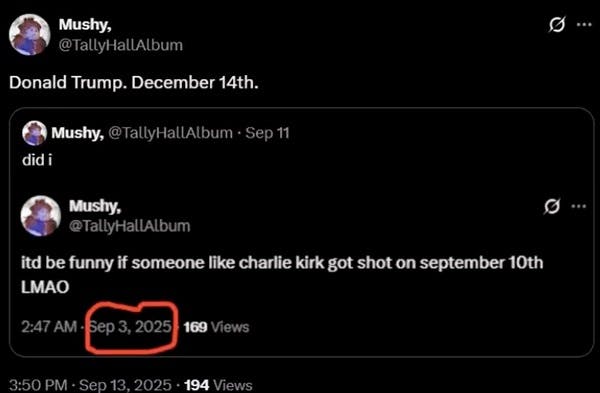
That’s a real post on X. It was unearthed by the account “Aesthetica.” It’s legitimate. Did that person have advanced knowledge of the shooting? It’s especially alarming because, as Cassandra Macdonald of Gateway Pundit has pointed out, the user name of that poster is “tally hall album.” And Tyler Robinson, coincidentally enough, had a publicly visible playlist of songs by the band Tally Hall on Spotify. Additionally, the shooter’s trans/furry-identifying boyfriend, MacDonald reported, was active on the Tally Hall subreddit.
There were several other posts along these lines.
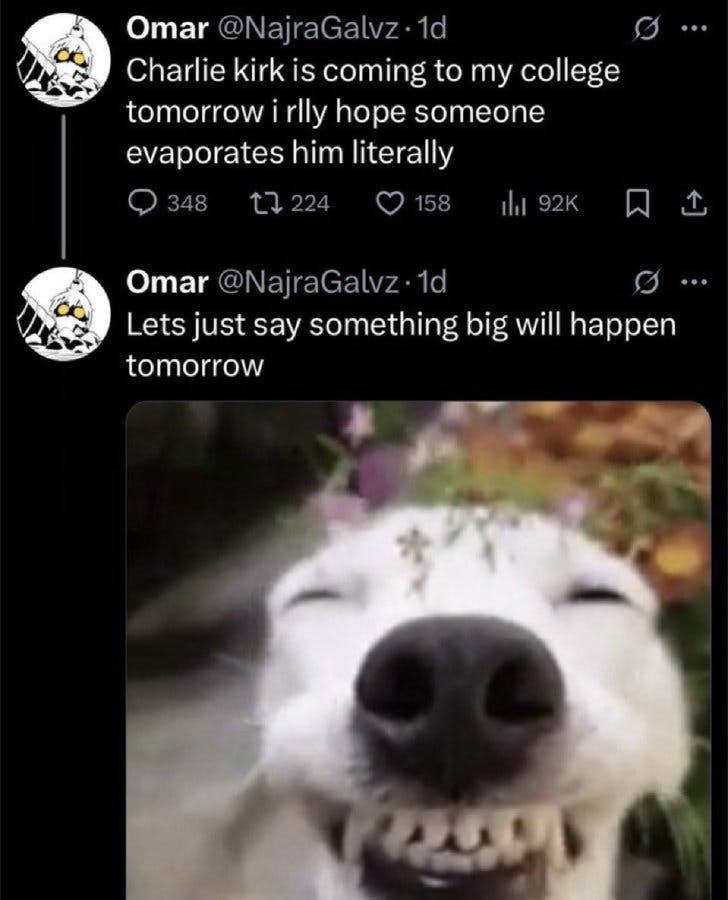
Another post read, “Charlie Kirk is coming to my college tomorrow, I really hope someone evaporates him literally … Let’s just say something big will happen tomorrow.”
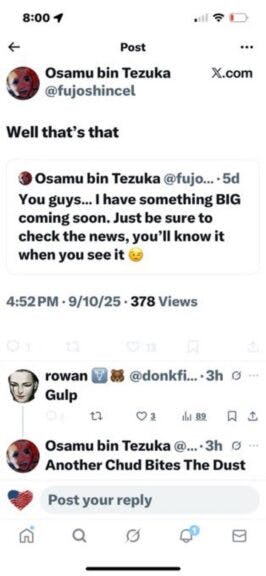
Additionally, days before the shooting, someone else indicated that something “BIG” was coming soon. Then, after the shooting, the author wrote, “Well that’s that” and “Another Chud bites the dust.”
Then there’s this one. It’s from shortly after the shooting.
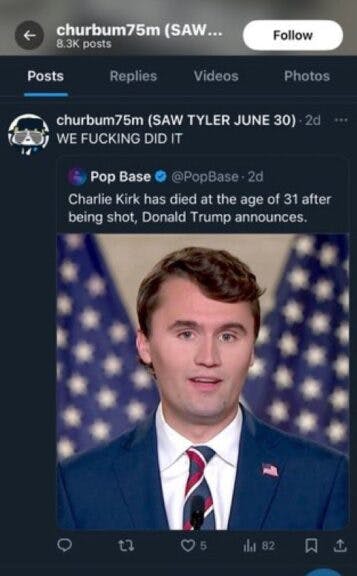
A trans-identifying individual who is followed by Lance Twiggs on TikTok wrote, WE F–ING DID IT!!”
Whatever happened to these people? The FBI says they investigated them. What did they uncover? Were they cleared? If so, how?
There’s a clear public interest in answering that question. It wouldn’t interfere with Tyler Robinson’s trial. So what’s the answer?
And while we’re at it, why did Robinson text his gay furry lover, “Remember how I was engraving bullets?”
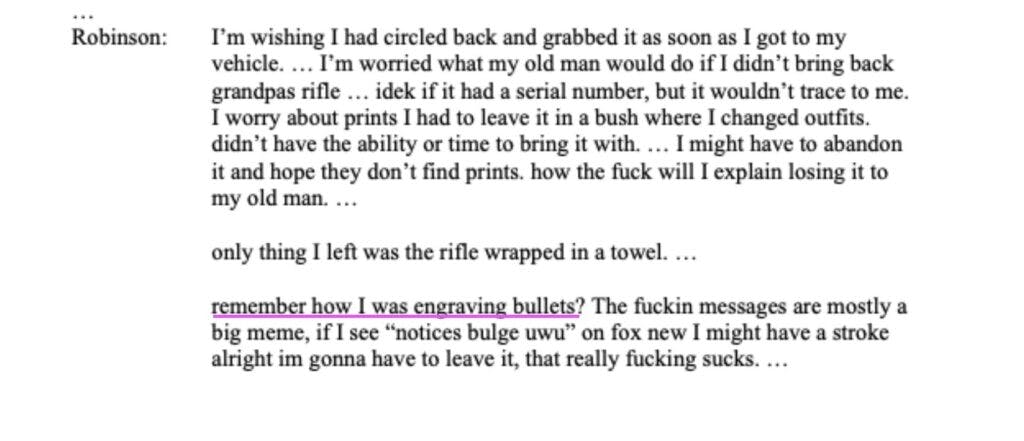
How is it possible that the roommate, Lance Twiggs, would see Robinson “engraving bullets,” but not have any idea why he was engraving them? Did he see him engraving messages like, “Hey Fascist, catch?” Did he ask why his roommate was engraving bullets? We have no idea. As far as we know, Twiggs has gone missing. No one seems to know where he is. So where is he? And has he actually been cleared of any wrongdoing or foreknowledge of this attack?
And what is the group Armed Queers Salt Lake City? And why did they scrub their entire social media presence immediately after the shooting?
These are legitimate questions that, for all I know, the government will answer during Robinson’s trial. But they should address some of these issues now. Even if they have to leak the information through unofficial sources, transparency is obviously necessary.
As of now, there is actually a case to be made for conspiracies. But it doesn’t involve the Egyptian Air Force or the French Foreign Legion. It involves Leftist freaks on the internet, who seemingly had foreknowledge of the attack. It involves the coordinated attacks by Leftists on law enforcement over the past several months. It involves the people — leftists militants — who have been committing acts of political violence all over the country for years, and who had all of the motive and all of the incentive to kill Charlie Kirk. There is one group and one group only that has actually benefited from Charlie’s assassination, and that ever had a chance of benefiting. And that is the militant left. On the other hand, the group that has been harmed the most, by far, and that could only be harmed by it, is TPUSA. Which means that — along with their being no evidence at all to implicate them — they also don’t have any discernible motive.
That includes, most obviously and especially, Erika Kirk. On that note, I want to say this about Erika. I had only met Erika maybe once or twice prior to Charlie’s death. After he was killed, of course, I reached out to her. We spoke briefly on the phone. Again, I won’t go into detail about the content of a private conversation, except to say that Erika, who had just lost her husband in the most shocking way imaginable, spent most of our conversation trying to encourage me and tell me how much I meant to Charlie. She’s the grieving widow, with children who at that point still didn’t even know that their father was dead, and yet here she was on the phone — through her tears, through the very deep anguish and pain in her voice — still trying to be gracious and encouraging to someone else, some guy she barely knew. It was clear to me then — and has become all the more clear to me since, as I’ve gotten to know her more — that this is someone with an immense amount of strength and courage.
So when people look at Erika and say, “She’s acting strange. I’ve never seen a grieving person act this way.” Well, I agree. She’s an exceptional person, in an extraordinary situation, handling it with remarkable poise and dignity. That is a virtue. And virtue is a strange thing in our day.
And even if she were not an impressive person, she would still be a grieving widow. She would still be my friend’s wife. And I would still feel duty-bound to support her — as I have over these past three months, in ways both public and not. So what I am asking everyone — including Candace — is to please leave this woman alone. Let her grieve. Let her pick up the pieces of her shattered life in whatever way she sees fit. She deserves that grace. And we owe it to her. Not because of any specific debt. Not because we have no right to question her. Of course, we do have the right. But we have a moral obligation, as children of our Heavenly Father, to be charitable and kind towards suffering widows, especially the widow of a man that all of us (on the Right anyway) say we respected and admired.
All told, the tragic reality is that three months after the assassination of Charlie Kirk, the Leftists who want us dead are more emboldened than ever. They’re thrilled. That was always the worst possible outcome. It’s a trajectory that, if it continues, could destroy not only what Charlie built, but also what’s left of the conservative movement — a movement that is the only thing standing between western civilization and the forces that wish to tear it down brick by brick. That’s the reason sociopaths like Tyler Robinson are smiling right now. They know they’re winning. And we cannot let them. Which means we must all return to the facts, to the truth and our defense of it, which is the mission that Charlie lived for, and died for. We cannot let it die with him.
What's Your Reaction?
 Like
0
Like
0
 Dislike
0
Dislike
0
 Love
0
Love
0
 Funny
0
Funny
0
 Wow
0
Wow
0
 Sad
0
Sad
0
 Angry
0
Angry
0

I am just an average American. My teen years were in the late 70s and I participated in all that that decade offered. Started working young, too young. Then I joined the Army before I graduated High School. I spent 25 years in, mostly in Infantry units. Since then I've worked in information technology positions all at small family owned companies. At this rate I'll never be a tech millionaire. When I was young I rode horses as much as I could. I do believe I should have been a cowboy. I'm getting in the saddle again by taking riding lessons and see where it goes.







Comments (0)