

Why The MAHA Coalition Has Its Eyes On The Supreme Court
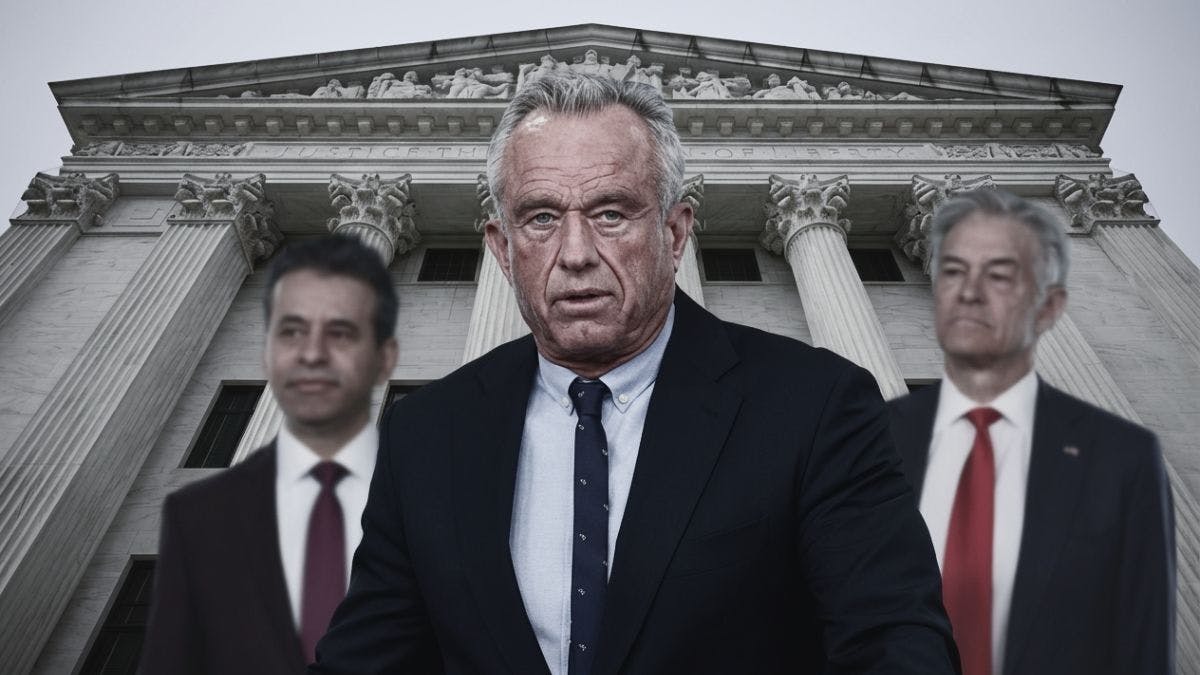
When Turning Point USA polled attendees at its annual convention last month, the most popular member of Donald Trump’s cabinet was Robert F. Kennedy Jr. He was viewed favorably by a shocking 96.8%, with more than 80% saying they strongly approved of him.
Live Your Best Retirement
Fun • Funds • Fitness • Freedom
The message, at least to anyone paying attention, is clear: Making America Healthy Again is a top priority for conservatives. One person paying attention is TPUSA’s Alex Clark, who has made MAHA the primary focus of her podcast Culture Apothecary.
Clark has been banging the drum for Republicans to not lose sight of MAHA voters and their priorities. She warns that MAHA is paying attention to whether the promises made will be kept. And they’re deciding now whether their new home on the right is temporary.
Her latest warning: MAHA is paying attention to who sides with big pesticide manufacturers. I’m thrilled to have her in the Daily Wire, laying out not only why the pesticide issue is so important to MAHA, but why how it’s handled can shift the political spectrum. —Brent Scher
—
The Supreme Court is set to decide on Friday whether to take up a case that could determine whether pesticide manufacturers can use federal regulators as a shield against accountability if their products make Americans sick.
At stake is whether families harmed by chemicals like Roundup will retain the right to seek justice in state courts, or whether corporate giants will be granted immunity for failing to warn the public.
The case, Monsanto v. Durnell, centers on a deceptively technical legal question with enormous real-world consequences: can federal pesticide law override state-level failure-to-warn claims once the Environmental Protection Agency has approved a product label?
For decades, state courts have served as the primary avenue for Americans harmed by dangerous chemicals, particularly when evidence shows manufacturers knew, or should have known, about serious health risks and failed to warn consumers. Bayer, which acquired Monsanto in 2018 and now sells Roundup, is asking the Supreme Court to shut that door entirely.
If the Supreme Court agrees, pesticide manufacturers would be able to point to EPA label approval as a legal shield, even if people develop cancer, infertility, or other serious illnesses after using their products. The result would be a sweeping expansion of corporate immunity — and a devastating loss of recourse for ordinary families.
What concerns me most is how such a ruling would affect American children.
A growing body of research has raised serious concerns about the role of glyphosate and other widely used pesticides in endocrine disruption, impaired reproductive development, and even infertility. Children are uniquely vulnerable to chemical exposure, especially substances that interfere with hormones during critical developmental windows. Yet many of these products are sold without clear warnings and marketed as safe for routine use in backyards, playgrounds, and schools.
The corporations pushing the Court to expand federal preemption are effectively arguing that once a federal agency signs off on a label, no further accountability should exist. Even if new evidence emerges, even if harm becomes widespread, and even if children pay the price. Preserving corporate profits takes precedence over whether future generations can grow up healthy and fertile.
The legal question before the Court is narrow, but the implications are not.
Under current law, victims can pursue state-level failure-to-warn claims by showing that a manufacturer knew, or should have known, that its product posed serious risks but failed to disclose them. Bayer wants the Supreme Court to rule that EPA approval of a pesticide label automatically wipes out those claims.
In the case of glyphosate-based Roundup, the EPA approved the product without a cancer warning. But internal documents revealed through litigation paint a far more troubling picture of how that label came to be.
Monsanto engaged in a sustained campaign to suppress unfavorable science and shape the regulatory narrative. The company is accused of ghost-writing supposedly independent research, burying inconvenient studies, and using backchannels to discredit scientists who raised safety concerns. Documents also show Monsanto never tested the full Roundup formulation for carcinogenicity. In one internal email, a Monsanto toxicologist admitted: “[Y]ou can’t say Roundup is not a carcinogen… we have not done the necessary testing on the formulation to make that statement.”
That is precisely the accountability mechanism Bayer now wants the Supreme Court to eliminate.
Imagine walking into a store and buying a bottle of Roundup. There is no warning on the label that it has been linked to cancer. No warning that it can be absorbed through the skin. No caution about spraying it where children play barefoot or crawl in the grass. Parents are expected to trust that if something were truly dangerous, someone would have warned them.
If Bayer wins this case, the message to manufacturers will be unmistakable: keep labels as weak as federal regulators allow, and if people get sick, it’s not your problem.
This is not a hypothetical concern. Bayer has already paid nearly $11 billion to settle cancer claims related to Roundup. Thousands of additional lawsuits remain pending. The company’s stock price has plummeted, and its own internal strategy documents describe a multi-pronged effort to “mitigate the risks of litigation.” One prong of that strategy is persuading the Supreme Court to declare that EPA approval preempts state law entirely.
A ruling in Bayer’s favor would not stop with Roundup. It would apply to more than 57,000 pesticide products currently on the market, many of them highly toxic. It would grant sweeping immunity to chemical manufacturers, including foreign-owned corporations like ChemChina, which sells pesticides in the United States that are banned in its home country for risks to human health.
This would amount to an unprecedented transfer of power away from families, juries, and state courts and toward multinational corporations whose primary obligation is to their shareholders, not to American children.
Congress has flirted with similar liability shields in recent spending bills and in the upcoming Farm Bill. As a lifelong conservative, my message to congressional Republicans is simple: the Make America Healthy Again coalition is paying attention.
In the 2024 election, millions of mothers voted Republican for the first time because they believed lawmakers would finally take children’s health seriously. They believed the party would stand up to corporate interests that profit while families bear the consequences.
That trust is not unconditional.
Before 2024, Republicans struggled to win suburban women. The MAHA coalition changed that, which was an unexpected political gift. But it is a fragile one. Shield Big Chemical from accountability, and that coalition will walk.
If the Supreme Court or Congress decides that corporate interests outweigh informed consent, the message to American families will be clear: your health is negotiable. Your children’s future is collateral damage.
That is a message no party, and no court, should be willing to send.
—
Alex Clark is a Turning Point USA contributor and the host of Culture Apothecary, a health and wellness podcast aimed at Gen Z and millennial conservative women.
The views expressed in this piece are those of the author and do not necessarily represent those of The Daily Wire.
What's Your Reaction?
 Like
0
Like
0
 Dislike
0
Dislike
0
 Love
0
Love
0
 Funny
0
Funny
0
 Wow
0
Wow
0
 Sad
0
Sad
0
 Angry
0
Angry
0

I am just an average American. My teen years were in the late 70s and I participated in all that that decade offered. Started working young, too young. Then I joined the Army before I graduated High School. I spent 25 years in, mostly in Infantry units. Since then I've worked in information technology positions all at small family owned companies. At this rate I'll never be a tech millionaire. When I was young I rode horses as much as I could. I do believe I should have been a cowboy. I'm getting in the saddle again by taking riding lessons and see where it goes.






Comments (0)