

Eileen Gu’s Dual Loyalties Earn Her Double Resentment
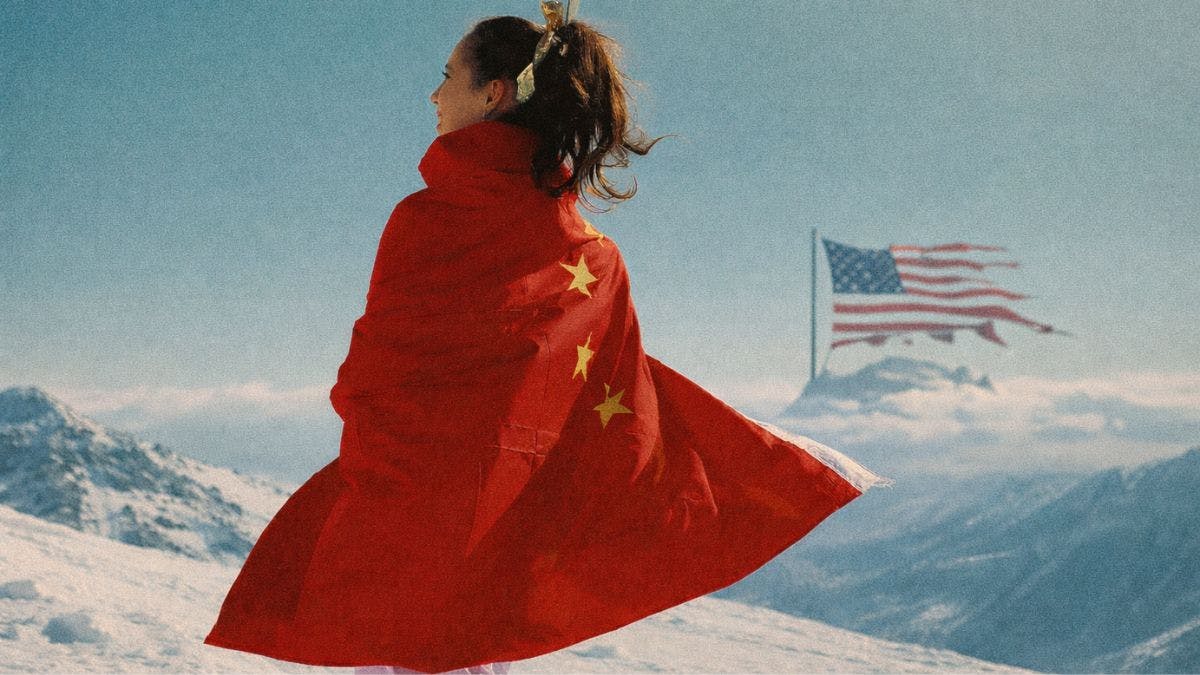
Confucius once said, “he who chases two rabbits, catches neither.” Perhaps San Francisco native Eileen Gu should have thought about that before skiing for China in the Olympics.
Live Your Best Retirement
Fun • Funds • Fitness • Freedom
Despite fawning coverage and glowing praise from the Western press, Gu has drawn sharp rebuke from Americans for snubbing her nation. But she isn’t catching much love from the Chinese public, either.
Her Chinese critics have nicknamed her “Gu Ai Qian,” a pointed play on her given Chinese name “Gu Ai Ling,” which literally translates to “Gu Loves Money.”
This insult highlights the widespread perception that Gu is an opportunist, ditching her native country to maximize personal profit in a system that, paradoxically, rewards her with state funds and endorsement riches unattainable for most Chinese citizens.
A Beijing Municipal Sports Bureau budget that was eventually scrubbed from the internet revealed China paid Gu and another athlete a combined $6.6 million ahead of the 2026 Milan Winter Olympics, with nearly $14 million paid over three years. On top of this government funding, she has also amassed enormous wealth through global luxury brand endorsements, earning around $23 million in 2025 from sponsorships with companies like Red Bull, Porsche, and Louis Vuitton, as well as Chinese firms such as Anta and TCL, making her one of the world’s highest-paid female athletes.
Ever since the 2022 Beijing Winter Olympics, speculation has raged over Eileen Gu’s actual citizenship status, with many wondering if she quietly holds dual citizenship with China. Gu has remained notoriously evasive whenever the topic comes up, dodging direct questions and leaving the public guessing.
This ambiguity has fueled resentment in China, where dual citizenship is strictly prohibited. Without any evidence that Gu has renounced her American citizenship, Chinese commentators bemoan her special treatment as a privileged foreign-born elite, bending rules that ordinary citizens could never get away with.
Chinese netizens have begun deploying the popular skincare mantra “Morning C, Evening A” — a reminder to use vitamin C products in the morning and vitamin A in the evening — to mock Gu’s dual loyalty. During the day, Gu competes under the Chinese flag, cheering for the motherland and reaping the rewards, only to revert to her American self off the slopes, enjoying the personal freedom and luxury brands of the West.
Other Chinese critics have openly called Gu unpatriotic — accusations which she responded to on the Chinese social media platform Douyin.
“In the past five years, I’ve represented China in 41 international competitions and have won 39 medals for China,” Gu says to the camera. “I have also introduced three chief coaches and donated freestyle skis to the national team, and continually advocated for China and women on the global stage. What have you done for the country?”
This fiery post notwithstanding, Gu has made several attempts to thread the needle on her identity, telling several media outlets that she’s American when she’s in the United States and Chinese when she’s in China. Her biculturalism and dual nationality might well be forgiven by Americans if U.S.-China tensions weren’t so heightened at the moment. If an American athlete had defected to represent the Soviet Winter Olympic team in the 1980s, she would have been branded as a traitor, universally despised by the public, and excoriated by the media.
The same accusations of dual loyalty leveled against Eileen Gu from the American side might have carried far less sting, and perhaps even been tempered with understanding, had she ever openly acknowledged and expressed genuine gratitude for the freedoms, opportunities and nurturing environment that both she and her mother, Yan Gu, enjoyed after Yan fled China decades ago to forge a new life in the United States. It was precisely those American liberties and opportunities, including access to elite education and world-class training facilities, that laid the foundation for Eileen’s extraordinary career and global success. A simple, heartfelt recognition of that debt could have softened the narrative of betrayal for many Americans.
Instead, she feels quite free to lob criticisms at her home country while remaining notably silent on China’s human rights record. When pressed on the documented repression and cultural erasure of Uyghur Muslims in Xinjiang by the Chinese Communist Party, Gu shrugged it off, saying, “I don’t think it’s my business.”
Of course, all of this actually endears her to the Western media elite and global consumer brands, who view Gu as the living embodiment of the Davos mindset — a borderless, fluid world citizen who transcends outdated notions of national loyalty. In this cosmopolitan worldview, sovereign allegiance is a parochial relic of a bygone era, unfit for the enlightened global class that prizes transnational flexibility and seamless access to markets above all else.
Gu’s ability to navigate and profit handsomely from both the American system that granted her mother refuge and the CCP’s vast, state-directed economy makes her the perfect poster child for this ideology. The message from glossy profiles, luxury campaigns, and elite commentary is unmistakable: true modern virtue lies not in unwavering loyalty and love of country, but in mastering the art of being everywhere and nowhere at once — especially when that strategy aligns with the interests of authoritarian capital and multinational corporations eager to court the Chinese market. In their eyes, Gu isn’t betraying anything; she’s simply ahead of the curve, a gleaming symbol of the post-national future they champion.
Perhaps Gu has unwittingly manifested her long-stated dream of serving as a bridge between China and the United States. On the ground in both countries, populist sentiment has coalesced in strikingly parallel ways: ordinary Americans decry her as an opportunistic turncoat who exploits American freedoms while cashing in on Beijing’s largesse, while Chinese citizens mock and brand her dual loyalties. Both Americans and Chinese are rejecting the notion that one can glide seamlessly between superpowers, reaping rewards from each without genuine allegiance or sacrifice.
In the end, it comes back to Confucius: If you want to catch a rabbit, you have to pick one to chase.
Melissa Chen is the managing director of Strategy Risks, a business intelligence firm dedicated to assessing and mitigating China-related risks for corporations, NGOs, and governments.
The views expressed in this piece are those of the author and do not necessarily represent those of The Daily Wire.
What's Your Reaction?
 Like
0
Like
0
 Dislike
0
Dislike
0
 Love
0
Love
0
 Funny
0
Funny
0
 Wow
0
Wow
0
 Sad
0
Sad
0
 Angry
0
Angry
0

I am just an average American. My teen years were in the late 70s and I participated in all that that decade offered. Started working young, too young. Then I joined the Army before I graduated High School. I spent 25 years in, mostly in Infantry units. Since then I've worked in information technology positions all at small family owned companies. At this rate I'll never be a tech millionaire. When I was young I rode horses as much as I could. I do believe I should have been a cowboy. I'm getting in the saddle again by taking riding lessons and see where it goes.








Comments (0)