

‘New Gaza’: Trump’s Board Of Peace Unveils Ambitious Postwar Vision At Davos
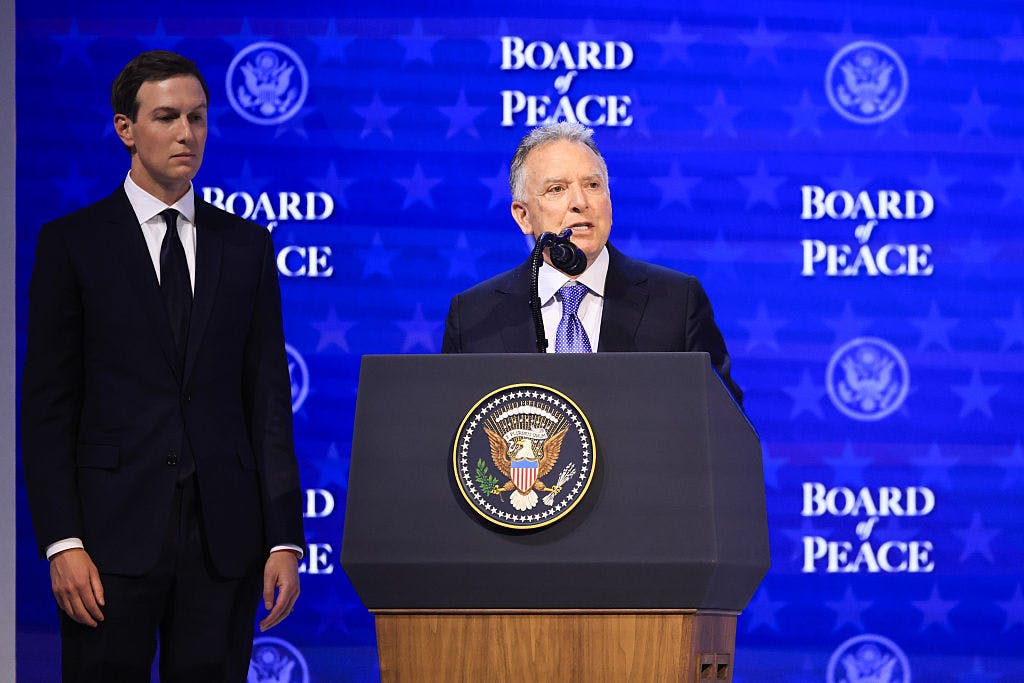
Secretary of State Marco Rubio, Jared Kushner, and U.S. Special Envoy Steve Witkoff appeared at Davos on Thursday as President Donald Trump’s Board of Peace was formally unveiled at the World Economic Forum, where Kushner and Witkoff discussed future plans for Gaza.
Live Your Best Retirement
Fun • Funds • Fitness • Freedom
The remarks by U.S. officials framed the Gaza agreement not simply as a ceasefire, but as the opening phase of an ambitious attempt to fundamentally reshape Gaza’s future. While Rubio emphasized President Trump’s role in breaking what many viewed as an intractable conflict, Kushner and Witkoff focused on security, governance, and economic transformation as the pillars of a postwar Gaza.
Witkoff described the Gaza deal as something “the world thought was impossible and unattainable,” recalling that when President Trump tasked him and Kushner with the effort, the directive was simple: “We had to try.” He emphasized that the outcome went beyond the return of hostages, saying, “We have achieved a peace deal in Gaza. We have brought the hostages home. All of the bodies, except for one, and we will bring that body home, too.”
But Witkoff stressed that the most consequential achievement was intangible: “Maybe most importantly, we have created a sense of hope for what the future can bring.” Kushner then outlined what comes after hope — implementation. Reflecting on the moment the deal was finalized, he said, “It was just over 100 days ago that we got the final deal done, and everyone was celebrating and joyous about the hostages coming home and the end to this long war that nobody thought was possible.” But he admitted that celebration quickly gave way to urgency: “Steve and I were panicking, saying, ‘What do we do next? How do you implement peace?’”
Economically, Kushner laid out a sharp break from Gaza’s historical dependence on aid. “Eighty-five percent of the GDP of Gaza has been aid for a long time,” he said. “That’s not sustainable. It doesn’t give these people dignity. It doesn’t give them hope.” Instead, the plan is to apply “free market economy principles” and bring private investment, jobs, and opportunity. “We want to bring the same mindset, the same approach, to a place like Gaza to give these people the ability to thrive and have a good life,” he explained.
“Hamas’s mission statement was: ‘We need to destroy the state of Israel,'” Kushner stated. “That has not worked well for the people, as we’ve seen. … But without security, nobody’s going to make investments, nobody’s going to come build there. We need investments in order to start giving jobs. … There’s a master plan. We’ll be doing it in phasing. In the Middle East, they build cities like this in three years. … We’ve already started removing the rubble and doing some of the demolition. And then New Gaza. It could be a hope. Could be a destination, have a lot of industry, and really be a place that the people there can thrive, [and] have great employment. Once this starts going, we think there should be 100% full employment and opportunity for everybody.”
Together, Witkoff and Kushner framed Gaza’s future as a test case for the implementation of peace itself — one that hinges not on speeches or resolutions, but on demilitarization, investment, and the belief that even the most entrenched conflicts can be solved.
What's Your Reaction?
 Like
0
Like
0
 Dislike
0
Dislike
0
 Love
0
Love
0
 Funny
0
Funny
0
 Wow
0
Wow
0
 Sad
0
Sad
0
 Angry
0
Angry
0

I am just an average American. My teen years were in the late 70s and I participated in all that that decade offered. Started working young, too young. Then I joined the Army before I graduated High School. I spent 25 years in, mostly in Infantry units. Since then I've worked in information technology positions all at small family owned companies. At this rate I'll never be a tech millionaire. When I was young I rode horses as much as I could. I do believe I should have been a cowboy. I'm getting in the saddle again by taking riding lessons and see where it goes.










Comments (0)