

What to Expect in PLA Activities Near Taiwan Leading up to Trump and Xi Summit
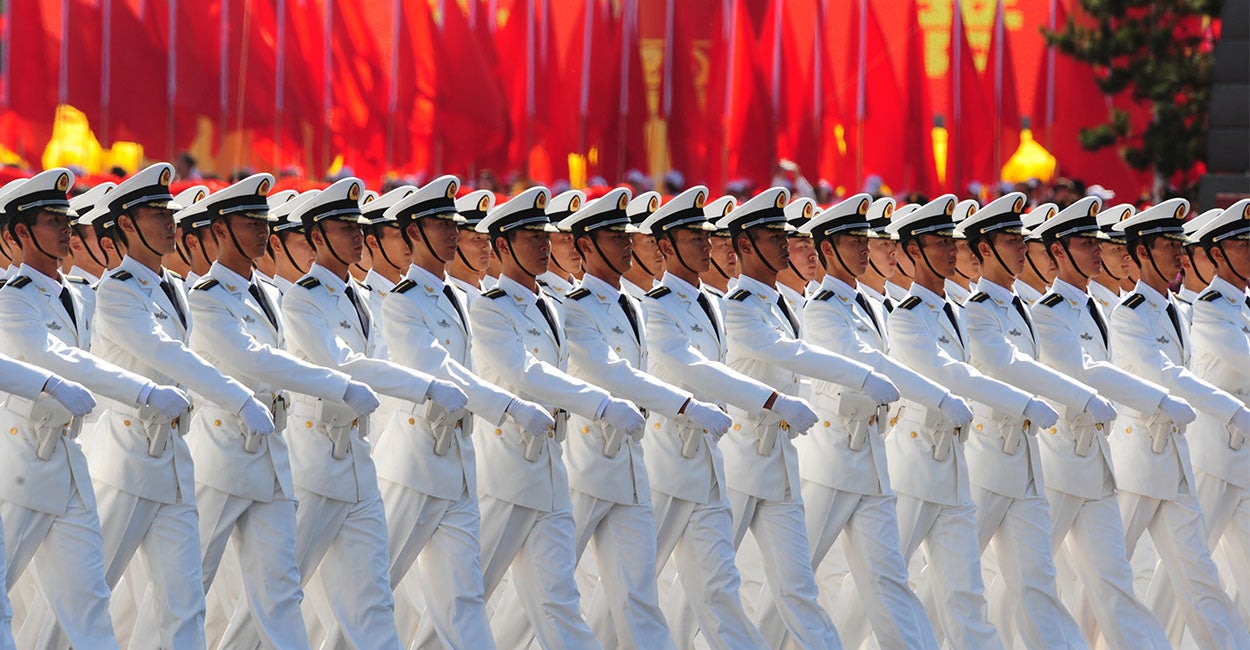
With a summit fast approaching between President Donald Trump and Secretary General Xi Jinping in April, expect China’s military activities around Taiwan to be subdued for now.
Live Your Best Retirement
Fun • Funds • Fitness • Freedom
Since the summer of 2022, China’s People’s Liberation Army has conducted routine military drills around Taiwan practicing blockades and simulating invasions of the island. This includes the late December Justice Mission 2025 which involved a large number of warships and 130 aircraft around Taiwan.
Recent PLA activities paint a picture of what to expect ahead of the approaching Lunar New Year, and, more importantly, Trump’s trip to China in April.
Previously, Heritage scholars predicted a continued increase in People’s Liberation Army Air Force activities near Taiwan. This was predicated on analysis based on previous PLAAF activity and an expected increase in military activity around Taiwan.
From September to February, around 65% of the PLAAF activities fell below predictions. Although a majority of activities being below predicted levels is good, this does not give Taiwan permission to lower its guard.
Of the 1,928 Chinese aircraft operating near Taiwan between September 2025 and January 2026, over 60% of them crossed the median line in the Taiwan strait. This is a provocative move and something unheard of prior to the elevated activity that began in the summer of 2022.
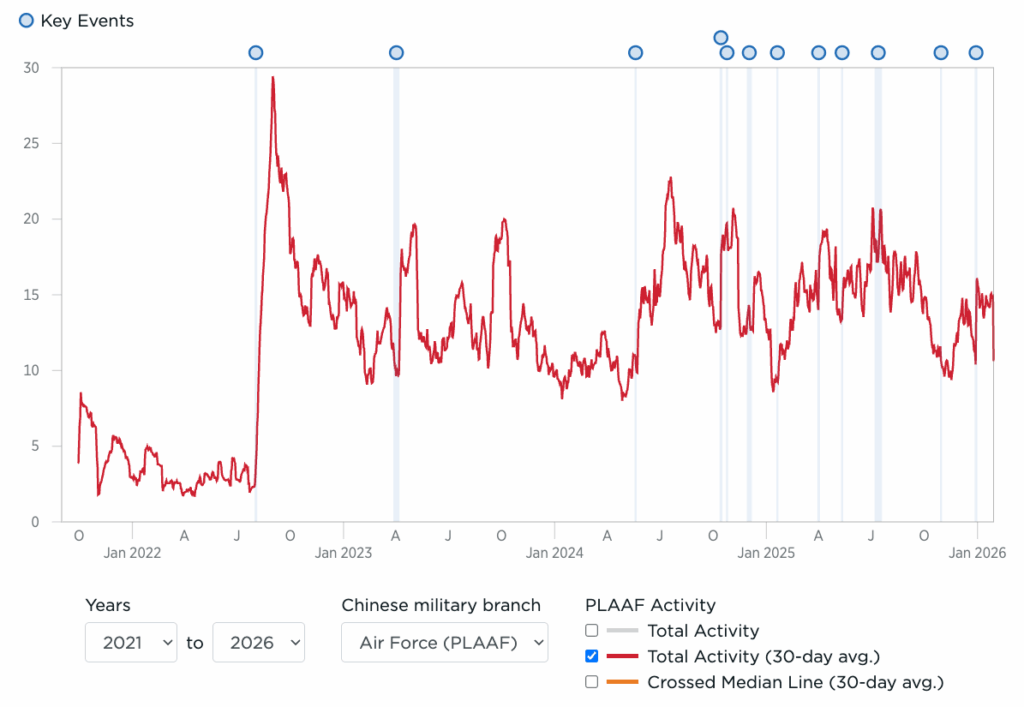
Increasingly frequent intrusions across the median line in the Taiwan Strait highlight how urgently Taiwan must be prepared for drills around the island, which could eventually be a precursor to a full-scale invasion. One of these surprise military drills, Justice Mission 2025 in December, saw a spike of PLA activity near Taiwan of up to 130 aircraft with 90 of them crossing the median line. This drill also included 17 Chinese navy ships plus significant coast guard activity in the region. At the time, this operation was not previously announced nor explicitly rationalized as a reaction to any action taken by the U.S. nor Taiwan.
As for the People’s Liberation Amy Navy, their activities have not varied significantly in recent months. Their quarterly average of ships near Taiwan has stayed within six to eight ships daily since Q3 of 2024. However, the Chinese navy is not the only maritime threat China possess.
On Dec. 25 over 2,900 Chinese fishing boats formed into an L formation stretching over 290 miles in the East China Sea. They conducted a similar operation on Jan. 11 with over 1,400 fishing boats forming into a rectangle formation spanning over 200 miles. This is not the first time Chinese fishing ships have been deployed in coordinated efforts, albeit in a much smaller scale, most often being used in small groups to obstruct maritime operations in the South China Sea.
This level of coordination represents a new challenge to Taiwan and the United States in multiple ways. China has used fishing ships to provide surveillance near foreign coastlines and to pressure other ships out of contested areas over the past few years. This new activity illustrates the capability to use massed fishing fleets to blockade or obstruct naval operations most likely in peacetime. It could just as well complicate wartime operations.
Over the next few months, there are multiple events that will affect China’s presence near Taiwan which includes the Lunar New Year and Trump’s trip to China in April–a time when the weather is optimal for military operations across the Taiwan Strait.
The 2026 Lunar New Year is a fifteen-day celebration in China that runs from Feb. 17 to March 3. In the past, the PLA activities decreased slightly during the celebration. This can be seen in 2023 when the Chinese air force average during the Lunar New Year celebration dropped to 8.9 aircraft near Taiwan daily compared to the 2023 Q1 average of 11.4 aircraft.
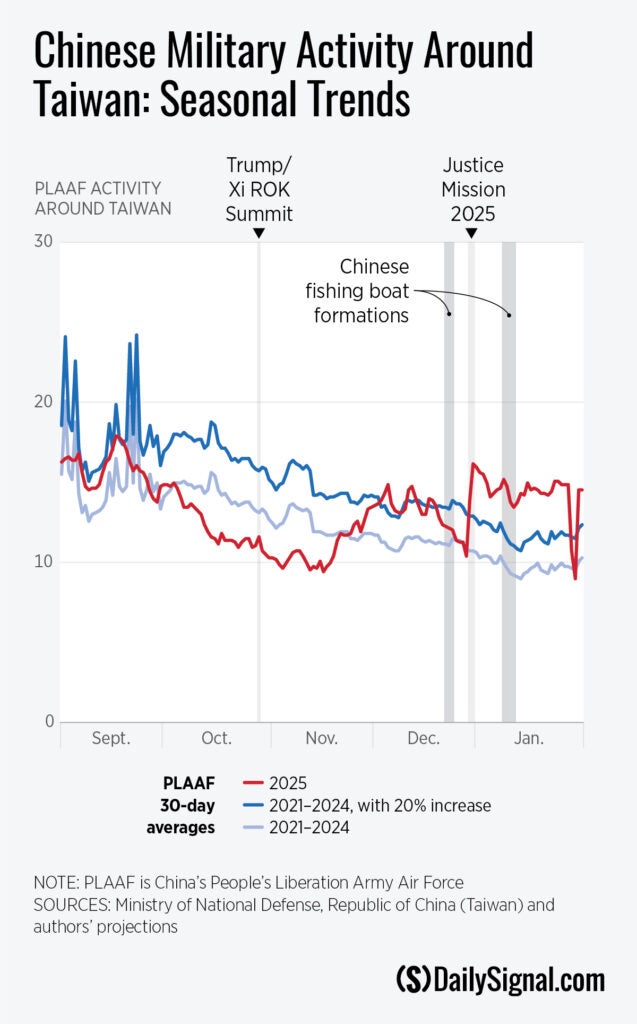
However, a decrease in activities for the holiday has not happened in the past two years as the levels of PLA activities during Lunar New Year in 2024 and 2025 stayed consistent with past levels in the first quarters of the respective years. Therefore, we expect PLA activities to remain consistent with past seasonal averages. However, this does not account for a possible reduction that could result ahead of the much-anticipated April summit.
In the past, following high-level engagements have noticeably affected China’s military activities. Notably, the sustained spike upwards in PLA activity after Speaker of the House Nancy Pelosi’s visit to Taiwan.
After her visit in August 2022, Chinese air force activities near Taiwan spiked dramatically and have remained at these higher levels since then. Before her visit the average PLA activities remained near 5 aircraft daily, but after her visit the average varied from around 10 to 20 aircraft daily. Additionally, before Pelosi’s trip, the last median line crossing by any PLA aircraft occurred in May 2022 and the grand total of such crossings between 2020 and August 2022 was 23, less than occurs in an average week in recent years.
Another key event in the growth of PLA activities around Taiwan is President Lai Ching-te’s inauguration in May 2024. After the inauguration, China conducted various military drills around the island as “punishment.”
Although Chinese air force activities returned to normal levels, the frequency of PLA aircraft crossing the median increased never returned to previous averages. In the five months after May 2024, the PLAAF averaged 11.7 aircraft crossing the median daily compared to the 3.25 aircraft daily in the five months before. Once PLA air activities rachet up, it likely remains at that level, symbolizing a new normal.
How will Trumps’ trip to China in April affect PLA activities?
After Xi met with former U.S. presidents in November 2022, 2023, and 2024, PLA activities remained standard compared to the rest of the season. However, PLA activities near Taiwan were below average for the week before and after Trump’s meeting with President Xi on Oct. 30 this past year. Yet activities returned to average levels in the following weeks, indicating this was a diplomatic gesture towards the U.S. and only a temporary reduction.
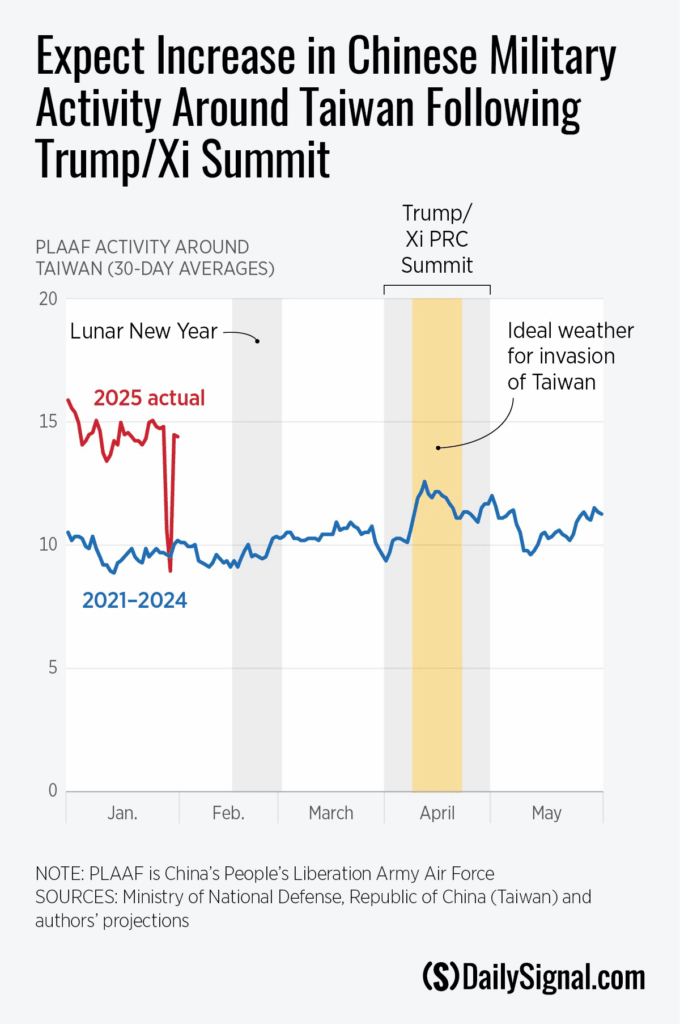
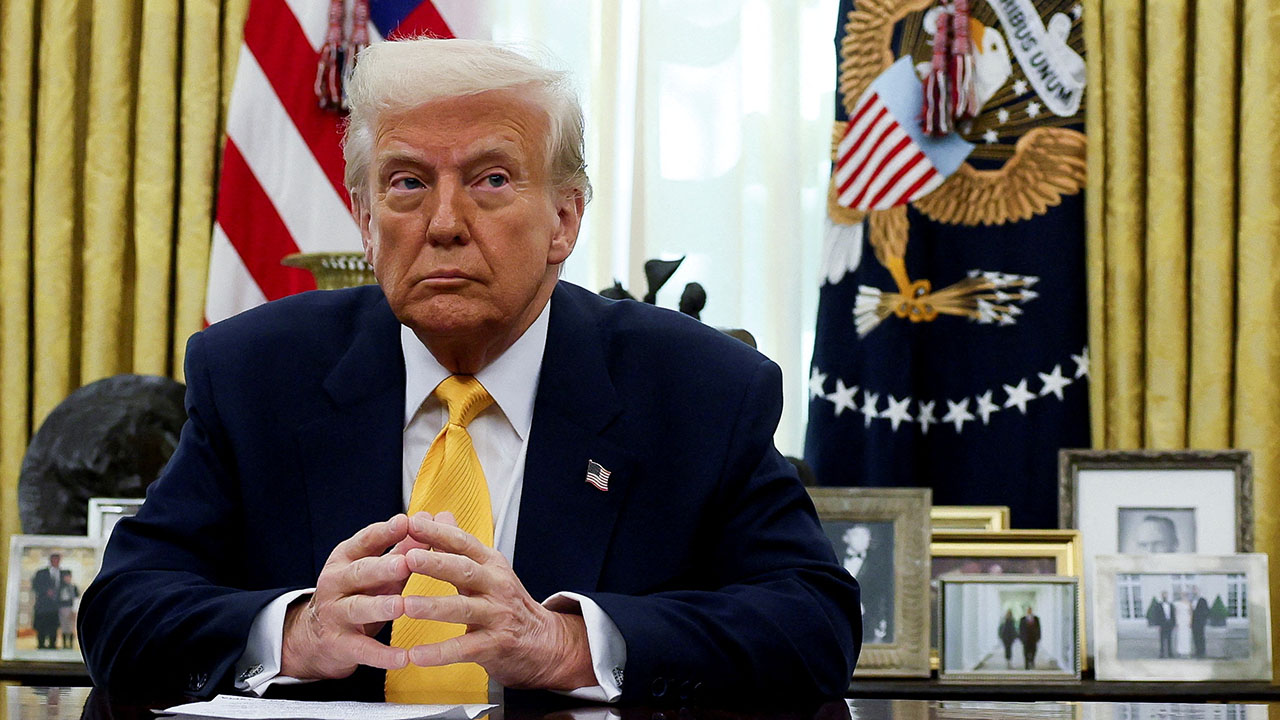
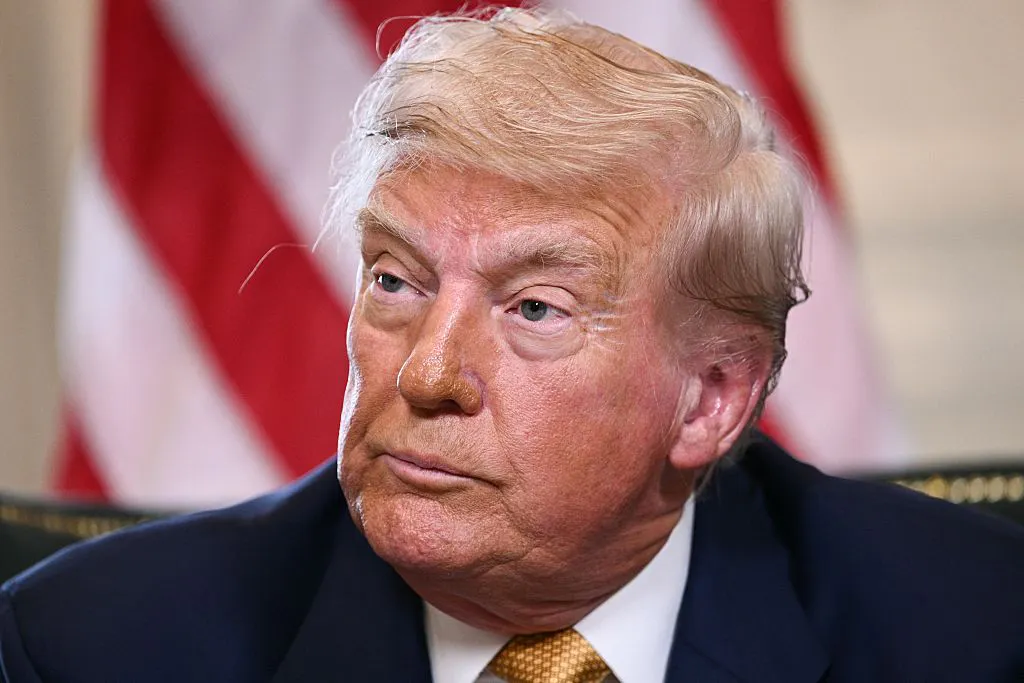
Taken together, the PLA remains likely to limit operations during the next few months in preparation for the April summit as a diplomatic gesture, especially as both Trump and Xi have spoken positively of U.S.-Sino relations ahead of the summit.
However, as seen in the past, PLA activities often spike in response to political events. Therefore, activities after April may rise above previous averages depending on the Chinese government’s view of the summit. Nevertheless, one can still expect levels to return to average after the temporary reduction for the summit.
Regardless, the U.S. and their allies must still remain vigilant as China still maintains a significant PLA activity near Taiwan. This should animate the dialogue best supported in the meantime with resolute and committed support to our partners and allies in East Asia.
For more information on PLA activities near Taiwan visit HERE.
The post What to Expect in PLA Activities Near Taiwan Leading up to Trump and Xi Summit appeared first on The Daily Signal.
What's Your Reaction?
 Like
0
Like
0
 Dislike
0
Dislike
0
 Love
0
Love
0
 Funny
0
Funny
0
 Wow
0
Wow
0
 Sad
0
Sad
0
 Angry
0
Angry
0

I am just an average American. My teen years were in the late 70s and I participated in all that that decade offered. Started working young, too young. Then I joined the Army before I graduated High School. I spent 25 years in, mostly in Infantry units. Since then I've worked in information technology positions all at small family owned companies. At this rate I'll never be a tech millionaire. When I was young I rode horses as much as I could. I do believe I should have been a cowboy. I'm getting in the saddle again by taking riding lessons and see where it goes.




















Comments (0)