

A Familiar Terrorist Foe May Be About To Enter The Iran War
Premium domains for sale
Freedom Is Back In Style
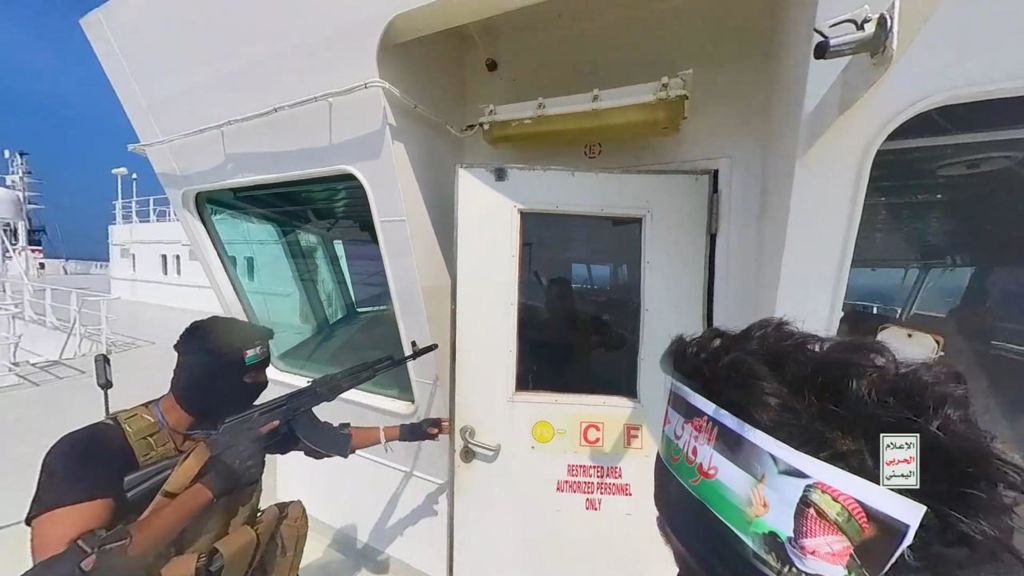
Iran-backed Houthi terrorists in Yemen have declared a maritime blockade targeting Saudi Arabian ships in the Red Sea, a move that risks pulling the group deeper into the U.S.-Iran war and further straining global energy routes.
Freedom Is Back
In Style
Premium domains for sale
As the conflict between the United States and Iran festered across the Middle East over the past five months, Yemen had largely remained a spectator. That changed Monday when the Houthis, who control a significant portion of the country including areas along the strategic Bab al-Mandab Strait, announced the blockade on Saudi vessels. The declaration comes amid rising tensions and raises the prospect of disrupted oil and gas shipments at a time when the Strait of Hormuz has already been heavily impacted.
The Houthis, a terrorist group originally from Yemen’s northern highlands, took control of the capital Sanaa over a decade ago with Iranian backing. Saudi Arabia responded in 2015 by leading a military intervention aimed at restoring the internationally recognized government, triggering a prolonged civil war. A ceasefire in 2022 largely froze the conflict into a fragile stalemate.
Tensions reignited last week after the Houthis accused Saudi Arabia of striking Sanaa’s main international airport. The dispute centered on an Iranian plane that attempted to land there following a Houthi delegation’s attendance at the funeral in Tehran for Iran’s slain supreme leader, Ayatollah Ali Khamenei. Yemen’s Saudi-backed government claimed responsibility for the airport strike, though it lacks a functional air force and depends heavily on Saudi military support. A senior Yemeni official said the plane was believed to be “carrying personnel and military dual-use equipment” from Iran.
In response, the Houthis launched an attack on Abha airport in southern Saudi Arabia, the first direct strike on Saudi soil by the group since early 2022. Houthi leader Abdul Malik al-Houthi had previously warned that all Saudi oil and energy facilities would become targets if the kingdom escalated militarily.
Analysts view the Red Sea threat as potential leverage for Iran in its confrontation with the United States. “I think the message from Iran is: Don’t assume our leverage is limited to the Strait of Hormuz. We also have an ally that can threaten the Bab al-Mandab if needed,” said Ahmed Nagi, a Yemen analyst at the International Crisis Group.
The Saudi-led coalition stated it would respond to any Houthi threats against transiting vessels “swiftly and firmly,” according to coalition spokesman Turki al-Malki. Yemen’s defense minister, Taher al-Aqili, said the army of the internationally recognized government stands ready “to end the Houthi coup,” while exiled president Rashad al-Alimi urged residents in Houthi-controlled areas to “align themselves around the state.”
The Houthis have disrupted Red Sea shipping before. During the two-year Gaza war that began in late 2023, they targeted commercial vessels with drones, missiles, and hijackings. Saudi Arabia has recently relied on Red Sea routes to export more than 3.6 million barrels of oil and related fuels a day, mostly to Asia, according to maritime data firm Kpler.
Yasir al-Rumayyan, chairman of Saudi Arabia’s state oil giant, described the ability to use Red Sea export terminals — circumventing the blocked Strait of Hormuz — as a “lifeline” for the country’s economy. A sustained Houthi blockade could impact more than 3 percent of the global oil market.
“The Red Sea is always an easy way in which they can make the world bleed,” said Farea Al-Muslimi, a research fellow at Chatham House. “The Houthis are banking on insurance costs going up and panic among the global shipping industry like what happened during the war in Gaza.”
The latest developments unfold against a backdrop of continued Iranian efforts to arm the Houthis. In July 2025, U.S. Central Command praised Yemeni National Resistance Forces, led by Gen. Tareq Saleh, for intercepting the largest seizure of Iranian advanced conventional weapons in their history, over 750 tons of munitions and hardware, including hundreds of advanced cruise, anti-ship, and anti-aircraft missiles, warheads, seekers, components, hundreds of drone engines, air defense equipment, radar systems, and communications gear. Manuals were in Farsi, and many systems came from a company affiliated with Iran’s Ministry of Defense.
At the time, CENTCOM Commander Gen. Michael Erik Kurilla called Iran “the most destabilizing actor in the region” and stressed that limiting the flow of Iranian support to the Houthis remains critical to regional security, stability, and freedom of navigation.
The Houthis have not yet detailed how they plan to enforce the blockade.
More from this network:
Domains for Sale · GOTPeople.org · TheDSAPlatform · The Truth About Socialism
What's Your Reaction?
 Like
0
Like
0
 Dislike
0
Dislike
0
 Love
0
Love
0
 Funny
0
Funny
0
 Wow
0
Wow
0
 Sad
0
Sad
0
 Angry
0
Angry
0

I am just an average American. My teen years were in the late 70s and I participated in all that that decade offered. Started working young, too young. Then I joined the Army before I graduated High School. I spent 25 years in, mostly in Infantry units. Since then I've worked in information technology positions all at small family owned companies. At this rate I'll never be a tech millionaire. When I was young I rode horses as much as I could. I do believe I should have been a cowboy. I'm getting in the saddle again by taking riding lessons and see where it goes.
Premium domains for sale

















Comments (0)