

Don’t Be Fooled by China’s Recent Months of Low Military Activity
Premium domains for sale
Freedom Is Back In Style
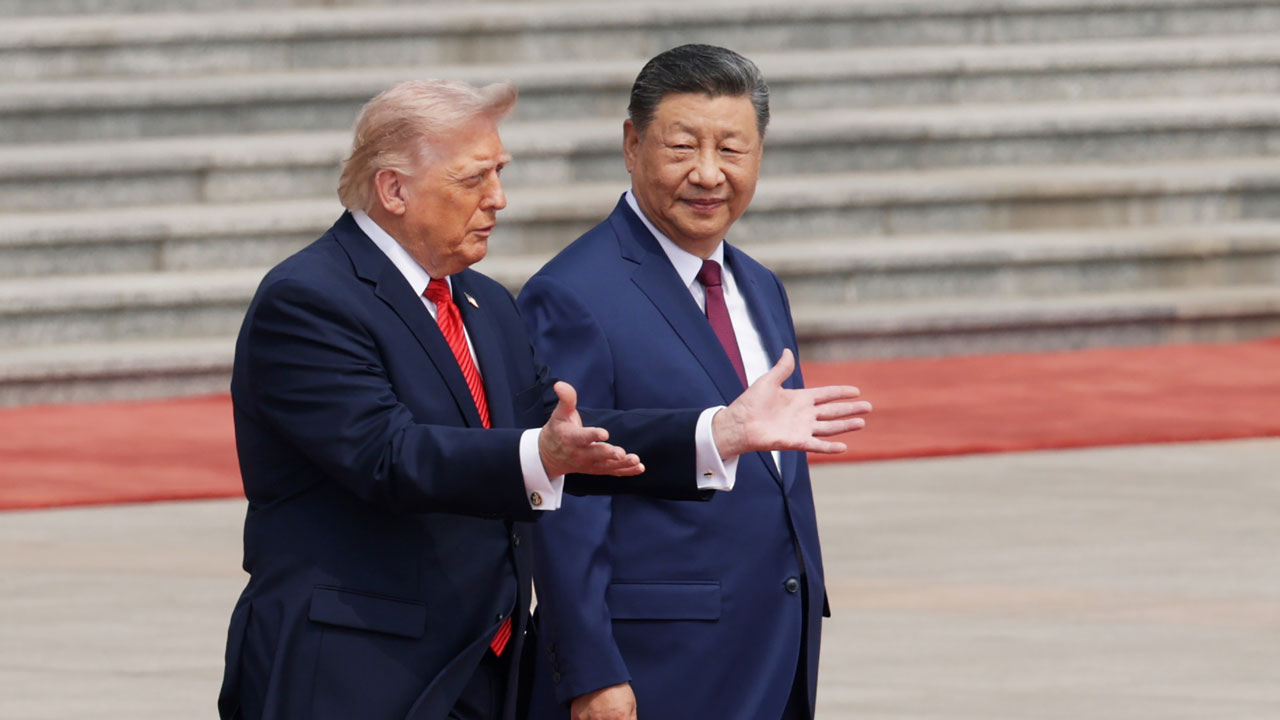
A day before the Washington meeting between Chinese leader Xi Jinping and President Donald Trump, Chinese military activity in the Taiwan Strait has been relatively subdued compared to previous years.
Freedom Is Back
In Style
Premium domains for sale
Recent restraint, however, should not be mistaken for a strategic shift.
If past patterns hold, Beijing’s respite after months of high military activity levels around Taiwan will soon return. With a series of high-level summits and public attention focused on it, Beijing may be using near-term diplomacy to preserve leverage later.
Heritage scholars have been tracking Chinese military activity around Taiwan and evolving tactics since 2021. In late July, Heritage published an opinion piece warning of increasing Chinese activity later this year. With Xi’s upcoming visit to the White House happening on Sept. 24, the question is: What is China’s next move?
The Past as a Reference for the Future
While overall activity in the Taiwan Strait is much lower than in previous years, several activity spikes have occurred since the July article.
In the four days leading up to Aug. 1, the anniversary of the founding of the Chinese armed forces (PLA Day), PLAAF activity climbed from one sortie to twenty-seven sorties a day. This closely follows past trends in which the eve of People’s Liberation Army Day saw spikes
in PLAAF and PLAN activity, along with sorties crossing the median line.
A week later, Taiwan conducted its yearly Han Kuang live-fire military exercises from Aug. 5 through Aug. 14. It was the 42nd iteration of this exercise designed to test the island’s readiness for a potential PLA invasion. Observed PLA activity showed PLAAF sorties rising above twenty in the initial stage, easing briefly, and then increasing again to above-average levels during the closing stages.
Another spike in activity occurred between Aug.18 and 19, with twenty PLAAF sorties, including fifteen that crossed the median line. This activity by the PLA may be in response to an Aug. 18 incident between the Coast Guards of China and Taiwan, in the restricted waters around Taiwan’s Dongsha Island.
From Sept. 16 through Sept. 19, reports showed a substantial increase in PLA sorties, averaging more than twenty per day during that period. This was likely a response to Taiwan conducting missile, drone, HIMARS, and other military tests as part of a China-focused anti-invasion drill. This comes amid recent U.S.-Philippine cooperation on integrating BrahMos anti-ship missiles, drone targeting networks, and coastal defense operations in northern Luzon.
Recent tensions in the South China Sea have continued despite the reduced military activity around Taiwan. After Philippine Defense Minister Gilberto Teodoro Jr. criticized China’s South China Sea claims, Beijing accused Manila of “stirring up trouble.” That exchange followed a July incident in which the Philippine military accused China’s coast guard of injuring a Filipino sailor at a South China Sea shoal.
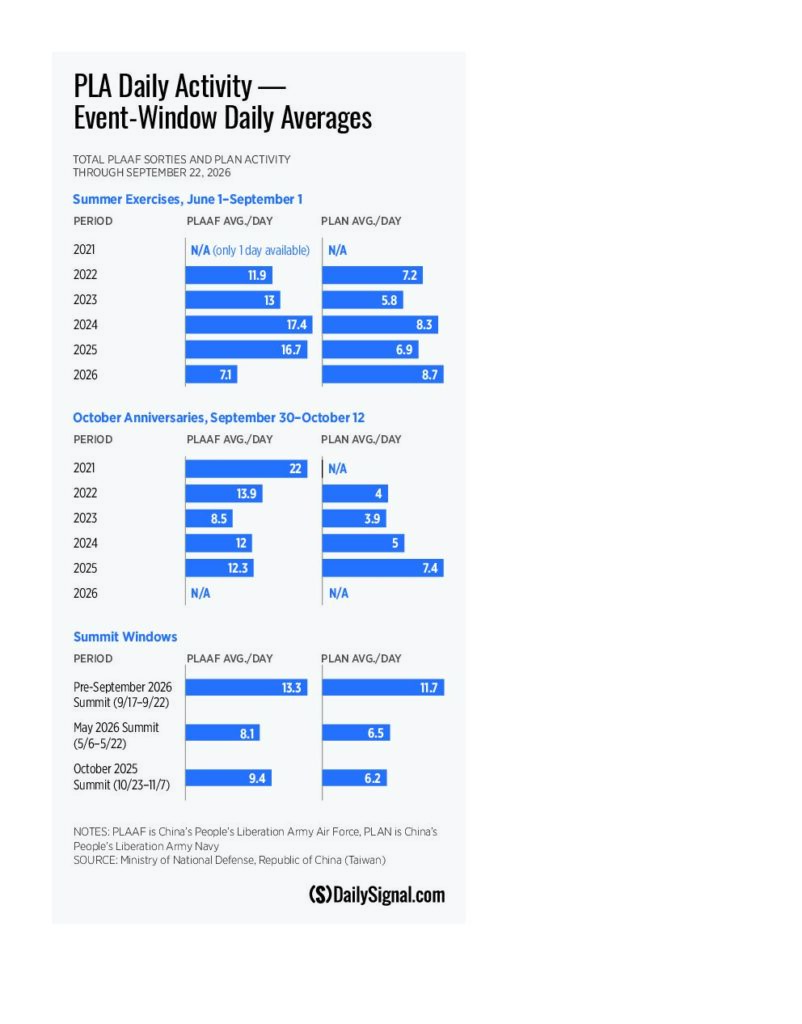
While spikes in PLA activity show that China remains active, analysis shows that overall PLAAF and PLAN activity in the strait remains historically low. Compared to a year ago this week, the 10-day average of PLAAF activity is down by almost 40%. While spikes of activity are still occurring, these spikes are down from previous highs, and the data shows a broad decrease in overall PLA activity.
What Could Be Causing the Decrease?
The decline in PLA activity is likely the result of several factors. Improving U.S.-China relations ahead of the Sept. 24 Trump-Xi meeting has likely contributed, as ongoing discussions over trade and tariffs have encouraged dialogue over escalation. At the same time, shifting regional tensions and evolving tactical decisions may be drawing attention away from the Taiwan Strait.
For instance, earlier this year Japan and the Philippines launched negotiations to delimit their overlapping maritime boundaries east of Taiwan. China strongly opposed the talks and responded by launching coast guard and maritime law-enforcement patrols into waters east of Taiwan and the Philippine Sea.
According to an August report by Allen Zhang of Heritage’s Asian Studies Center, Beijing is also increasingly relying on research vessels operating under civilian scientific missions to collect data on underwater terrain, cables, and other militarily strategic features around Taiwan.
China has also sought to strengthen military ties with countries including Indonesia and Russia. Recent exercises between PLA and Indonesian warships conducted east of Taiwan demonstrate China’s desire to display military force while strengthening partnerships with other Asian nations.
Likewise, China conducted the Joint Sea-2026 naval exercise with Russia near Qingdao, after which participating forces reportedly carried out joint Pacific patrols. This activity suggests Beijing is using combined exercises to signal that pressure around Taiwan is part of a broader Indo-Pacific strategy.
China is not the only country reducing its presence in the Taiwan Strait. In a separate piece by Zhang, he warns that U.S. naval transits through the Strait have declined by fifty percent during President Trump’s second term compared to his first. He argues that a reduced American presence could create the perception in Beijing that U.S. commitment is weakening.
Looking Forward
If the Trump-Xi summit produces positive outcomes, PLA activity could stabilize or decline further as both countries seek areas of cooperation and attempt to manage tensions in the South and East China Seas. This may prove an overly rosy possibility given years of antagonism at sea. Conversely, a less favorable outcome could contribute to renewed friction between China and the United States, potentially leading Beijing to increase military pressure around Taiwan and drive PLA activity toward levels seen in previous years.
With a wide range of issues expected to be discussed, including artificial intelligence, trade, and regional security, it remains unclear what specific agreements or understandings may emerge regarding Taiwan. While Beijing is unlikely to soften its position on the Taiwan question, it may seek to use the issue of its reduced military presence as leverage in negotiations to secure broader guarantees or concessions from Washington.
Lower Activity Does Not Equal Lower Risk
The upcoming summit may be shaping Beijing’s timing more than its intentions. If Chinese leaders believe restraint strengthens their diplomatic hand, PLAN and PLAAF activity may remain relatively subdued around Taiwan but increase elsewhere as seen in the Philippine Sea this year. If the summit disappoints Beijing, the Taiwan Strait could once again become a convenient arena for signaling resolve and displeasure with the U.S.
All told, Beijing tends to celebrate significant anniversary dates with military demonstrations. Looking to the future, two dates are important to keep in mind: Oct. 1 (PRC Founding Day) and Oct. 10 (Taiwan’s National Day). Both have historically coincided with spikes in PLA activity. For instance, in 2024, 153 sorties were flown on Oct. 14 in direct response to remarks made just a few days earlier by President William Lai Ching-te on Taiwan’s National Day.
More from this network:
Domains for Sale · GOTPeople.org · TheDSAPlatform · The Truth About Socialism
What's Your Reaction?
 Like
0
Like
0
 Dislike
0
Dislike
0
 Love
0
Love
0
 Funny
0
Funny
0
 Wow
0
Wow
0
 Sad
0
Sad
0
 Angry
0
Angry
0

I am just an average American. My teen years were in the late 70s and I participated in all that that decade offered. Started working young, too young. Then I joined the Army before I graduated High School. I spent 25 years in, mostly in Infantry units. Since then I've worked in information technology positions all at small family owned companies. At this rate I'll never be a tech millionaire. When I was young I rode horses as much as I could. I do believe I should have been a cowboy. I'm getting in the saddle again by taking riding lessons and see where it goes.
Premium domains for sale


















Comments (0)