

Five Movies To Watch After ‘Confession’
Premium domains for sale
Freedom Is Back In Style
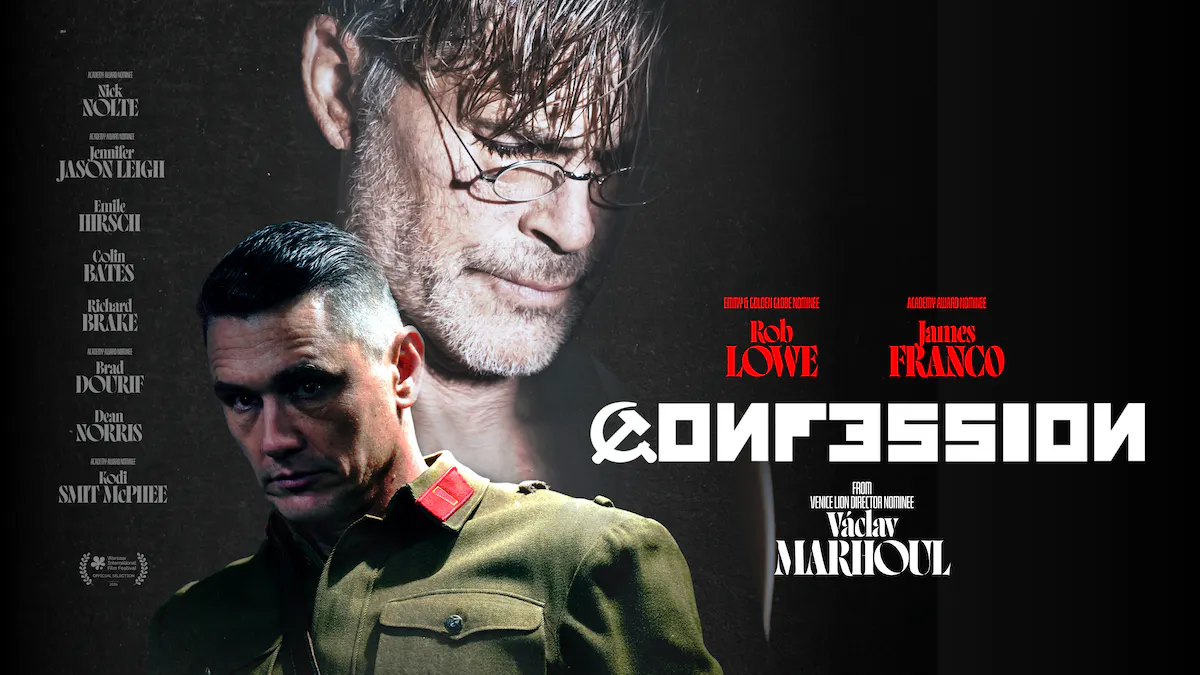
With The Daily Wire’s new movie “Confession” recently released, I couldn’t help but think of other movies that depict life in the Soviet Union. Some films are about the government leaders responsible for some truly monstrous actions, while others focus on the citizens whose lives were made miserable by them. Some are pitch-black comedies, and others are hard-bitten dramas.
Freedom Is Back
In Style
Premium domains for sale
No matter the genre or the specific focus, these films have one thing in common. They all feature an unfeeling, monolithic state so obsessed with maintaining power that it loses all perspective on itself. These movies, all made after the fall of the Soviet Union, are able to look back, clear-eyed, at what we now know was an inevitable decline and ultimate crumbling.
It could be easy to look at these films as a sort of victory lap, celebrating the vanquishing of “the evil empire” and the triumph of Western values. I prefer to look at them as cautionary tales about what can happen when a government becomes more invested in its own prosperity than that of its citizens. Former President Ronald Reagan famously said freedom is never more than a generation away from extinction, and these films can help us to stay vigilant against the perpetual growth and increasing unaccountability of our own government, no matter who is in power.
On that cheerful note, let’s get started!
“Bridge of Spies”
While some people might scoff at Steven Spielberg’s left-leaning perspective, there is no doubt in my mind that he treasures his country and the freedoms it affords its people. This is certainly made clear in the 2015 film “Bridge of Spies,” which features Tom Hanks as an insurance lawyer recruited to negotiate the trade of an American pilot for a Russian spy. This takes him to East Berlin, where living conditions are terrible and his Soviet counterparts seem resentful of having to deal with an American. Over the course of the film, Hanks becomes friendly with the Russian spy (played by Mark Rylance, in a droll Oscar-winning performance), and comes to understand that individuals have a lot in common, even if their governments certainly do not. By the end of the film, the prisoners are exchanged and we are left to wonder if the Soviet military cares at all about its recovered spy, or if it will just execute him for being compromised. Soon after, Hanks returns to America and marvels at our way of life, which encourages individual freedom over a cold, oppressive state.
“Mr. Jones”
While there was plenty of violence against Russian citizens by their own government, not every death was quite so expedient. Officials had no qualms about stealing from their less-populated farming regions to better support their cities, leading to the Holodomor, a completely man-made famine in Ukraine that resulted in the slow deaths of millions of people, usually by starvation, in the 1930s. Journalist Gareth Jones, curious about the perceived luxury of Soviet Russia, travels to Moscow and gets wind of something terrible happening in Ukraine’s rural areas. He travels there and discovers that the government has confiscated every last bit of food, forcing the people to eat grass and tree bark (and even the bodies of the dead, as depicted in one of the film’s more harrowing moments).
Jones attempts to report this back to England and the United States, but is publicly contradicted by Walter Duranty, a respected New York Times reporter living in Moscow. Having received a Pulitzer Prize for his coverage of Stalin’s Five-Year Plan, Duranty actively worked to cover up the famine, assuring those out west that the Soviet Union was, in fact, a thriving country that they would be wise to emulate. Jones continues to assert the truth, leading to a mysterious death. Meanwhile, even after the discovery of Duranty’s blatant lies about the intentional mass death orchestrated by the Soviet government, his Pulitzer is not yet revoked. This makes “Mr. Jones” a particularly infuriating film about the Soviet Union’s reliance on positive perception, and those “useful idiots” in the West who are all too willing to help with that.
“Citizen X”
An HBO original film from the 1990s, “Citizen X” may not have the cinematic flourishes of some of these other movies, but that might actually work in its favor. The film is a straightforward depiction of the hunt for a savage serial killer who specifically targets children and teenagers in the Soviet Union in the 1970s and ’80s. The detective in charge of the investigation is dogged in his pursuit, but is perpetually delayed, if not completely blocked, by a committee of government officials more interested in preserving Russia’s reputation than in actually catching the killer. At every turn, the detective is stymied by the more stubborn members of the committee, who, at one point, state that it can’t possibly be a serial killer, as that is exclusively a “decadent western phenomenon.” As the murders continue, the search slowly goes on, until they find an actual viable suspect, who is soon released because he is a member of the Communist Party in good standing. As we watch this unfold, we are incredulous that the committee would put the reputation of the party above the lives of innocent children. But, as with “Mr. Jones,” the film reminds us that individuals (even children) can and will be sacrificed by a communist government to preserve its image.
“The Death of Stalin”
It’s pretty rare for a comedy to have a body count quite as high as Armando Iannucci’s “The Death of Stalin.” The highest probably belongs to Stanley Kubrick’s “Dr. Strangelove,” a film from which Iannucci clearly drew inspiration. Starting with Joseph Stalin’s death, this film depicts the frantic attempts by his cronies to take his place. As these men turn armies against each other and the public, the film begins to feel much more like a farce than a legitimate historical account, which makes everything even more horrifying, as we realize that most of these events are based in truth. It is the histrionic behavior, the constant creative use of profanity, and a literal scramble to build alliances that set this film apart from other depictions of the insane Soviet leadership. Watching these men behave like children is often hilarious, but it comes with the very real knowledge that their impulsive, neurotic actions have extreme consequences, not the least of which is the slaughter of millions of innocent civilians. In many ways, the fact that “The Death of Stalin” is a madcap comedy makes it the bleakest film on this list.
“Chernobyl”
This one is a bit of a cheat, because it is a miniseries, but I consider it a vital addition to this conversation. So far, the films have been from the perspective of state officials, police officers, reporters, and others who can really only see the horrible consequences of the Soviet government’s actions from the outside. And while this miniseries certainly does that, we are also able to see the terrible results of the Chernobyl meltdown from the points of view of those most directly affected by it. Certainly, we see plenty of the self-preserving bureaucracy getting in the way of any actual solution, and we also get to see the spirit and genuine camaraderie of regular, working-class people, who were more than willing to sacrifice themselves for the good of their fellow man. It is both a sobering and vaguely inspiring portrait of the biggest nuclear disaster in history.
It can be easy to look at the Soviet Union as one massive destructive entity, but these films work as a good reminder that there is a big difference between the people in charge and those who have to live with (and die with) the horrendous consequences of their actions. And that communism isn’t just some wrongheaded theory that exists in a vacuum, but an untenable philosophy that, when put into practice, does the most harm to those whom it claims to care about.
***
Tyler Smith is a professional film critic, college professor, and documentarian. His latest endeavor is being sole curator for the new streaming service Jitters.
This article is part of Upstream, The Daily Wire’s new home for culture and lifestyle. Real human insight and human stories — from our featured writers to you.
More from this network:
Domains for Sale · GOTPeople.org · TheDSAPlatform · The Truth About Socialism
What's Your Reaction?
 Like
0
 Dislike
0
 Love
0
 Funny
0
 Wow
0
 Sad
0
 Angry
0

I am just an average American. My teen years were in the late 70s and I participated in all that that decade offered. Started working young, too young. Then I joined the Army before I graduated High School. I spent 25 years in, mostly in Infantry units. Since then I've worked in information technology positions all at small family owned companies. At this rate I'll never be a tech millionaire. When I was young I rode horses as much as I could. I do believe I should have been a cowboy. I'm getting in the saddle again by taking riding lessons and see where it goes.
Premium domains for sale
























Comments (0)