

Georgia Election Vendors Boast of Equipment as Lawmakers Prepare to Issue Report
Premium domains for sale
Freedom Is Back In Style
Summary
Freedom Is Back
In Style
Premium domains for sale
- Georgia’s Joint Election Equipment Specifications and Standards Committee met with two more vendors aiming to inform the state’s new election system.
- Tenex Software Solutions stressed its ePollbook and how it works with hand-marked paper ballots, while Democracy Live and Hewlett-Packard pitched their “tabulation-neutral ballot marking and ballot-on-demand device.”
- Committee members stressed the goal is for elections to be “totally secure and totally safe.”
ATLANTA-The Joint Election Equipment Specifications and Standards Committee held its sixth meeting at the State Capitol on Thursday morning, hearing from two vendors who made their pitches as to why their recommendations should be considered in the state’s next voting system.
The committee is made up of two co-chairs, state Sen. Max Burns, R-Sylvania, and state Rep. Victor Anderson, R-Cornelia, in addition to other experts.
Following state Sen. Rick Williams’ prayer, Burns spoke about the historic voter turnout the state has seen during the period of early voting that has been ongoing in the Peach State.
Burns said, “We’ve had wonderful, record, early voting turnout. I want to encourage all Georgian voters, today, tomorrow, or Tuesday the 3rd, please cast your ballot. The state will be better for it.”
Tenex Software Sets Itself Apart
Florida-based Tenex Software Solutions was the first vendor to present. Ravi Kallem, president of the company, spoke as to what sets it apart in the voting industry.
“We don’t do any hardware, in general,” he said. “We are more into voter check-in, voter experience, along with voter registration and some of the other tooling that offices at the county level and the state levels need.”
Deployed across 25 states and catering to over 60 million voters, Kallem keenly sought to win over the committee members with the company’s “precinct central ePollbook.”
Ashley Raja, chief operating officer for Tenex, dove into the logistics of the ePollbook and the company’s desire for how the technology operates, saying, “We really focus on the technology being resilient, being capable of supporting larger jurisdictions, like the state of Georgia.”
One feature setting the company apart in the industry is how its system works with hand-marked paper ballots. After the ballot is printed, the voter hand-marks their ballot, and from there, the ballot is logged and can be audited.
The conversation shifted when Kallem spoke about the cybersecurity aspect of the company’s software, saying, “That is something that’s built into the product from day one.”
Later, Brandon Johnson, director of client services, highlighted that the company’s iPad “device is accessible by design” with “readable fonts, buttons, built-in assistive tools, [and] assistance process.”
As far as the lifetime of the technology goes, Johnson added that “most devices handle two presidential election cycles, so those eight years.”
Following the company’s presentation, state Sen. Bo Hatchett asked about “the security of [the vendor’s] poll book,” noting that there are various concerns when it comes to election integrity, such as double voting and verifying that the people who check in “are actually who they say they are.”
Kallem replied by noting the company uniquely makes “the data available for general review,” making the voting record available to voters in an “auditable kind of format.”
Hatchett continued quizzing the vendor, asking about “what recommendations [the committee] can put in place that would assure someone who has access to a poll book cannot start printing ballots for voters and casting ballots.”
Raja replied by stating that “every action on the poll book is logged. We have a whole log file that keeps track of every voter that was looked up, and how they were looked up.”
Democracy Live and Hewlett-Packard Boast of Their Equipment
Bryan Finney, founder and CEO of Democracy Live, opened his presentation by boasting of the “combination between Hewlett-Packard and Democracy Live bringing the first in the nation ballot-marking device, which is a tabulation-neutral ballot marking and ballot-on-demand device.”
“This separation,” he said, “between the tabulation and the ballot marking and the ballot-on-demand is inherently a security benefit, backed by the NIST security protocols as well.”
He added, “It provides you the autonomy and the independence to really pick what’s best for you, while maintaining the security of separation of vendors. That’s inherently a security benefit.”
Finney also noted an important distinction, saying, “because this is a standalone tabulation-neutral ballot marking device, is does not tabulate. Therefore, [the vendor] cannot go to the [Election Assistance Commission] and be EAC certified directly as a tabulation system because we’re not a tabulation system.”
He spoke about the security of the vendor’s software, saying, “The software itself is the most tested technology in U.S. elections.”
Nelson Gomez from Hewlett-Packard spoke about the life cycle of the technology, saying, “We’re proposing with the solution that they have a 10-year life cycle.”
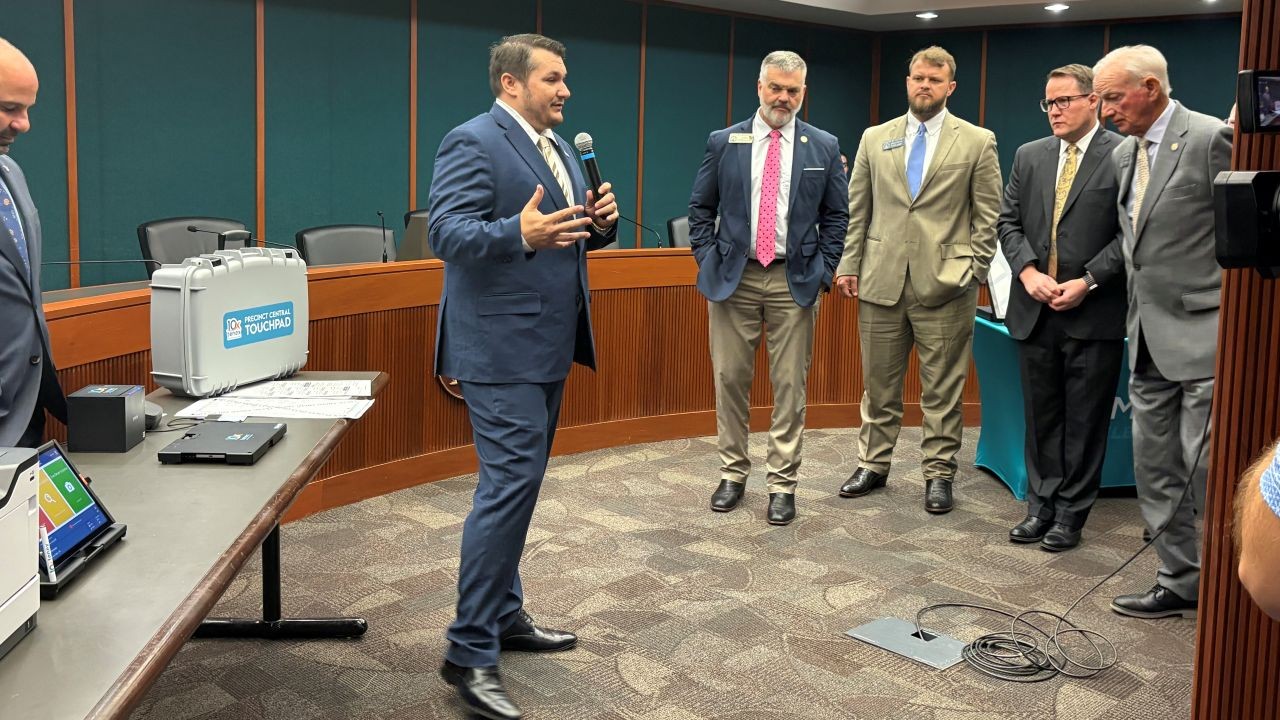
Following the companies’ presentations, the vendors explained their equipment practically through demonstrations to the committee, followed by public comment.
Lawmakers Comment on Purpose of Committee, Shared Goal With Public
Burns commented on the heated public comment that occurred during the meeting, saying, “Those who are strong advocates, passionate advocates about hand-marked paper ballots, they rightfully so want to communicate that.”
But ultimately, as Burns added, “This committee’s not a policy committee that relates to whether or not we should have hand-marked ballots versus machine ballots. It’s about standards and specifications for equipment.”
At the end of the day, as Burns said, the committee and those who urged the committee to switch to hand-marked paper ballots “want the same thing. We want a strong election system that is totally secure and totally safe.”
Moving forward, the committee’s decision will come down to “whether or not they can offer Georgia what [the committee] feel[s] Georgia needs over the next decade,” Burns said.
A report from the committee is expected by Jan. 31, 2027.
More from this network:
Domains for Sale · GOTPeople.org · TheDSAPlatform · The Truth About Socialism
What's Your Reaction?
 Like
0
 Dislike
0
 Love
0
 Funny
0
 Wow
0
 Sad
0
 Angry
0

I am just an average American. My teen years were in the late 70s and I participated in all that that decade offered. Started working young, too young. Then I joined the Army before I graduated High School. I spent 25 years in, mostly in Infantry units. Since then I've worked in information technology positions all at small family owned companies. At this rate I'll never be a tech millionaire. When I was young I rode horses as much as I could. I do believe I should have been a cowboy. I'm getting in the saddle again by taking riding lessons and see where it goes.
Premium domains for sale






















Comments (0)