

Hollywood’s Liberal Darling Just Ruined His Own Masterpiece
Premium domains for sale
Freedom Is Back In Style
“Hamlet Returns.” “Gatsby II: Carraway’s Revenge.” “Casablanca: The Vichy Years.”
Freedom Is Back
In Style
Premium domains for sale
It’s funny to think of classics having sequels, partially because the “Fast and Furious” franchise made sequel titling conventions meme-able, but also because there’s something inherently laughable about touching perfection.
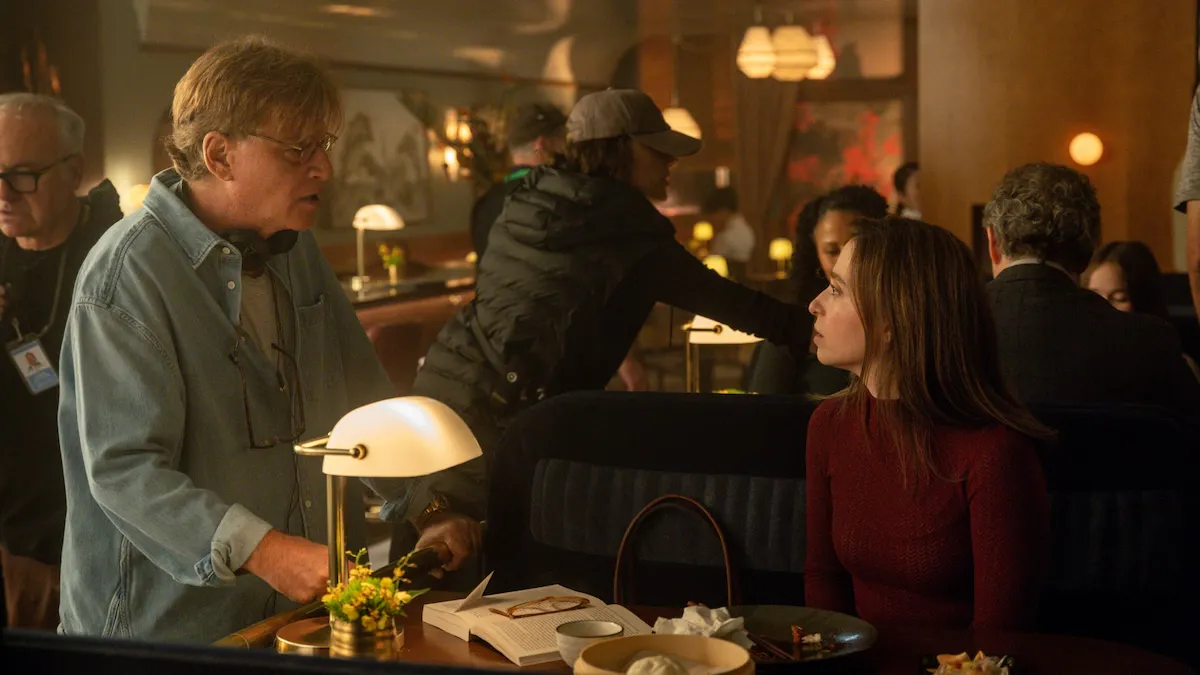
In a just world, “The Social Reckoning” would rank among those titles. Unfortunately, in this world it is an all-too-real sequel to Aaron Sorkin and David Fincher’s 2010 masterpiece, “The Social Network.” That film is a brilliant meditation on what makes us human. Its successor is a two-hour dramatization of a Slate podcast.
“The Social Reckoning” picks up a decade after “The Social Network” left off. Mark Zuckerberg (Jeremy Strong) is now running a tech empire, preparing for congressional testimony, surrounded by consultants who are trying to make him seem human. But scenes with Zuckerberg are few and far between, with the film largely focusing on Facebook whistleblower Frances Haugen (Mikey Madison) and her efforts to expose her company’s secrets with the help of Wall Street Journal reporter Jeff Horwitz (Jeremy Allen White).
We don’t need to dwell on the plot; the film is mostly a beat-for-beat staging of Horwitz’s 2021 stories, though it adds a Zuckerberg testimony that, in real life, happened months before. This actual news cycle dominated headlines recently enough for everyone to remember the details. At Zuckerberg’s instruction, Facebook’s algorithm began weighting reshares and emoji reactions more than likes. This incentivized people to post inflammatory content and caused that content to spread widely, a vicious cycle that Haugen and others felt posed a threat to American democracy.
The more shocking parts of the Journal’s “Facebook Files” dealt with how the company knowingly ignored the deleterious effects of Instagram on kids, specifically young girls, who joined the platform for friendship and instead found bullying, untoward sexual advances, and in some cases human trafficking. But that’s more or less glossed over in the film, condensed to the essentials to make room for montages of the Jan. 6 riots.
It’s not at all surprising that Aaron Sorkin, the high priest of American liberalism, made a movie critical of social media polarization and Jan. 6. Nor would it be shocking if the movie were preachy; after all, that’s Sorkin’s hallmark. But “The Social Reckoning” isn’t preachy in Sorkin’s usual way. There are no grand ideas or sweeping monologues about human greatness. The banter-filled walk-and-talks that defined “The West Wing” are replaced by technocratic patter. The point is not to make a point, but to convey a lot of information in such a way that the audience will all come to the same conclusion. The whole thing feels small.
And that’s the problem. Sorkin works best when he goes big, when he swings for the fences. The swelling speech, the brilliant debate, the perfect needle drop. The man knows drama and understands the importance of gravitas, a topic upon which his characters frequently opine. But for some reason, “The Social Reckoning” shows no real trace of what makes Sorkin Sorkin.
This is partially an instance of Sorkin’s Achilles’ heel: The more he tries to capture reality, the more likely he is to fail. “The West Wing” works largely because it is a drama. Realistic, yes, and occasionally accurate, but a drama nonetheless, with fictitious countries and characters that advance the plot.
Compare this with “The Newsroom,” the flawed HBO series in which Sorkin built a fictional cable show in the very real world of America in the early 2010s. Even Sorkin admits that his reliance on real events “was a pebble in my shoe” that prevented him from ever “put[ting] a good episode together of the show.”
Similarly, “The Social Network” is unabashedly cinematic. What is on paper a story about two civil lawsuits becomes, in Sorkin’s hands, a timeless tale of class and ambition. Jesse Eisenberg’s Zuckerberg is a striving outsider so desperate to join the upper echelons of society that, after being repeatedly denied entry to this higher stratum, he creates an entirely new upper class and rockets to its peak. That even this fails to satisfy him — the film famously ends on a shot of Zuckerberg, alone, refreshing the pending friend request of the ex-girlfriend whose rejection inspired him to launch Facebook in the first place — shows that Mark is human, all too human.
In “The Social Reckoning,” Jeremy Strong gives us the common caricature of Zuckerberg, the ruthless automaton uninterested in other people and singularly focused on success. One of the things that made “The Social Network” so profound is that it shattered this image of Zuckerberg. But Mark Zuckerberg can’t have depth for “The Social Reckoning” to work. He must be this frigid titan, willing to sacrifice kids and democracy and everything in between rather than lose even one Facebook user. And so Sorkin completely negates his first film, discarding one of the great characters of 21st-century cinema in favor of a cheap political prop.
The problem isn’t that Sorkin doesn’t give Zuckerberg a fair shake, but that this doesn’t make for a good movie. In “The Social Reckoning,” the heroes and villains are clear, as are their motivations: Zuckerberg is wrong because he only cares about money; Haugen and Horwitz are good because they care about the truth.
In “The Social Network,” the heroes and villains are just as clear, but their motivations and characters are tantalizingly ambiguous. Mark is both sympathetic and pathetic, a man wreaking havoc and a boy begging for attention. Tyler and Cameron Winklevoss (both played by Armie Hammer) have clearly been wronged by Mark, but they’re so arrogant it almost seems like they had it coming.
And then there’s Facebook co-founder Eduardo Saverin, played to perfection by Andrew Garfield. In the film’s best scene, Eduardo confronts Mark for diluting his shares and pushing him out of the company.
“You set me up,” Eduardo says, clearly wounded by his best friend’s betrayal.
“You’re gonna blame me because you were the business head of the company and you made a bad business deal with your own company?” Mark retorts with a condescension both biting and borrowed, as if he were trying on his father’s Hèrmes tie.
It’s an incredible moment, not just for the drama — the betrayal, the reveal, the stakes — but because, for a brief moment, you can see on Eduardo’s face that he realizes Mark is a little bit right. And we, the audience, realize it, too. Which makes it all the more heartbreaking to perceive: friendship became business, trust gave way to transaction, and everyone got hurt while the company succeeded.
There is not a single moment in “The Social Reckoning’s” two-hour run that approaches anything close to that scene, or any of the similarly great scenes that comprise “The Social Network,” one of the most beautifully written, shot, and scored films of all time. It’s a pity, too, because Madison and White are two of our finest working actors. It would have been a joy to watch them sink their teeth into a proper Sorkin script, rather than this warmed-over NPR fanfic.
“The Social Reckoning” has been called a “stand-alone sequel” to “The Social Network.” It’s an absurd, contradictory phrase — but one that makes sense once you’ve seen the film. If I were Sorkin, I wouldn’t want anyone comparing this ordinary historical drama with my magnum opus. That’s fair enough. But you need not have seen “The Social Network” to realize “The Social Reckoning” is a bad film. That much is self-evident; the comparison merely adds insult to injury.
***
This article is part of Upstream, The Daily Wire’s new home for culture and lifestyle. Real human insight and human stories — from our featured writers to you.
More from this network:
Domains for Sale · GOTPeople.org · TheDSAPlatform · The Truth About Socialism
What's Your Reaction?
 Like
0
Like
0
 Dislike
0
Dislike
0
 Love
0
Love
0
 Funny
0
Funny
0
 Wow
0
Wow
0
 Sad
0
Sad
0
 Angry
0
Angry
0

I am just an average American. My teen years were in the late 70s and I participated in all that that decade offered. Started working young, too young. Then I joined the Army before I graduated High School. I spent 25 years in, mostly in Infantry units. Since then I've worked in information technology positions all at small family owned companies. At this rate I'll never be a tech millionaire. When I was young I rode horses as much as I could. I do believe I should have been a cowboy. I'm getting in the saddle again by taking riding lessons and see where it goes.
Premium domains for sale









Comments (0)