

How Jumbotron Killed The Stadium Star
Premium domains for sale
Freedom Is Back In Style
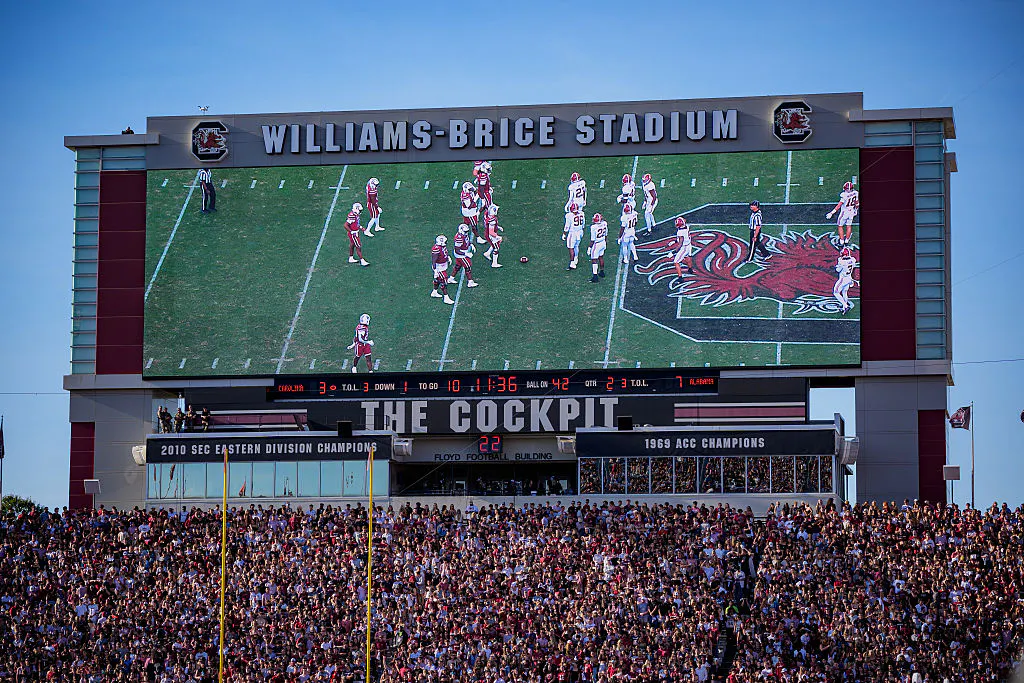
If you’ve been to a sporting event at a stadium, you’ve probably caught yourself drifting out of the moment. It’s not that you’re consumed with the attractive women in attendance or that you indulged a little too heavily in adult beverages. It’s not even that you’re distracted by the screen in your pocket, though you are distracted by a screen. The game is happening in real time on the field in front of you, but you aren’t looking in that direction. Instead, you’re looking at the jumbotron.
Freedom Is Back
In Style
Premium domains for sale
The Buffalo Bills have taken an innovative step towards resolving this problem — installing extremely small screens at Highmark Stadium, the team’s newly completed home. Did they pair this with a plethora of obstructed views? Yes, of course they did. Great job, fellas! You just made the case for even bigger screens, even though your current approach, minus the seats that don’t allow attendees to watch the game, is actually the way forward.
Developed in the 1980s with Mitsubishi and Sony each claiming credit for its invention, the first commercial installation of a giant screen was in 1986 at HemisFair Arena, then home of the San Antonio Spurs. That particular technological monument to eye-scorching, gargantuan surplusage was a Sony, and the product, before the name faced genericide, was known as the JumboTron. The original purpose was laudable. It was a way to make sure everyone could see the scoreboard.
Even the later, secondary use — showing instant replays — was fine, though home crowds are not usually swayed by visible evidence that the refs got the call right. But then invention became the mother of necessity, and these giant and expensive screens took on other roles.
There is the “kiss cam,” also available at concerts for those looking to throw the scarlet letter on two people who are separated from their spouses. That’s not the only kiss cam disaster. There are also proposals which can go very wrong. There are proposals that go very, very wrong. And even though they can eventually capture sweet and successful moments, there is still the fact that the kiss cam itself still invites failure.
It’s not just kissing and proposals that set audience members up for embarrassment. There is also the dancing, which can lead to things like falling down the stairs while holding a young girl. Though, to be fair, the dance cam moments are generally more entertaining, whether it’s the “Livin’ on a Prayer” guy or a kid busting out his best Michael Jackson impression.
Whether success or failure, though, the fact remains that football, basketball, soccer, and hockey games have nothing to do with dancing and kissing, unless we’re talking that softcore porn loosely centered around hockey that’s a hit with middle-aged liberal women. No, those sports are about strength, cunning, strategy, and occasional brutality. They’re about gladiators, and gladiators are best experienced in visceral sweat and blood.
But that’s not the only reason to stop watching the screen and instead watch the field. Sports are one of those things that bind people together. It’s irrational: tickets are overpriced, and “we” don’t accomplish anything when our team wins, nor do we contribute to their failure when they lose. (This is true even if the crowd does pay attention to the jumbotron and MAKES SOME NOISE when their team is down and trying to mount a comeback.)
We do experience camaraderie, though. There is the bonhomie. There are occasionally fights. There are high fives and hugs. It’s a bunch of humans enjoying the thrill of vicarious victory or defeat, no matter how irrational those emotions are.
Life is dominated by screens. That seems unlikely to go away. Even if we go full “Player Piano” and destroy all the technology, we’ll probably just set about to fix it immediately, as do the characters in Kurt Vonnegut’s novel. As such, we have to work to stay outside the machines, to stay involved in the real world. Stop worrying about how large the screens at the new stadium are and, instead, demand a return to tradition. Sports don’t require technology; they simply require two teams, however many fans, and a scoreboard, all things which keep us rooted in the actual moment and not the digitized one.
***
Rich Cromwell is a writer living in Northwest Arkansas. He produces the Cookin’ Up a Story podcast, which you can listen to here. You can also follow him on X: @rcromwell4
More from this network:
Domains for Sale · GOTPeople.org · TheDSAPlatform · The Truth About Socialism
What's Your Reaction?
 Like
0
Like
0
 Dislike
0
Dislike
0
 Love
0
Love
0
 Funny
0
Funny
0
 Wow
0
Wow
0
 Sad
0
Sad
0
 Angry
0
Angry
0

I am just an average American. My teen years were in the late 70s and I participated in all that that decade offered. Started working young, too young. Then I joined the Army before I graduated High School. I spent 25 years in, mostly in Infantry units. Since then I've worked in information technology positions all at small family owned companies. At this rate I'll never be a tech millionaire. When I was young I rode horses as much as I could. I do believe I should have been a cowboy. I'm getting in the saddle again by taking riding lessons and see where it goes.
Premium domains for sale

























Comments (0)