

How Nikole Hannah-Jones’s Ideological Parenting Failed Her Child
Premium domains for sale
Freedom Is Back In Style
This is republished with permission from the author. The original, “Nikole Hannah-Jones and the Hard Bigotry of Progressives,” is found at the National Populist Newsletter.
Freedom Is Back
In Style
Premium domains for sale
***
Nikole Hannah-Jones is having a moment every parent dreads: questioning whether her parenting decisions have harmed her child. In her case, the evidence seems clear… it did.
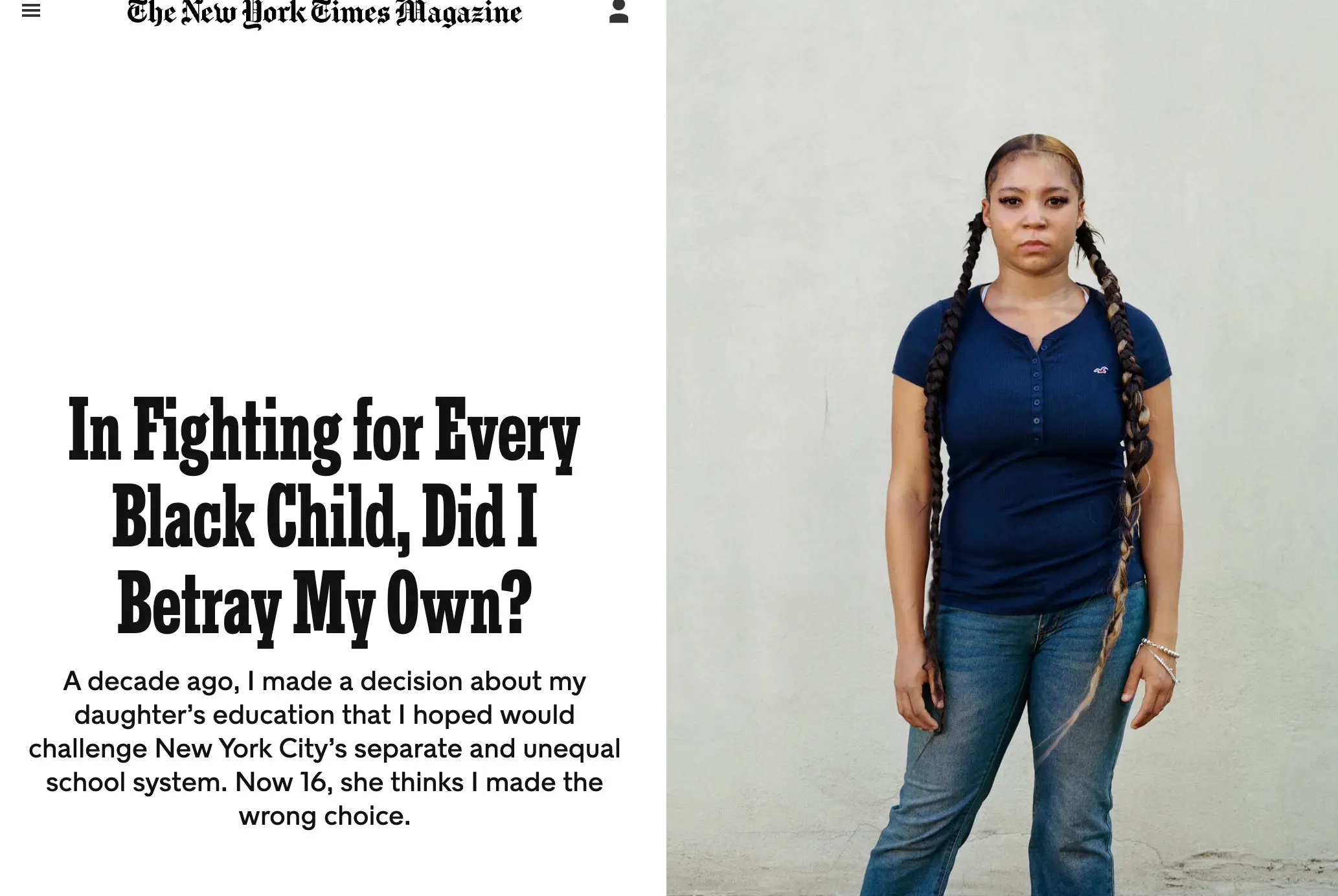
In The New York Times Magazine, Hannah-Jones, who makes a healthy six-figure salary, including receiving tens of thousands of dollars for paid speeches, decided to send her daughter to an economically deprived public school out of an obligation to the greater good instead of giving her daughter more advantages that could help her get into a better college and perhaps a high-paying career.
Hannah-Jones first wrote about choosing her daughter’s school in 2016, when she described her desire to send her child to public school but the difficulty of selecting a school in a “segregated city.”
“In a city where white children are only 15 percent of the more than one million public-school students, half of them are clustered in just 11 percent of the schools, which not coincidentally include many of the city’s top performers.”
This is one of the first fallacies of Hannah-Jones’s logic on segregation to begin with: more than two-thirds of the city’s public school population at the time was Latino or black (the black student enrollment has since plummeted along with the overall student population); the city is not segregating the 15% as if they are a protected class. Hannah-Jones is under the impression that there’s a constitutional right for every child to be in proximity to a white student. Perhaps it’s because they believe they can enshrine the child with the wisdom that comes from interacting with black girl magic; perhaps it’s because she believes the city will invest more equitably if it knew white students were more fairly spread around, as if Caucasian students were a commodity.
“In 2014, the Civil Rights Project at the University of California, Los Angeles, released a report showing that New York City public schools are among the most segregated in the country. Black and Latino children here have become increasingly isolated, with 85 percent of black students and 75 percent of Latino students attending ‘intensely’ segregated schools — schools that are less than 10 percent white,” she writes.
Hannah-Jones needs to believe that she is a victim, that systems are permanently in place to deprive black Americans like her, the millionaire New York Times writer who’s authored a bestselling book based on historical inaccuracies and has been rewarded for a decade of writing basically the same thing over and over again. If she stopped for a moment and thought about it, a school that is less than 10% white is slightly below the city’s overall average of 15% of the public school population.
And the lack of white children didn’t translate into a lack of funds for other schools. The city’s highest-need schools receive more funding from local government, on top of state aid and federal Title I spending. The problem with these schools isn’t their lack of funds or white bodies.
Hannah-Jones wrote in her 2016 article that she wanted to enroll her daughter in a segregated, low-income school because she didn’t want her daughter to be liberated from the experience that most black and Latino children faced.
“I understood that so much of school segregation is structural — a result of decades of housing discrimination, of political calculations and the machinations of policy makers, of simple inertia. But I also believed that it is the choices of individual parents that uphold the system, and I was determined not to do what I’d seen so many others do when their values about integration collided with the reality of where to send their own children to school.”
While there is a long history of systemic discrimination against blacks in the United States, it was not the country her daughter was born in. Imagining that the United States of 2016, when her daughter was entering the New York City public school system, was comparable to the same world as Selma, Alabama in the 1950s is a fable that liberals tell themselves to excuse poor behavior by parents, teachers, and children that has resulted in failing test scores, chronic absenteeism, or disciplinary issues. Hannah-Jones’s own blindness is that public schools in New York City and many other regions of our country are built not for children but for adults, whether it be various unions, the whims of activist superintendents, or dozens of contractors who tether well-meaning teachers to various technological platforms and professional development workshops that bury them in bureaucratic nonsense.
For her decade of bemoaning the fact that her daughter’s school wasn’t properly integrated with flocks of white children from the nearby wealthy neighborhoods, she fails to mention that many schools, including her daughter’s, openly opposed integration because it jeopardized their Title I funding for low-income schools, something her own paper chronicled in the year before she enrolled her child.
It was not proximity to white bodies or systemic changes in race that elevated recent Asian immigrants to be the highest scholastic achievers in New York City, nor was it what helped millions of black students in Mississippi achieve some of the highest reading scores in the country as most other public schools saw their test results plunge in the aftermath of the COVID-19 pandemic. It was New York City’s poor education system built for the powerful teachers’ union. Children are allowed to fall through the cracks if their parents let them.
Her now-teenage daughter asked her a very simple question: what has she accomplished by using her as a tool for political progress? A question that Hannah-Jones couldn’t answer.
Hannah-Jones says she saw problems in the school as early as first grade, when children were hitting, chasing, and pushing each other while adults stood by. New York City’s unions have extremely restrictive rules on the ability to discipline a student; basically, they cannot touch a child even if another child is being attacked, unless they risk their jobs and benefits.
The writer chalked it up to the idea that all children were like this and that the institution had failed. But not all children are like this; her own daughter wasn’t. And rather than expecting more from other parents, Hannah-Jones kept expecting the school to discipline the children. When other middle-class, mostly white families left the school, Hannah-Jones became more determined to make sure her daughter stayed; there was an ideological war to be won, after all.
Year after year, Hannah-Jones witnessed failures in the school, and with each passing year she kept her child in a failing school.
It was so bad that in the fourth grade, she opened her daughter’s schoolbag and found that none of her work was graded. Her daughter believed she excelled at math because the teacher never corrected her, and the same was true for her writing assignments. She earned As and Bs because, had she failed, or a majority of the black children failed and been left behind, it would have been an example of the systemic racism Hannah-Jones is always looking for. So, instead, everyone passed, regardless of what they wrote.
She says the school was underfunded and understaffed, while the teacher-to-student ratio was less than 10 children per teacher and taxpayers spent more than $50,000 per child. None of the standard liberal excuses hold any merit, but they are much more comfortable lies than examining truths that fly in the face of your ideology.
Still, Hannah-Jones chided specialized schools that test children and only allow the best and brightest, alluding to the idea that it’s a system of white supremacy that magically also benefits Asian families, most of whom earn far less than Hannah-Jones and her husband.
“This systemic sorting of worthy and unworthy children is justified by saying that our ‘brightest’ students deserve and demand more rigor,” Hannah-Jones writes. “While many of the city’s Asian students have benefited from these screens, in reality the screens are part of a tawdry bargain to keep a dwindling number of white and wealthier parents from exiting the public school system.”
Once again, if Hannah-Jones took a moment to look at the math, she’d realize it doesn’t make any sense. Whites are a minority of the voting population; most upper-class whites send their children to private schools that have similar expenses to a college education. Yet many Asian students, many of whom come from homes with little affluence and where English is a second language, thrive. It’s not for a voting bloc or to appease a white demographic, but the system of white supremacy is more concrete in Hannah-Jones’ head than in the outside world, so it’s what she always must fall back on.
Hannah-Jones’s daughter tried to take a specialized test to get into one of those high-performing schools, but couldn’t compete with a substandard education. In the ninth grade, she didn’t even have a full-time math teacher.
After detailing years of watching disciplinary issues in these failing schools, Hannah-Jones never asks herself why teacher retention is so difficult. Could it be that teachers who get into education to make a difference feel like they can’t in such an environment?
Hannah-Jones’s mission to promote failing schools at her child’s expense never stopped. She boasted that her daughter graduated on the honor roll, even though she knew her teachers had never graded her work and that she couldn’t do basic math.
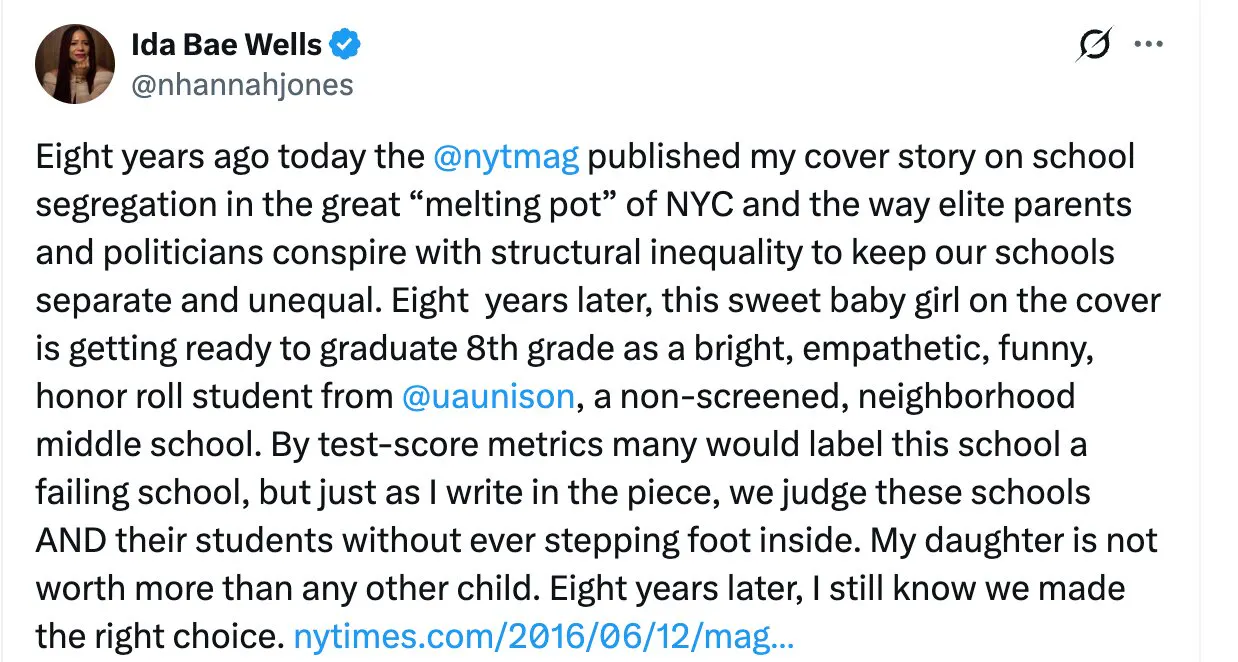
The decision to send her child to a failing elementary school haunted her in high school; up to that point, she had experienced no academic rigor, including homework. The culture shock meant she struggled in most classes, and Hannah-Jones found out that her daughter couldn’t do algebra because her grade school never taught long division or fractions.
If a decade of this shared experience was supposed to make Hannah-Jones or her teenage daughter realize anything beyond lessons about race or class, it didn’t.
“She then said she was glad she had not spent her early years in a white environment as many of the Black students at her high school had, because she’d developed a strong sense of her identity and had the confidence to speak up against the casual racism they sometimes experienced. Najya said that spending the last two years in classrooms full of privileged kids had taught her that these students weren’t smarter or even necessarily better behaved than the kids she had gone to school with before; they just had more.”
This is just a refusal to acknowledge disparities not only in race and income, but in parental expectations, discipline, and an education system meant to fail children forward. It’s not segregation, money, teachers, or all the other people Hannah-Jones has decided to blame that are holding black children in New York City back. It is the failure of parents to demand more from their children and of a teachers’ union and government that fail children forward. Black children in Mississippi don’t have universal school choice, a voucher program, or anywhere near the kind of money spent on black students in New York City, $52,349 in the case of Jones’s daughter’s school versus $12,324 for the average school in Mississippi. Yet the latter outperforms New York City students on tests.
Neither Hannah-Jones nor her daughter can admit the hard truth that these black students didn’t have less when it came to school spending. In fact, because of New York City’s Fair Student Funding rule, she and her classmates actually had more.
In the comment section of the article, Hannah-Jones said her daughter doesn’t believe she’s being hard enough on herself, and there’s a lot of truth to that. How did she knowingly put her child in an unsafe, failing school without supplemental tutoring? Why did she wait until the fourth grade to realize that none of her work was being graded? For someone who claims to be an education expert, Hannah-Jones was constantly surprised. Still, aside from running to the principal or emailing the teacher, she didn’t do personalized follow-up to make sure her daughter met her standards. It’s question after question on a slow-moving train wreck that’s supposed to conclude with the thought that at least she was honest. But is that enough? Because if she had her way, her daughter would still be on track for a much harder life, where she failed to meet the basic needs of a college freshman. So she would have been left behind, and it would have been nearly impossible ever to catch up.
Hannah-Jones worries that in fighting for all children and standing true to her values, she let her child down, but she’s asking the wrong question entirely. It’s not that raising your children with values rooted in your ideological framework is a bad decision; it’s the choice most parents make, whether that be based on religion, culture, or politics. The problem is that Hannah-Jones’s ideology is inherently poisonous.
All of her answers to the problems were because of whiteness, structural racism, funding, poor teachers, or understaffing; on deeper examination, all of those explanations fall apart. Hannah-Jones is so profoundly inept at analyzing cause and effect that at this point it’s a moral failing.
You’d be hard-pressed to find a single Asian or white parent who makes decisions for their children because they’re fighting for every child of that race. They understand their child will compete with every other member of their race for the rest of their life. They are not separating themselves from failing schools because they hold an animosity against black students the way she holds a venom against whites. She assumes the worst of other people because they are mirror images of herself, and her answer to this was to disenfranchise her own child instead of making her compete in their schools and prove she was as gifted, talented, and intelligent as them.
Instead, Hannah-Jones’s daughter is a victim of her mother’s virtue signaling, her lack of attention to her daughter’s education, and her refusal to ever believe that her own worldview not only imprisoned her in an endless cycle of the identitarian victimhood mind virus, but also hurt her child.
Her arguments are all about a thematic struggle when she lost sight of what was right in front of her eyes. Even when she talks about disparities in funding for black-majority schools, she’s not talking about New York City schools receiving as much as, if not more than, white- and Asian-majority schools. And in the need to address the greater “struggle” at large, she failed to see that the racially-lensed progressivism that she bathed in did not prioritize her daughter.
***
Ryan James Girdusky is an author, podcaster, political consultant, and writer whose work has been featured in multiple publications including the Washington Examiner, The American Conservative Magazine, The Week, Human Events, and The Daily Caller. He is the host of the “It’s A Numbers Game with Ryan Girdusky” podcast. Follow him on X: @RyanGirdusky
More from this network:
Domains for Sale · GOTPeople.org · TheDSAPlatform · The Truth About Socialism
What's Your Reaction?
 Like
0
Like
0
 Dislike
0
Dislike
0
 Love
0
Love
0
 Funny
0
Funny
0
 Wow
0
Wow
0
 Sad
0
Sad
0
 Angry
0
Angry
0

I am just an average American. My teen years were in the late 70s and I participated in all that that decade offered. Started working young, too young. Then I joined the Army before I graduated High School. I spent 25 years in, mostly in Infantry units. Since then I've worked in information technology positions all at small family owned companies. At this rate I'll never be a tech millionaire. When I was young I rode horses as much as I could. I do believe I should have been a cowboy. I'm getting in the saddle again by taking riding lessons and see where it goes.
Premium domains for sale




















Comments (0)