

How Progressive Presidents Abandoned the American Tradition of Thanksgiving
Premium domains for sale
Freedom Is Back In Style
Summary
Freedom Is Back
In Style
Premium domains for sale
- Presidential Thanksgiving proclamations traditionally acknowledged God as the ultimate source of America’s blessings.
- Washington, Lincoln, Reagan, and Trump have upheld the holiday’s religious character.
- Progressive presidents have increasingly transformed Thanksgiving into a celebration of human solidarity.
Thanksgiving is such a beloved American holiday that it is rarely examined as a possible source of self-knowledge. Yet the longstanding tradition of presidential Thanksgiving Proclamations reveals a particular vision of politics, religion, and the American nation—one that progressive presidents have increasingly repudiated.
In 1789, George Washington declared: “It is the duty of all nations to acknowledge the providence of Almighty God, to obey his will, to be grateful for his benefits, and humbly to implore his protection and favor.”
As a new report shows, Presidential Thanksgiving Proclamations have been the chief executive’s annual means of fulfilling that duty, coordinating the free choice of a free people so that the nation itself, rather than a mere collection of individuals, might give thanks to God.
For nearly two centuries, from Washington through Franklin Roosevelt, these proclamations were emphatically vertical. They attributed every blessing of the year—crops harvested, industries expanded, peace maintained, liberties enjoyed—ultimately to “the beneficent Author of all the good that was, that is, or that will be.” Human effort was never denied, but it was understood as secondary causality: free men cooperating with divine providence.
Abraham Lincoln captured the principle perfectly in 1863 when he insisted that “no human counsel hath devised nor hath any mortal hand worked out these great things. They are the gracious gifts of the Most High God.”
This tradition bridged parties and eras. Andrew Johnson, Grover Cleveland, Theodore Roosevelt, Woodrow Wilson, and Herbert Hoover all spoke in the same register. Even Franklin Roosevelt, the architect of the modern administrative state, consistently acknowledged that worldly achievement was the product of human and divine cooperation. “From our earliest recorded history,” he wrote, “Americans have thanked God for their blessings.”
The Old Way: Washington, Lincoln, Reagan, and Trump
Washington set the pattern. His proclamations treated national thanksgiving as a duty of the nation as such, fulfilled when the highest officer of government exhorted citizens to retire to their churches and homes to acknowledge God. Lincoln revived the annual late-November tradition amid civil war and preserved its vertical focus, calling the people to “thanksgiving and praise to our beneficent Father who dwelleth in the heavens.”
Ronald Reagan reasserted the tradition against the secularizing currents of the late 20th century. “In keeping with America’s heritage,” he wrote in 1981, “one day each year is set aside for giving thanks to God for all His blessings.”
In 1986 he went further: “rooted deeply in our Judeo-Christian heritage, the practice of offering thanksgiving underscores our unshakeable belief in God as the foundation of our Nation and our firm reliance upon Him from Whom all blessings flow.”
Reagan attributed the honest toil of every American worker, farmer, and professional to God, framing human achievement within divine beneficence.
President Donald Trump has likewise recovered the original spirit. His 2017 proclamation declared unequivocally: “On Thanksgiving Day, as we have for nearly four centuries, Americans give thanks to Almighty God for our abundant blessings.” In 2025 he opened by quoting Washington’s “duty of all Nations” and closed by encouraging Americans “to gather in homes and places of worship, to offer a prayer of thanks to God for our many blessings.”
“Gratitude and grit,” as Trump has put it, captures the American combination of daring human effort and ultimate dependence upon Providence.
The New Way: Ford, Obama, and Biden
The break began in earnest with Gerald Ford’s 1975 proclamation, the first in history to make no clear reference to God. Instead of thanking the Almighty, Ford called upon Americans to “reaffirm our belief in a dynamic spirit” and to celebrate “our cultural pluralism” and “the men and women who founded and built our great Nation.” Gratitude was redirected from God to fellow citizens and to an abstract progressive force.
Barack Obama accelerated the secularization. Two of his proclamations mention God only by quoting earlier presidents; his 2016 proclamation makes no reference at all to God. He never uses masculine pronouns for God, never calls Him “Father,” and never exhorts Americans to give thanks to God in the formal closing.
Instead, he encourages them to “give thanks for all we have received” and to “express appreciation to those whose lives enrich our own”—leaving the object of thanksgiving deliberately ambiguous. In 2016 he recast the Pilgrims as “refugees” grateful primarily to the Wampanoag, not to God.
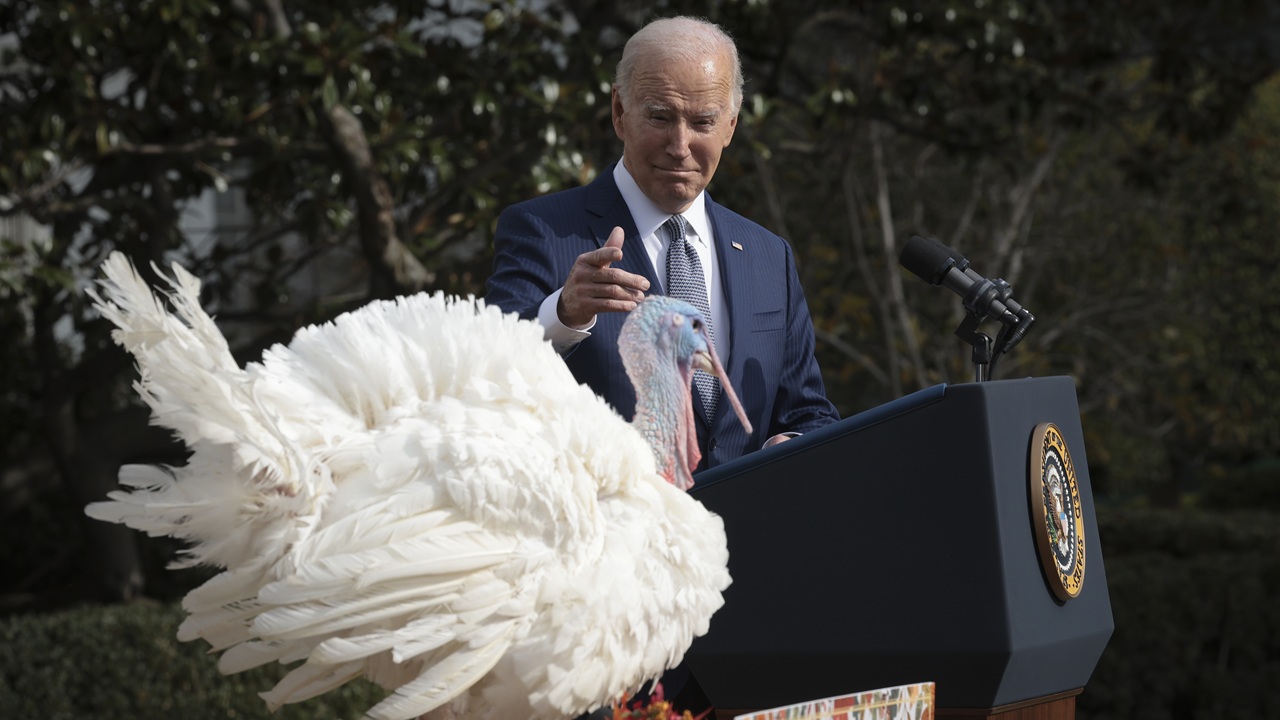
Joe Biden went further still. Each of his four proclamations concludes with identical language urging Americans to “give thanks for the friends, neighbors, family members, and strangers who have supported each other.”
God appears in only two of the four documents, and even then merely as one possible source of blessings among others, or via truncated biblical quotation stripped of its Christological conclusion. Biden repeatedly describes the first Thanksgiving as an occasion of gratitude to the Wampanoag for their “generosity and kindness,” and speaks of America’s “limitless possibilities” if “we do it together.”
The vertical has been replaced by the horizontal; the nation gives thanks to itself.
The political nature of the shift is unmistakable. For most of American history, Thanksgiving proclamations were ceremonial rhetoric that shaped the nation’s moral imagination toward the recognition of God as the ultimate source of all good. Progressive presidents have transformed the holiday into an occasion for self-congratulation and the celebration of human solidarity. In so doing they have unmoored the nation from its most distinctive national holiday.
Thanksgiving is an emphatically religious national holiday. Future presidents who wish to restore its traditional character should follow Washington, Lincoln, Reagan, and Trump: Attribute all the blessings the nation has enjoyed to God as their ultimate source, and directly exhort the American people to give thanks to Him. In so doing they would faithfully guard a custom handed down to them, and they would fulfill the “duty of all Nations, to acknowledge the providence of Almighty God.”
This essay draws on Pavlos Papadopoulos, “The Duty of All Nations: The American Tradition of Presidential Thanksgiving Proclamations,” a report from the Simon Center released Nov. 20, 2026.
What's Your Reaction?
 Like
0
 Dislike
0
 Love
0
 Funny
0
 Wow
0
 Sad
0
 Angry
0
I am just an average American. My teen years were in the late 70s and I participated in all that that decade offered. Started working young, too young. Then I joined the Army before I graduated High School. I spent 25 years in, mostly in Infantry units. Since then I've worked in information technology positions all at small family owned companies. At this rate I'll never be a tech millionaire. When I was young I rode horses as much as I could. I do believe I should have been a cowboy. I'm getting in the saddle again by taking riding lessons and see where it goes.
Premium domains for sale












Comments (0)