

Read The Prologue To Andrew Klavan’s Upcoming Book: ‘Find Me Nowhere’
Premium domains for sale
Freedom Is Back In Style
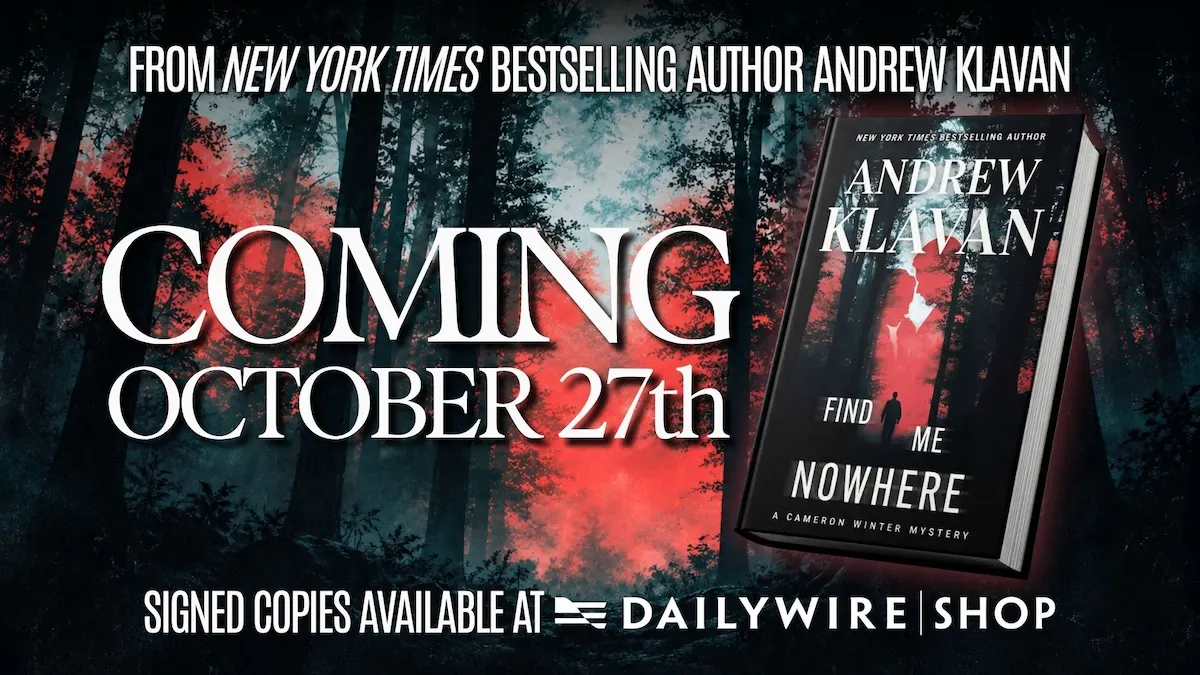
The following prologue is taken from “Find Me Nowhere” by Andrew Klavan (The Mysterious Press/Simon & Schuster, October 27, 2026). Available for Pre-Order at the Daily Wire Shop.
Freedom Is Back
In Style
Premium domains for sale
* * *
Standing against a backdrop of almost infinite desolation, she was, he thought, the most beautiful woman he had ever seen. The wind moved strands of her golden hair across her delicate features. Her blue eyes shone bright and calm in the afternoon light. Her lips were soft and still and her expression seemed to him—what was the word? Transcendent. Maybe even holy. Her Kevlar vest flattened the graceful shape of her, but he had had a good look at her figure back at the base, and could still imagine it clearly. Even now, she looked fit and slender in her jeans and her khaki windbreaker. With the knife-sharp peaks of colorless mountains falling away behind her as far as the pale horizon, she seemed to him more real than the reality, a girl-shaped portal from this wasteland of endless war into the serene romance of home.
Specialist Jonah Henning—Dooby to his comrades-in-arms—was still thinking about her three weeks later. She was the last image in his mind before the shooting started in the gorge at Ibram Kalay.
The sight of her—that particular sight of her framed against the wilderness of mountains—had somehow awakened him from the long trance of battle. When he had seen her, it had been six months since he had touched a woman. Six months since he had seen a woman’s bare body, not in an online video but there in the flesh before him, near to hand. Something about this woman, this particular woman standing where she stood, brought all his old life back to him in force. He found himself wondering suddenly, Where am I? Like a man coming conscious in an unfamiliar room. What the hell? What the hell am I doing here at war? What is this thing called war?

Image courtesy of Simon & Schuster
Before he enlisted, up to the very day before, he had been living a surfer’s fantasy in Southern California. At night, he played piano at Roland’s restaurant in Malibu. By day, he rode the waves at Paradise and Dume. He lived in a house in the hills with other guys, as few as three, as many as seven, sometimes strangers, sometimes friends. Women drifted in and drifted away like the visionary dreams of desire. Sculpted women of sun-kissed beauty and bright white smiles. So many of them floated in and out of his house, his bed, his arms that he could not name them even on the night they came. That’s what his life had been before this. High water, good dope, white smiles, and tender touches out of some half-imagined movie show that had somehow become half real.
Then one day, one fine and random day, almost without thinking, he had decided that life, real life, the good life would be better found in a fiery kill zone in some godforsaken outpost of the American empire.
And here was the funny thing. It was. It really was. He had found the good life exactly there. For weeks and weeks and months, he was in it wholeheartedly. Dodging rockets and martyring evildoers in a mindless zen more vivid even than riding a hollow bomb of a wave straight into the sand. That—that thrill of God’s green tubular water—could only approximate this—this radical stillness of fear and boredom and occasional mayhem. Because in truth, paradise got old on you. Playing piano in a restaurant bar got old. Dope just deadened him after a while. Even sex was not sexy forever. Sometimes, toward the end of his California idyll, he found himself fantasizing that he was making love to a woman when he actually was making love to a woman. How crazy was that?
But war…
Dooby did not love war. He did not revel in killing. He did not get high on the frenetic terror of combat. When things got gnarly, he was just—just gone. And it was the being gone he loved. Gone, gone, gone, with Great Death all around him. All around but powerless because he was gone. One with his body. A soul unaware of itself. That—that was life. Life shucked of its adornments like an ear of corn. The hard kernel of life. For months and months in the theater of battle, he did not miss the sun or water or even riding a flat-bellied beach girl into rapture and a smoky sleep. He did not miss any of it. Until that woman—until the sight of that woman framed against the wilderness. Seeing her, he had thought suddenly: What the hell? As if awakening. What the hell am I doing in this thing called war?

The answer to that question, at this particular moment, was that he was riding in the rear of the second MRAP in a small convoy of four. Mine-resistant ambush protected vehicles grinding along a narrow snake of a path, a familiar path they patrolled fairly often. Gray skies above him. A wall of scrubby rock to his left. A heart-stopping drop into a deep, muddy gorge on his right. Command had received intel that scarabs were gathering near the village of Ibram Kalay. Scarabs were what they called this season’s bad guys, nicknamed after the flesh-devouring beetles in a monster movie from a few years back. Tubs—Dooby’s best friend, Corporal Geoffrey Tubman—was beside him, working the CROW of the .50 cal up top. Screen and joystick, just like a video game, only not as cool as a video game where the enemy reeled when you shot him and half exploded and fell and conveniently vanished so as not to clutter the field. Here, you pressed the button and, yeah, the gun barrel up there lunged and chattered like a coked-up cobra—but out of sight. And the evildoers on the screen simply drooped and fluttered to the ground through a cloud of dust, quietly transformed from a potential threat into a pile of laundry.
Sergeant Go-Go was in front of him, driving. Eli—Lieutenant Fred Manning, a New Yorker nicknamed after the old Giants quarterback—was riding shotgun.
As they grinded along the trail, Dooby felt relaxed but alert. He scanned the far wall of the gorge for snipers, tracing the flora on the steep slope all the way down to the banks of the black and glittering river on the gorge floor, searching for any nonvegetable douchebag on the hunt with a rocket launcher, or even some pain-in-the-ass scout who might be worth perforating with copper-covered steel. But even as he eyeballed the terrain, his mind was still on that woman. That woman standing against the wilderness and somehow setting the ashes of his memory ablaze. She haunted him. In fantasies, he saw her open her arms. He heard her whisper, “Come to mama.” He felt if he could only waft as softly as a feather down between her legs and slide into the glory of her humid interior, he would magically emerge on Roland’s patio above the Malibu breakers, the red sunglow stretched across the surface of the water, a margarita in his hand and all the rich girls giving him the eye as they went swishing by him on the arms of their played-out sugar daddies. Home, he thought.
Then the scarabs opened fire.
There was a throaty reverberation and the road beneath them shook. Something—a mine or an IED—had exploded up front. There was another thump in back. A mortar? Dooby wasn’t sure. The convoy halted. Tubman hit his joystick button. The air outside rattled with machine-gun fire. The gorge’s shadows danced as with a swarm of killer fireflies. Rockets sparkled and exploded. Dooby thought he heard the whoosh and whump of another mortar. The MRAP shook. He caught his breath like he was swallowing his soul. The syncopated cough of Tubman’s .50 paused and started up again and Dooby looked out the window and saw the bullets chewing up the dirt on the gorge’s far wall. Every fourth shot was a tracer and Dooby watched for another second as Tubman walked the green-light lines up the sharp slope toward the smoke from a mortar launcher until, bang, a scarab threw up his arms and tumbled out of the weeds, a shredded rag.
More explosions. The air expanded like a balloon all around him. Dooby’s heartbeat was so loud in his ears that it muted the blasts. Eli was shouting to HQ over the sat-com. Go-Go was on the radio to forward air. Their voices seemed lost among a chaos of voices, all of them shouting through the static.
He was never completely sure what happened next. He became aware of an unexpected silence shrouding the noise. The .50 cal above him had stopped. Had Eli ordered Tubman to dismount? That made no sense. Yet, without a pause, he saw the MRAP’s door open. His buddy snapped up his M4 Shorty and tumbled from the vehicle like jumping from a plane.
The moment seemed to tear jaggedly like paper. All at once, Dooby himself was belly-down in the dust between the vehicles, a 249 machine gun propped in front of him. He lined up on a scarab with a grenade launcher and pulled the trigger. Shot the bad guy’s knees out from under him, then pounded his body, then panned and killed another man even as the first man fell. The atmosphere was bulky and kinetic with the stutter of the .50 cals from the other MRAP’s still rattling the air. The noise became so steady it was a sort of silence, like the noise of crickets in the night forest. And his hammering heartbeat was silent too. Because Dooby was gone. He was flowing like water. Panning the machine gun. Dropping the men on the ridge across the way and in the gorge below. He was a mind of no reflection. He was only life—that life he had come here to find.
Later, when he could think again, he would remember it as an almost lovely scene. The glittering river winding among the vegetation of the gorge floor. The dramatic rises and juts and angles of rock, streaked with green tracer fire, dotted with fiery blasts and the smoke that followed. The atmosphere was alive with gunfire. The scenery was alive with running men and tumbling corpses. The river ran black and the bushes stood green and his heartbeat swallowed the chaos of voices and explosions. In memory, it would remind him of the wooded slopes of his boyhood home in the San Gabriel mountains when he’d play at battle with his brothers and their friends. The setting was prehistoric and the action choreographic: nature made human by war.
But all that came to him later. Now he was immersed in the action, the raw and unconscious life. Even the woman, the image, the memory of the woman outlined against the wilderness as if she were a portal home—even that image was altogether gone. Gone as he was gone, that mind that knew itself—it had blissfully left him the moment he came under fire.
But that time also passed. He began to return to awareness. The ambush was winding down. The gunfire was growing sporadic. There were dead scarabs on the ridge and on the slope and in the gorge. Across the way and down the slope, the surviving attackers were on the run. They scurried, crouched over, then seemed to vanish like demons into their surroundings. They seemed to blend with the greenery and the dark brown earth and melt away. Dooby became Dooby again and he understood: they were retreating into caves and into tunnels that would carry them invisibly to safety.
His heart began to slow. His mind began to know itself again.
It was just at that moment—just as he was making that transition back to ordinary awareness—just then that he spotted Tubman, running, out in the open.
Now, yes, here in war-world, Tubs was Dooby’s best friend. But they were an odd pair. They were an odd couple to look at, for sure. Dooby was a laid-back California dude, lean and pale and blond and dopey-eyed, with the posture of a question mark. Tubman, from a dying factory town in Someplace, Pennsylvania, was short, dark, erect, buzzy eyed. Weirdly gleeful, with a yuk-yuk laugh that Dooby found both hilarious and kind of insane.
They didn’t just look mismatched. They really were. Dooby really was as laid-back as he seemed. Letting things happen as they would, taking them as they came. He was stoned even when he was straight, Tubman often said of him; relaxed as boiled spaghetti. Whereas Tubman—he was all fight all the time, looking for a fight when there was or wasn’t one, it made no difference. He once went on patrol draped in one of those bright orange panels that were used to mark the spot for air support and rescue. That’s how eager he was to draw enemy fire and get into it with the evildoers.
The two men were so different from one another that, half the time, when they were talking together, they were talking about their differences. Teasing each other about their accents and the phrases they used. Dewd, Tubman would say in imitation of Dooby. Gnarly, Dewd, like totally gnarly. Dooby said Tubman was so wound up he sometimes wondered if he had ever been laid. Like, ever. Seriously. Were you ever laid, Tubs? Ever? Tubman laughed yuk-yuk-yuk like the crazy man he was.
And he was crazy—Tubman—he was nuts, no question. So it was not the most uncanny event that had ever occurred when, with the Ibram Kalay firefight coming to an end, Tubs was suddenly running, his M4 in hand, along the sharp slope of the gorge, shouting, “Hey! Hey!” as if he were chasing someone Dooby couldn’t see.
He had done stuff just like this in the past. Dooby had witnessed it with his own eyes. Tubman had chased scarabs through underbrush that could have been mined, into houses that might have hidden ambushes, even into caves that might have swallowed him whole. More than once, Lieutenant Eli had reamed him for it, rectum to glottis. Screamed at him nose-to-nose and red-faced like a drill sergeant hazing a recruit.
Now, Dooby looked up startled over the sight of his 249. Saw his buddy racing away from the convoy. After what? Chasing what?
He shouted out to him: “Tubs!”
Tubman didn’t even hesitate. He scurried slantwise over the slope. Then, suddenly, he vanished.
Dooby’s jaw dropped. His mouth hung open. It was a long, blinkless moment before he realized: Like the retreating scarabs, Tubman had dashed into an opening in the rock. Into a cave or a tunnel. Chasing after some bad guy, no doubt. Which was crazier than craziness itself.
Dooby let out a curse, then a long, creative string of curses. Incredibly, he found himself running also, running toward the crevice into which Tubs had disappeared, carrying his M249 before him in his two hands. He shouted Tubman’s name as he ran. He shouted obscenities. He shouted Tubman’s name and obscenities all mangled up together. His brain, frizzing like the radios with a chaos of battle static, refused to form an idea—any idea—of what Tubs was up to, of what he could have possibly been thinking that would lead him to charge with such suicidal abandon into what could only be the entry into the pit of scarab hell. Over his own bootsteps, over his own huffing breath, Dooby heard his own name being shouted behind him, also mashed up with obscenities. But he could not think about it. He could only keep running after his friend.
There was the gap in the rock wall, up ahead, now closer. Looming large. Before he realized he had done it, Dooby plunged through.
The world went out like a candle. It was shocking how fast there was nothing, just blackness. He stopped short. His pulse was in his ears like cannibal drums. His breath scraped his lungs like a rasp-faced file. The air around him was cave cold, cave damp.
“Tubman!” he meant to shout, but it came out a whisper. Because who knew what was hiding up there in the lightless nothingness? And where had Tubman got to anyway? And where were those voices that had been calling to Dooby, calling him back? He couldn’t hear them anymore. There was nothing in the dark but that heart of his, beating.
Dooby shuffled forward. He had not been afraid during the battle. He had not been anything during the battle. He had just been there. He was afraid now, though. Wound up like a chattering monkey toy, chattering like a monkey toy as the underground cold ate into him. There was no zen here. This was guts-strung-tight, movie-style suspense. Final Girl in the dark hallway with the serial killer on the loose and boo scares waiting up ahead. Dooby’s hand went to the flashlight clipped on his belt. A Streamlight ProTac, small but bright. He brushed it with his fingers, but he didn’t draw it free. He did not want to make a target of himself. So he inched on, deeper into the blackness.
Afterward—after they brought him back around—he could not say—he could not remember—how long that black, suspenseful, black, terrifying and black moment lasted before the climax came, before the tunnel erupted. In the utterness of that dark, time did some funny, timelike thing. It slowed or expanded or stopped cold maybe. He couldn’t be sure which. The way it seemed to him in hindsight, the way he recalled it, there was this immeasurable, inanimate interlude in which he might have been only the simulation of a man because there was no movement, no sight, no sound, no sense of life, just him and nothingness, stopped cold.
Then the depths of the dark exploded.
A soundless shock. A muted roar. A blinding light like white fire. The ground was gone from beneath his feet. He was helplessly thrown through the air and did not know whether he was flying or falling. The ground hit him, jolting his bones. The breath was jarred out of him. With a beastlike grumble, the earth shook and rocks began to rain down on top of him.
Dooby thought he was going to be buried alive and he felt himself become a man-shaped emptiness lanced with lightning strikes of terror. The rocks showered down on him. Gasping and grunting, he began to crawl lizard-fast in what he hoped was the direction of the tunnel entrance. A rock smacked against his helmet and his thoughts scrambled. Groaning, he crawled on faster, propelling himself with his forearms and elbows. His sleeves and his flesh were torn open with a pain he could not feel but knew was there. His mind was loud now, crying for help from heaven.
The tunnel collapsed around him. Maybe he was near the opening, near the daylight, because he could see it happen. But he did not believe what he was seeing. It did not look real. The rock walls seemed to melt into bouldery liquid. Dooby gaped at them, amazed and fearful. The next instant, it felt as if the tunnel’s ceiling dropped like a monster’s footstep on his leg. Crushed it to nothing, flesh and bones and all. His buddies told him later they could hear him screaming from the rolling stomach of the avalanche, but he did not remember screaming. He remembered nothing after that, a nothingness so solid he could actually remember the nothingness of it. He had thought the tunnel was dark before, black before, but that was a blackness he could see and experience. In that blackness, he was still there.
In this nothing, he was nothing.
And afterward, he was never again what he had been.
***
The prologue is taken from “Find Me Nowhere” by Andrew Klavan (The Mysterious Press/Simon & Schuster, October 27, 2026)
Published by permission of The Mysterious Press/Simon & Schuster.
***
More from this network:
Domains for Sale · GOTPeople.org · TheDSAPlatform · The Truth About Socialism
What's Your Reaction?
 Like
0
Like
0
 Dislike
0
Dislike
0
 Love
0
Love
0
 Funny
0
Funny
0
 Wow
0
Wow
0
 Sad
0
Sad
0
 Angry
0
Angry
0

I am just an average American. My teen years were in the late 70s and I participated in all that that decade offered. Started working young, too young. Then I joined the Army before I graduated High School. I spent 25 years in, mostly in Infantry units. Since then I've worked in information technology positions all at small family owned companies. At this rate I'll never be a tech millionaire. When I was young I rode horses as much as I could. I do believe I should have been a cowboy. I'm getting in the saddle again by taking riding lessons and see where it goes.
Premium domains for sale















Comments (0)