

Selling The ‘China Story’: Why America Must Reject Beijing’s Academic Exchange
Premium domains for sale
Freedom Is Back In Style
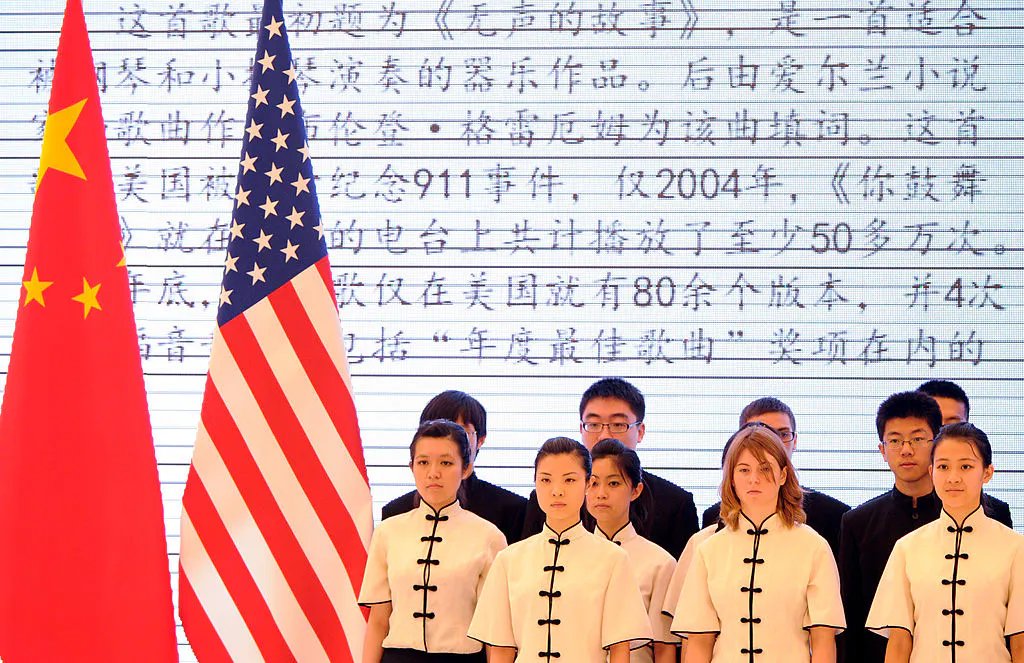
On the White House lawn last month, Xi Jinping offered America a gift. “I am glad to announce an invitation for 100,000 young Americans to visit China for exchanges and study in the coming five years,” he said at the arrival ceremony with President Trump. He framed it as friendship between peoples, with the future in the hands of the young.
Freedom Is Back
In Style
Premium domains for sale
It doubled a promise he made in San Francisco in 2023, when he pledged to host 50,000 young Americans over five years. Beijing says it met that target by May 2026, two and a half years early, a misleading claim because most of the 50,000 participated in short camps, language tours, and friendship voyages, run in part through the China Education Association for International Exchange. This is not what Americans usually mean by study abroad.
At the peak around 2012, nearly 15,000 Americans were studying full-time in China. By 2019, the figure dropped to 11,000. A recent U.S.-China Education Trust tally puts it under 2,000 in 2026. Meanwhile, Chinese students enrolled in American universities still number about 266,000, highlighting how skewed the ratio is (150:1).
On the surface, it seems generous of Xi to graciously invite so many Americans to study in China, but the question that must be asked is, exactly which China are these 100,000 students invited to immerse themselves in?
A new report from the research firm Strategy Risks answers that question, and it is not reassuring. In June 2024, Mary Evelyn Tucker and John Grim — longtime Yale scholars and co-directors of the Yale Forum on Religion and Ecology — attended the International Forum on the History and Future of Xinjiang, a Chinese academic conference co-hosted in part by Kashgar University. They toured a prearranged circuit that included Id Kah Mosque, Kashgar Old City, the Mo’er Temple ruins, and the Kashgar Comprehensive Bonded Zone. China’s National Ethnic Affairs Commission announced the itinerary the day the forum opened.
Xinjiang has been the subject of extensive scrutiny over the Chinese government’s treatment of Uyghurs and other predominantly Muslim minorities. The United Nations and human rights organizations have documented arbitrary detention, restrictions on religious and cultural practices, political indoctrination, and other serious abuses in the region. In January 2021, the U.S. government formally determined that China had committed genocide and crimes against humanity against Uyghurs and other predominantly Muslim minorities in Xinjiang. More recently, as late as May of this year, a Financial Times investigation found that Xinjiang has the “world’s largest detention system relative to population.”
Since COVID, foreign journalists can reach Xinjiang, but not investigate freely. In the Foreign Correspondents’ Club of China’s 2025 survey, 61% of those who traveled there faced interference, restriction, or harassment; nationwide, 94% said reporting conditions do not meet international standards, and 77% said sources refused interviews because they were not allowed to speak to foreign media. Official tours are supervised, with fixed itineraries and access only to approved sites and people. One French journalist on a personal holiday, not reporting, said multiple cars followed them and they could not speak to residents.
The man who played a prominent role in this visit by the Yale scholars was Pan Yue, then deputy head of the Chinese Communist Party’s United Front Work Department and director of the National Ethnic Affairs Commission. Tucker and Grim, who have described themselves as “citizen diplomats,” have known him since 2008, when he was a vice minister of environmental protection. On Yale’s own website, the Forum on Religion and Ecology recorded that Pan chaired the Urumqi session at which they spoke. In interviews with Chinese state media and in their own accounts, they praised the preservation of minority culture and the integration of Xinjiang into Chinese civilization. They did not once mention surveillance, police saturation, or the campaign of mass detention that the U.S. government determined in 2021 constitutes genocide and crimes against humanity against Uyghurs and other Turkic Muslims.
While there’s no direct evidence they were paid or instructed by the party, it is clear this was a propaganda tour masquerading as independent fieldwork. What Beijing needs most is a slew of respected outsiders to visit Xinjiang under heavily curated circumstances and then describe what they were shown in the language of scholarship. Their goal is to promote an alternative narrative portraying Xinjiang as stable, prosperous, and protective of minority culture. Chinese state media then broadcasts their laundered talking points. Among the sites on the official tour were Kashgar University and the Kashgar Comprehensive Bonded Zone, which have problematic ties to the Xinjiang Production and Construction Corps (XPCC), the paramilitary body the U.S. Treasury sanctioned in 2020 for serious human rights abuses.
This same method has been used on diplomats from countries such as Brazil, Indonesia, Senegal, Myanmar, and Pakistan. A 2025 controversy over Princeton University Press staff on a Xinjiang tour organized with a local propaganda department ended with the press conceding the visit was “curated,” and that footage of its staff had been repurposed. Director Christie Henry’s remark that cultures there could “peacefully coexist” was clipped and circulated. But Yale’s Tucker and Grim went even further. They were among the first scholars from a major U.S. university to join an officially organized Xinjiang forum after COVID, and their public accounts contained no criticism at all.
Pan’s theme at the forum — diversity inside a single Chinese civilization — later hardened into the 2026 Law on Promoting Ethnic Unity and Progress, which the bipartisan U.S. Congressional-Executive Commission on China warned would institutionalize forced assimilation, further eroding Uyghur identity and culture. Representatives Chris Smith and Jim McGovern introduced a resolution condemning it. In other words, there is a direct line connecting the academic language used by these Yale scholars and the statute promoting cultural erasure.
So extrapolate the case of Tucker and Grim to Xi’s hope for 100,000 American students in China. A Chinese student at Harvard can publish an essay criticizing the sitting American president; he can organize a protest against U.S. foreign policy without being detained. That is what academic freedom looks like.
Now ask yourself whether one of Xi’s invited Americans on a Chinese campus can interview an anti-CCP dissident? Start a Taiwan club? Publish a paper arguing that Xi’s policies are hurting China? Or organize a discussion group on COVID origins, or investigate the finances of senior Party families? Could he walk into Xinjiang and talk to former detainees without a handler? The answer is no, and everyone involved in these programs knows it. The “China” on offer is the China story, told well — Xi’s own phrase for external propaganda.
Foreigners in China face exit bans, vague national-security statutes, and routine monitoring. The worst case is already on record. On June 3 of this year, the American scholar Min Zin flew into Kunming for an academic conference he had been invited to attend, sent word that he had landed, and was not heard from again. Chinese State security held him incommunicado and accused him of espionage. In August, the State Department designated him wrongfully detained. He had gone to China on the same premise now being offered to 100,000 young Americans: an invitation to study, meet, and exchange.
Some will come home and, like Tucker and Grim, lend a prestigious university name to what they were permitted to see. Yale’s longer institutional ties to China — the Yale Center Beijing, partnerships with Tsinghua and Peking, a large Chinese student body, Joseph Tsai’s $30 million gift to the law school’s China center — are part of this backdrop. Alibaba, Tsai’s company, has invested in facial-recognition firms later sanctioned over Xinjiang surveillance; in June 2026, the Pentagon listed Alibaba as a Chinese military company, which the company denies. Under these conditions, could any Yale scholar dare to contradict Beijing’s preferred narratives about Xinjiang in public and on the record?
An exchange is premised on reciprocity, and the Yale episode shows that these types of cultural exchanges are increasingly asymmetric. Chinese students in the United States are free to denounce the American president while American scholars in China come home praising a region their own government has called the site of genocide. If Beijing wants American students, it can start by balancing the playing field and granting the privileges Chinese students in America have: full academic freedom, the right to criticize the host government in public, and unescorted access to “sensitive” regions.
Until then, short of the risks of arbitrary detention, the Yale episode is a cautionary tale of how an exchange with a closed society will only yield American mouthpieces for Chinese propaganda. Xi’s invitation, under the guise of cultural exchange, is nothing more than a Faustian bargain that the U.S. should firmly reject.
***
Melissa Chen is the managing director of Strategy Risks, a business intelligence firm dedicated to assessing and mitigating China-related risks for corporations, NGOs, and governments.
More from this network:
Domains for Sale · GOTPeople.org · TheDSAPlatform · The Truth About Socialism
What's Your Reaction?
 Like
0
Like
0
 Dislike
0
Dislike
0
 Love
0
Love
0
 Funny
0
Funny
0
 Wow
0
Wow
0
 Sad
0
Sad
0
 Angry
0
Angry
0

I am just an average American. My teen years were in the late 70s and I participated in all that that decade offered. Started working young, too young. Then I joined the Army before I graduated High School. I spent 25 years in, mostly in Infantry units. Since then I've worked in information technology positions all at small family owned companies. At this rate I'll never be a tech millionaire. When I was young I rode horses as much as I could. I do believe I should have been a cowboy. I'm getting in the saddle again by taking riding lessons and see where it goes.
Premium domains for sale













Comments (0)