

Surveillance pricing is here — and this surprising state is saying NO
Premium domains for sale
Freedom Is Back In Style
The hardest job in American politics isn’t balancing the budget, but admitting that the other side might have a good idea.
Freedom Is Back
In Style
Premium domains for sale
I understand this can feel like swallowing glass, but credit belongs where credit is due.
Prices fluctuate constantly under normal market conditions. Gas prices spike during oil embargoes. Airline tickets double in December. Retailers drop prices to shift winter inventory. Every consumer understands basic supply and demand.
Sustainable commerce requires a baseline of public trust.
Now, however, there's a new way of pricing that flouts the usual rules, one most people are still oblivious to. It's known as surveillance pricing.
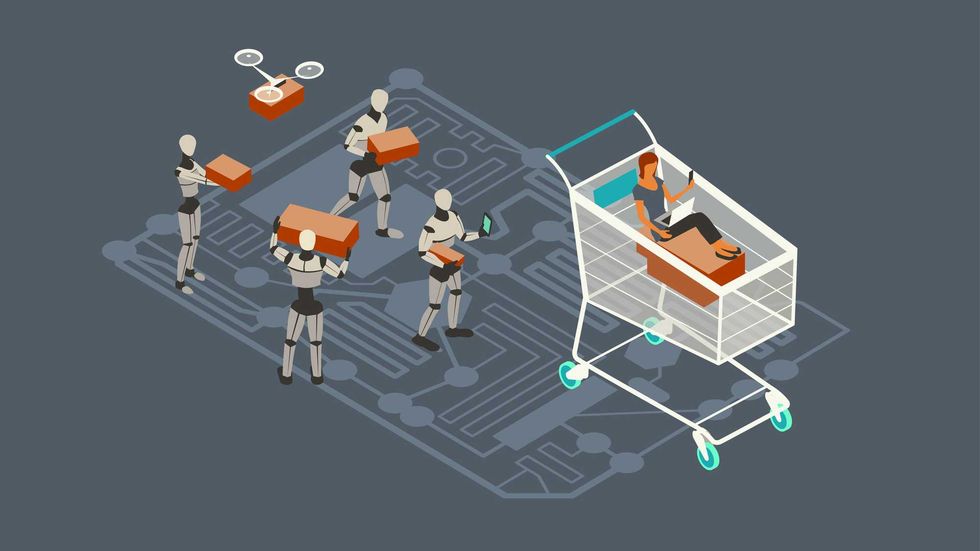
Companies harvest vast amounts of personal data. They then study behavioral quirks and calculate the maximum amount an individual will pay for a given product.
New Jersey Governor Mikie Sherrill (D) recently signed a law, dubbed the Fair Price Protection Act, that tackles this predatory corporate practice.
Personalized price tags
When a customer goes to buy something online, the algorithm instantly detects a recent job promotion, a broken appliance, and an exhausting 20-mile commute. The system spits out a "personalized offer" that looks like a VIP discount, right up until you realize the VIP treatment is just a bespoke mugging.
New Jersey’s new law stops businesses from using personal information to construct personalized price tags for essential goods. The statute leaves traditional coupons, storewide clearance events, and opt-in loyalty programs alone. It places a hard ceiling on using private data to extract extra cash from individual wallets.
Every person participating in the economy is a target. Algorithms track physical location coordinates from cell towers, record search histories, and log exact purchasing frequencies down to the minute.
Data collection makes sense when it helps a company stock shelves or route delivery trucks. But we're way beyond that now. High-tech logistics phases into loan-sharking when it’s used to calculate just how much price pressure you can bear before tapping out.
For example, let's say two neighbors order identical refrigerators from the same website on a Tuesday afternoon. The first neighbor clears browser cookies, runs price comparisons across four tabs, and waits three days to buy. The second neighbor searches frantically because his old unit died overnight, threatening $300 worth of groceries. The algorithm identifies the second buyer as highly motivated (desperate) and jacks up the price tag.
RELATED: This throwback app is competing with Big Tech — using a business model out of the 1980s
 Bryan Bedder/Getty Images
Grocery shopping exposes the same vulnerability that's ready to exploit. A household managing a strict monthly budget leaves a detailed digital breadcrumb trail across meal-planning apps and store searches. Predictive software analyzes those habits and adjusts item pricing to test the family's financial pain threshold. The family ends up paying an invisible desperation tax at checkout.
Stopping invisible pickpockets
In 1914, Congress created the Federal Trade Commission to stop trusts from fixing prices in smoke-filled boardrooms. Today, those boardrooms are replaced by cloud servers executing real-time financial extraction on millions of cell phones. Technology scales predatory practices at unprecedented speeds. Automated systems run millions of behavioral calculations every single second, adjusting prices faster than a human brain can process.
New Jersey’s law creates a blueprint for a uniform federal standard. Geographic boundaries should not dictate basic consumer protections against automated price gouging. A family driving across the George Washington Bridge into New York shouldn’t lose basic economic protections the second they cross the state line.
A national policy establishes clear boundaries for market competition. Companies should win customers by refining manufacturing, streamlining distribution, and lowering overhead costs. They shouldn’t win by writing software that hunts down strapped parents searching for infant formula at two in the morning.
Free-market economics depend on transparent pricing and informed consent. Adam Smith wrote extensively about the invisible hand of the market, but he never envisioned an invisible algorithm picking pockets in real time. Transactional freedom evaporates when a multibillion-dollar corporate server has complete information on a buyer simply trying to purchase dinner.
Capitalism for citizens
Conservatives traditionally champion market transparency, personal privacy, and fair exchange. New Jersey's statute aligns directly with those values. True capitalism requires open competition, not rigged games where one side owns the deck, the table, and the security cameras overhead.
Companies retain every right to generate profits and return value to shareholders. Wealth creation drives technological progress and raises standard of living metrics in America and beyond. Sustainable commerce, however, requires a baseline of public trust. When consumers discover that their own personal information serves as a weapon against their bank accounts, that trust dissolves entirely.
New Jersey typically dominates headlines for political corruption trials, abysmal Turnpike traffic, and the inevitable road rage that follows. Yet Governor Sherrill’s administration managed to draw a remarkably sane line in the sand. Washington and the remaining 49 states need to adopt the exact same rule before every price tag in the country morphs into an automated shakedown.
More from this network:
Domains for Sale · GOTPeople.org · TheDSAPlatform · The Truth About Socialism
What's Your Reaction?
 Like
0
Like
0
 Dislike
0
Dislike
0
 Love
0
Love
0
 Funny
0
Funny
0
 Wow
0
Wow
0
 Sad
0
Sad
0
 Angry
0
Angry
0

I am just an average American. My teen years were in the late 70s and I participated in all that that decade offered. Started working young, too young. Then I joined the Army before I graduated High School. I spent 25 years in, mostly in Infantry units. Since then I've worked in information technology positions all at small family owned companies. At this rate I'll never be a tech millionaire. When I was young I rode horses as much as I could. I do believe I should have been a cowboy. I'm getting in the saddle again by taking riding lessons and see where it goes.
Premium domains for sale



















Comments (0)