

The cost of living is coming for Congress
Premium domains for sale
Freedom Is Back In Style
I have spent more than two decades working in politics and have been involved in roughly 50 campaigns, from local races to presidential contests. If there is one lesson I have learned, it is this: Never tell voters that what they are experiencing isn’t real.
Freedom Is Back
In Style
Premium domains for sale
With the midterm elections eight weeks away, too many campaigns risk making that mistake. Washington wants to talk about foreign policy, economic indicators, and political strategy. Voters are looking at receipts, and those receipts tell a different story.
Voters can forgive difficult circumstances. What they will not forgive is being told those circumstances don’t exist.
In the week ending September 7, the national average for diesel reached a record $5.97 a gallon. That matters far beyond truck stops. Farmers, contractors, freight carriers, and delivery networks all depend on diesel.
When those costs rise, they move through the supply chain. Fuel becomes part of the grocery bill, the restaurant bill, the cost of construction, shipping, and nearly everything else Americans buy. The consumer ultimately pays.
The line between foreign policy and affordability is not always clean. Wars, sanctions, and instability abroad can raise oil prices and transportation costs at home. But voters experience those events through household economics: the price on the pump, the supermarket receipt, and the balance in the checking account.
Politicians love macroeconomics. Voters live in microeconomics.
A candidate can talk about GDP, job creation, or the stock market, but those figures do not erase what a family pays for groceries, housing, insurance, and energy. The voter's checking account gets the final vote.
As much as it pains me to admit it, Democrat strategist James Carville got at least one thing right. During Bill Clinton’s 1992 presidential campaign, Carville drove home a simple message: “It’s the economy, stupid.” More than three decades later, Republicans would be wise to remember the lesson.
I have seen campaigns become consumed with the issue they want voters to care about rather than the issue voters actually care about. Those are not always the same thing.
The evidence this year is hard to miss. A July Pew Research Center survey found that voters most wanted congressional candidates to discuss economic issues, especially prices and affordability. In a companion survey, 66% said they were very concerned about food and consumer-goods prices, 64% about housing costs, and 56% about gasoline prices.
RELATED: Can a $1.2 trillion giveaway become a fiscal bargain?
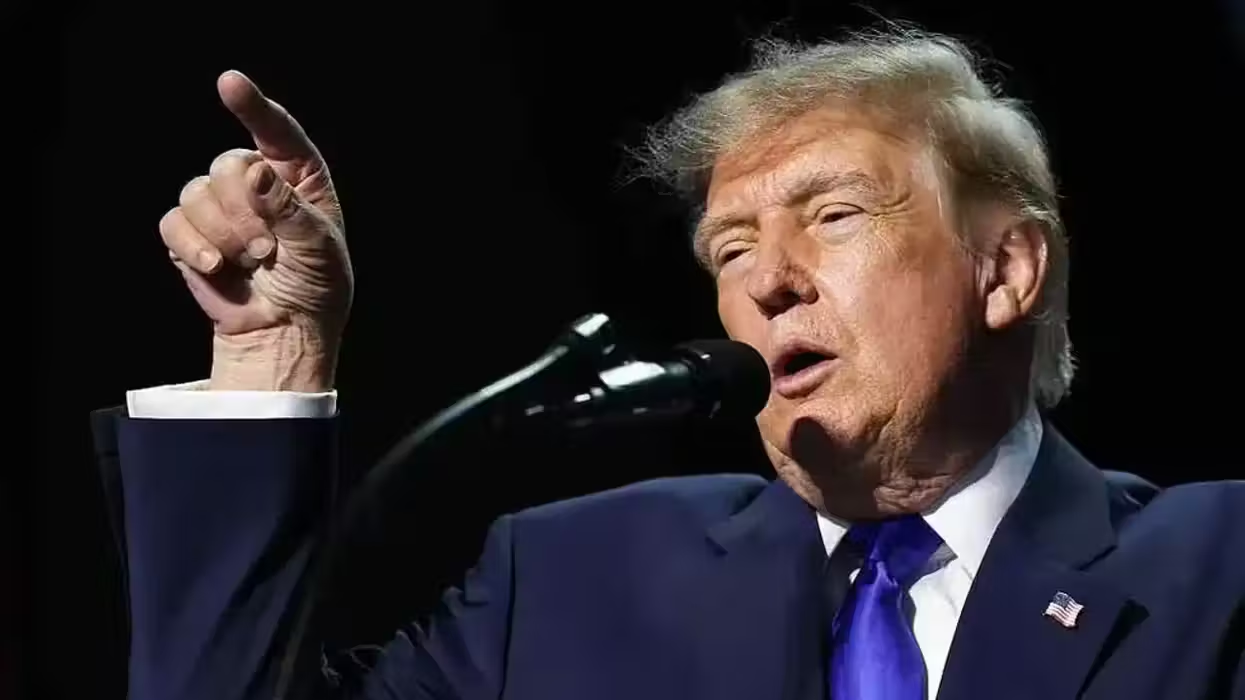 Kevin Dietsch/Getty Images
Foreign policy and national security still matter. China, Russia, Iran, and America’s place in the world cannot be dismissed. No single issue will decide every race. But elections are personal, and voters usually encounter national policy through its effect on daily life.
A parent in a supermarket aisle is not conducting a geopolitical analysis while comparing grocery prices. A driver filling the family SUV is watching the numbers on the pump. Both are asking the same question: How much is this going to cost me?
They are thinking about the mortgage, electric bill, car payment, insurance, groceries, gas, child care, and credit cards. They are wondering why an income that once felt comfortable now seems barely sufficient. That is affordability, and it will decide November.
Economic frustration helped return Donald Trump to the White House. Republicans cannot assume that the issue automatically works in their favor now. They cannot tell families struggling with grocery and fuel bills that everything is fine or insist that distant events matter more than household finances.
That does not require Republicans to abandon foreign policy or the administration’s agenda. It requires candidates to acknowledge what voters are experiencing and explain what they intend to do about it. There is an enormous political difference between saying, “The economy is great,” and saying, “We’ve made progress, but prices are still too high, and here is what we’re doing next.”
RELATED: Free money wins elections — and that’s why America’s debt will keep growing
 Blaze Media Illustration
Democrats should not celebrate, either. Economic frustration does not automatically translate into support for Democratic policies. Voters will judge which candidates understand their financial situation and offer credible solutions. That gives both parties an opportunity, but neither a guaranteed victory.
Campaigns succeed when candidates understand what voters are feeling. They fail when consultants persuade candidates that voters should care about something else. After roughly 50 campaigns, I have found that voters can forgive difficult circumstances. What they will not forgive is being told those circumstances don’t exist.
The question in November will not be whether Washington can produce statistics showing that parts of the economy are strong. It will be whether Americans believe they can afford their lives.
When they enter the voting booth, they will not be carrying economic charts. They will be carrying their grocery receipts.
More from this network:
Domains for Sale · GOTPeople.org · TheDSAPlatform · The Truth About Socialism
What's Your Reaction?
 Like
0
Like
0
 Dislike
0
Dislike
0
 Love
0
Love
0
 Funny
0
Funny
0
 Wow
0
Wow
0
 Sad
0
Sad
0
 Angry
0
Angry
0

I am just an average American. My teen years were in the late 70s and I participated in all that that decade offered. Started working young, too young. Then I joined the Army before I graduated High School. I spent 25 years in, mostly in Infantry units. Since then I've worked in information technology positions all at small family owned companies. At this rate I'll never be a tech millionaire. When I was young I rode horses as much as I could. I do believe I should have been a cowboy. I'm getting in the saddle again by taking riding lessons and see where it goes.
Premium domains for sale














Comments (0)