

The Fantasy That Could Destroy America
Premium domains for sale
Freedom Is Back In Style
Laura Ingraham says the American people are done with war. They won’t fight; won’t fund it; won’t support it, and that this new isolationism is going to win.
Freedom Is Back
In Style
Premium domains for sale
It might win. But that kind of thinking is dramatically wrong. It’s the kind of wrong that destroys countries and that could destroy America.
I understand why people feel the way they do. Gas prices are high. Families are stretched thin. Folks are looking at the grocery bill and their rent and thinking, “Why on earth are we spending blood and treasure halfway around the world and not even getting to the endpoint?”
But this is why it’s imperative that America wins and wins quickly.
There are three options. Number one: We win. We do what we have to do in order to achieve our goals. Number two: We fight antiseptically, and the war goes on pretty much forever. Number three: We go full isolationist and pacifist and then continue to fight forever wars forever, because that’s what will happen.
The choice is right there in front of us, which means there’s really only one choice: Victory.

Ingraham wrote on X, “The American people are done with war. They will not support war. They will not voluntarily pay for war. They will not make sacrifices to support war. They will not encourage their kids and grandkids to fight in wars. They won’t vote for politicians who promise war, and they will punish politicians who get them into war. It’s not Trump who’s making America more isolationist. It’s the American people. And they are going to win this fight.”
If that is how the American people are now operating, it’s a foolish and dangerous sentiment. The idea that we’ll never fund; we’ll never fight; we’ll never allow anyone to declare war; we’ll never get into a war? You may as well say that you will never allow the sun to rise, because the reality is that the world will come to you.
Let’s look into the sentiment that’s feeding this foolish point of view.
The American people are looking at the situation in the Middle East, and they don’t know what’s going on. It is confusing because it’s not clear whether the Strait of Hormuz is open.
President Trump said, “If you combine us and Venezuela, we have about 62% of the world’s oil market. So we don’t need Straits, we don’t need anything, we don’t need the Hormuz Strait. But we do it because we have to do it because we cannot let Iran have a nuclear weapon.”
With the president saying that we shouldn’t care about the Strait, Americans are saying, “So why should we care about what we are doing there? Just hit the nuclear facilities and go home.”
It’s all discombobulated; it doesn’t feel like it moves us toward victory.
And then things get more complicated.
In reality, Iran is in very serious trouble. Iran’s economy is flat on its back. There are rifts inside the Iranian governing structure. Iran has no capacity to ship its oil out. They have no capacity to shoot down things that are flying over their country. That’s why they’ve been activating their friends, the Houthis.
I understand why people are confused and upset. It feels like things are stalemated, and even that they’re getting broader and more difficult.
Why? Because what the American people want is victory. There’s this bizarre notion in foreign policy that the American people are deeply worried about the immediate cost of war to the enemy, that the American people can’t handle the ugliness of war for even a day, and that every conflict has to be totally antiseptic.
I’m not even talking about the American willingness to undergo casualties. No one in America wants American casualties. It’s a tragedy and a horror. We do understand that war does come along with casualties, and we are willing to undergo those casualties in pursuit of an end and a victory for America.
But as far as the idea that America can’t hit Kharg Island because the Iranian people would then be deprived of oil resources, the American people are not particularly concerned about that. We are far more concerned with why we’re there and not winning.
You have to balance these options. We would like to be antiseptic and to win. But victory wins over antiseptic every time. If antiseptic wins over victory, then you will get neither victory nor antiseptic.
That is how this works. In reality, always and forever, there are only three real possibilities, and those possibilities stack up to only one choice. The first possibility is you go fast and you go hard and we win. That means we bomb their nuclear facilities into dust. We bomb Kharg Island, we bomb South Pars. We put the regime on its last legs. We destroy their fields and their capacity for a final result. We force open the Strait.
The president wanted to do this, remember? He tried to do this for one day with Project Freedom in the Strait. It was one day. One day. And then the Saudis said no.
We have to tell them to shove it; we’re going to do it anyway. Allies like the United Arab Emirates and Saudi Arabia should help us militarily. They should provide us with soldiers for use on the north shore of Hormuz and on Qeshm Island and Kharg Island. It may be uglier, and it may be costlier, but it’s faster, and we win.
War is bad. It is hell. It is awful. It always has been, and it always will be. War is the infliction of pain on the enemy to the point where they no longer want to undergo that pain while you are able to withstand pain. That’s what war is. It is a test of willpower and a test of pain tolerance.
But war is also and forever a necessary tool in the American arsenal. It always has been. It always will be. So you ought to win, and you have to win as fast as possible.
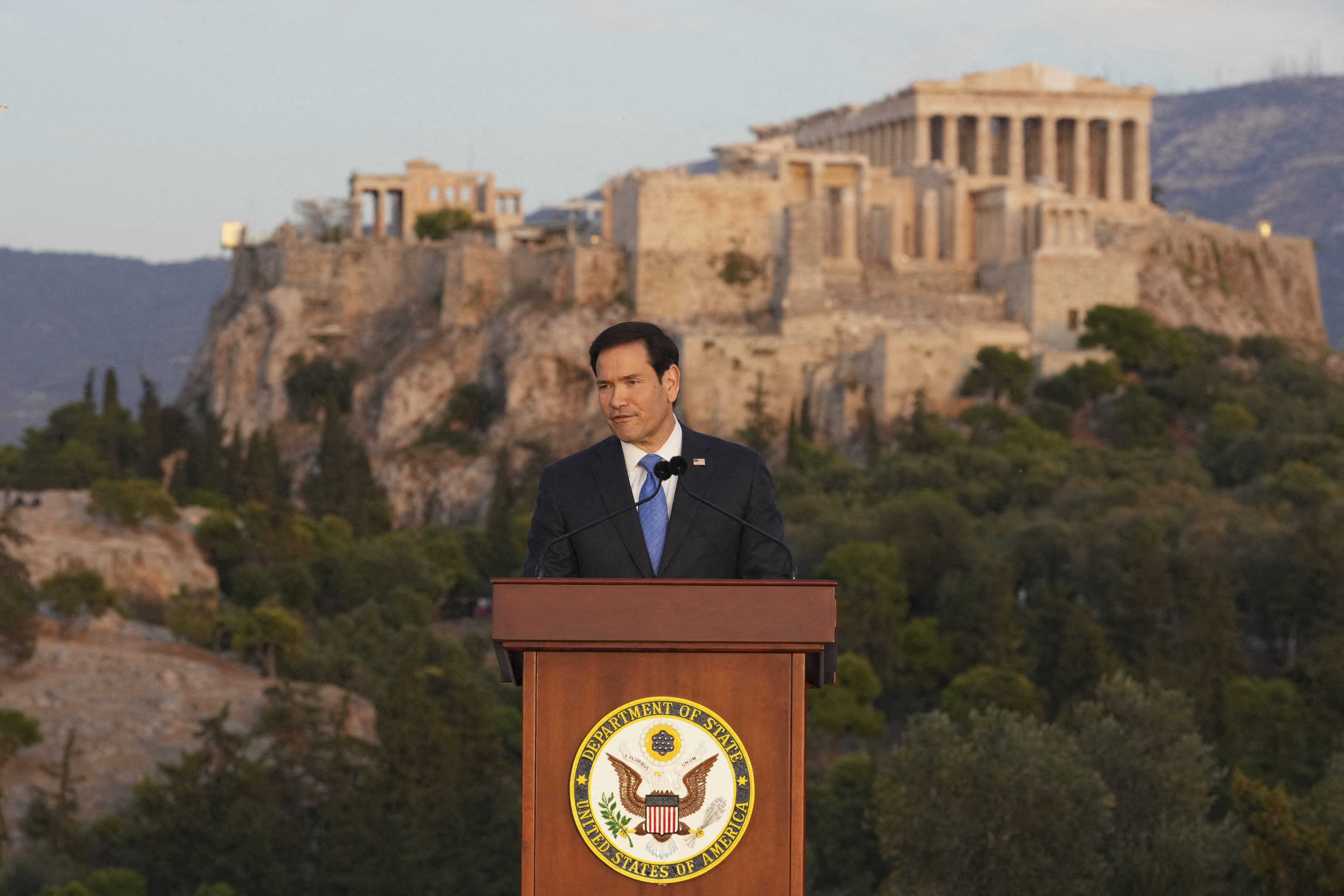
As Marco Rubio said at an Asian summit in Manila:
I saw Araghchi, the [Iranian] foreign minister, the other day say something about their policy is “an eye for an eye.” The president’s policy is “a head for an eye.” I mean, honestly, that’s what it’s gonna be. They will pay a very heavy price for the things they’re doing. They’re already paying a very heavy price. You guys don’t know it because you don’t cover it; you’re not in Iran; you’re not in the street; they don’t have a free media. But they’re going to continue to pay a very heavy price; their industrial base has been decimated; their defense industrial base has been decimated. They’re losing launchers; they’re losing radars every single night.
This is correct. It’s not an eye for an eye. It’s a head for an eye.
That’s option one: Actual victory.
Option two: Go antiseptic. This is the strategy of gradual escalation. We tried it in Vietnam. We have to be as clean as possible; it’s the strategy of an eye for an eye or tit for tat, or you hit a ship, and we hit a bridge.
But here’s the thing about the Iranians: they are perfectly willing to put out their own eye if it means you lose an eye.
An Iranian analyst close to the Iranian regime threatened, “It’s time to evacuate Kuwait, Qatar, Saudi Arabia, Bahrain, the UAE and probably Oman.” Trump is saying “an eye for an eye,” and the Iranians are saying “an eye for everything.”
Why is Iran doing that? Iran doesn’t have the military capacity to do all of that. We do. Why is he making that threat? Because he knows that threat works. It turns out that antiseptic and proportional in the statistical sense is very, very bad and foolish foreign policy. What you’re relegated to if you end up with this sort of tit-for-tat strategy is hoping they eventually collapse from within.
I never thought the administration would end up with this option, because historically, President Trump didn’t like this. He didn’t like forever wars; he liked the big spectacular strike that was over quickly, like the attack on Venezuela’s Maduro, or “Let’s kill Qasem Soleimani and then he’s dead,” or “Let’s hit the nuclear facilities in Iran, and then let’s leave,” as he did with Operation Midnight Hammer.
It seems that the president originally wanted to go very hard, but he was talked out of it by Turkey and Saudi Arabia and some of his own advisers, and then he got stuck in this tit-for-tat, gradual escalation, gradual de-escalation routine. And now we’re stuck here.
The quickest path to a forever war is to eschew using overwhelming force.
Option three: Give up on war. Give up on military optionality. Give up global power, recede within your own borders.
Isolationist pacifism has been tried before. It is legitimately one of the great failures in all of world history.
After World War I, when the Allies had imposed a peace on Germany, the Allies then refused to actually hold Germany to that peace. You can make the case that the Treaty of Versailles was too strenuous in its desire for reparations from the Germans; there’s a solid historical case for that.
But — there is no question that if France had stood up to Germany, if the Brits had stood up to Germany, if America had stood up to Germany in the interwar period, World War II would never have happened. Instead, Great Britain, France, and the United States all attempted to pursue a pacifist and isolationist strategy, and this led to the worst and most costly war in all of human history.
You don’t have to speculate that this is what they were trying to do. They openly said they were trying to do this. In 1928, the United States Secretary of State and the French foreign minister designed the so-called Kellogg-Briand pact. It outlawed war as an instrument of policy. The signatories to that agreement that outlawed war were the U.S., France, the U.K., along with Germany, Italy, and Japan.
You may notice that it didn’t work out well.
This is the theme of Churchill’s “The Gathering Storm,” the first volume of his World War II history. In 1933, students at Oxford University famously voted in favor of the so-called “King and Country” resolution. That resolution said that the students would “under no circumstances fight for king and country.”
That sounds exactly like what Laura Ingraham is saying.
Over the course of the 1930s, the United States slashed our military to the bone. By the time World War II broke out, the United States had the 19th largest military on planet Earth. We were stacked behind Portugal.
One of the reasons that World War II took so long and killed so many people is that once the United States got involved after December 7, 1941, it took us fully three years to rearm and then four years to win. If we had had that weaponry at the ready, would Pearl Harbor ever have happened?
Isolationism plus pacifism is a deadly combination because it turns out the world is a deadly place. Our enemies are not going to subscribe to those notions.
There’s also this very ahistorical notion that American foreign policy was once truly isolationist and pacifist. That’s nonsense. If you look at the history of America’s wars, America has been involved in conflicts all over the globe almost since its founding. We were fighting wars with the Barbary pirates under Thomas Jefferson.
Our national interests have always extended beyond pure physical threat. I know that some people think, “Unless we get physically hit, we cannot get involved in conflict.”
That is stupid. We have interests that require us to defend them. And sometimes — with luck as rarely as possible — that requires military force.
But to pretend otherwise is to be stupid.
The idea that America is supposed to lose or surrender to a third-rate regime that is shooting drones at ships opens the door to actual, significantly larger threats. Money will pour into Iran from China and Russia. They’ll rearm stronger than they ever were. China and Russia themselves will flex their muscle if you choose this path.
Americans are not pacifists. We’re not isolationists. We don’t like to lose. We like to win.
So let’s go do it.
More from this network:
Domains for Sale · GOTPeople.org · TheDSAPlatform · The Truth About Socialism
What's Your Reaction?
 Like
0
Like
0
 Dislike
0
Dislike
0
 Love
0
Love
0
 Funny
0
Funny
0
 Wow
0
Wow
0
 Sad
0
Sad
0
 Angry
0
Angry
0

I am just an average American. My teen years were in the late 70s and I participated in all that that decade offered. Started working young, too young. Then I joined the Army before I graduated High School. I spent 25 years in, mostly in Infantry units. Since then I've worked in information technology positions all at small family owned companies. At this rate I'll never be a tech millionaire. When I was young I rode horses as much as I could. I do believe I should have been a cowboy. I'm getting in the saddle again by taking riding lessons and see where it goes.
Premium domains for sale














Comments (0)