

The Motherhood Stage Nobody Talks About Might Be The Best One
Premium domains for sale
Freedom Is Back In Style
So much of the discourse about maternity these days, both positive and negative, revolves around babies. On the positive side, common refrains are about the ephemeral sweetness of baby smiles and toddler snuggles, being nap-trapped and inhaling that special infant scent. On the negative side, moms lament the lack of sleep, the endless stuff, and the incessant crying.
Freedom Is Back
In Style
Premium domains for sale
It makes sense that babyhood tends to get top billing. It’s a special, intense time. It’s also the time closest to another preoccupation of today’s conversation about parenting more broadly: whether or not to become one (or whether or not to become one again).
That said, the bulk of parenthood — both the work and the joy — isn’t baby-centered.
As I come to the likely end of my family’s baby years, with my youngest of four sons about to turn three while his eldest brother approaches 12, I find myself reflecting on our transition to this “all kids, no babies” stage.
Putting the “sweet” in bittersweet
My third son started kindergarten last week. Until now, he’s been in part-time preschool. I can’t deny that I cried more than a few tears when it hit me that this is my new normal. I put the two-year-old down for a nap in his toddler bed the other day and, for the first time since his birth, there was no big brother downstairs waiting for me. And, of course, even this new normal is ephemeral.
In a matter of weeks, the toddler bed will be gone. (An eagerly awaited second set of bunk beds is due to arrive any day.) Moreover, in a matter of months, no one will be napping at all. I probably haven’t had my final contact nap just yet (lots of big brothers means lots of sporting event sidelines at nap time) but it’s coming — and soon.
Having kids means that you’re always grieving what you’re losing, enjoying what you’re observing, and anticipating what’s next at the same time. Having several kids means that you’re sometimes doing all of these things on overdrive.
I have been reading to my crew over breakfast since 2021; when the third one came along, nights got too unpredictable for more than a few picture books. But we take a break over the summer. When we resumed our school year read-aloud routine a few days ago, I was delighted not to have to shout over my two-year-old, who babbled at the height of his voice during this ritual throughout last school year. Instead of competing with me for attention, he was engrossed in listening to “Stuart Little.” What a joy! Then I thought about how my oldest will be off to high school in a few short years. This time with four attentive listeners around the breakfast table is fleeting indeed.
See? Overdrive.
Here’s the thing: Taking joy in your kids’ growth does not eliminate its simultaneous sadness. Especially because, in a normal and healthy family ecology, each kid grows up faster than the one before. My two-year-old has five-year-old interests, while my five-year-old has eight-year-old ones.
But we can choose what we focus on. The centering of all our conversations around babies and babyhood makes it harder to zero in on the unique and equally special time with older children.
Sometimes, the emotional un-relatability of the moms who are “just so glad to be done” and seem to resent the waning demands of their kids’ little years makes the rest of us reluctant to admit that a family with everyone out of diapers does bring its own blessings.
Laying the foundation for family joy
There isn’t actually a binary between “I want to be forever drowning in babies” and “liberate me from this maternal hell.”
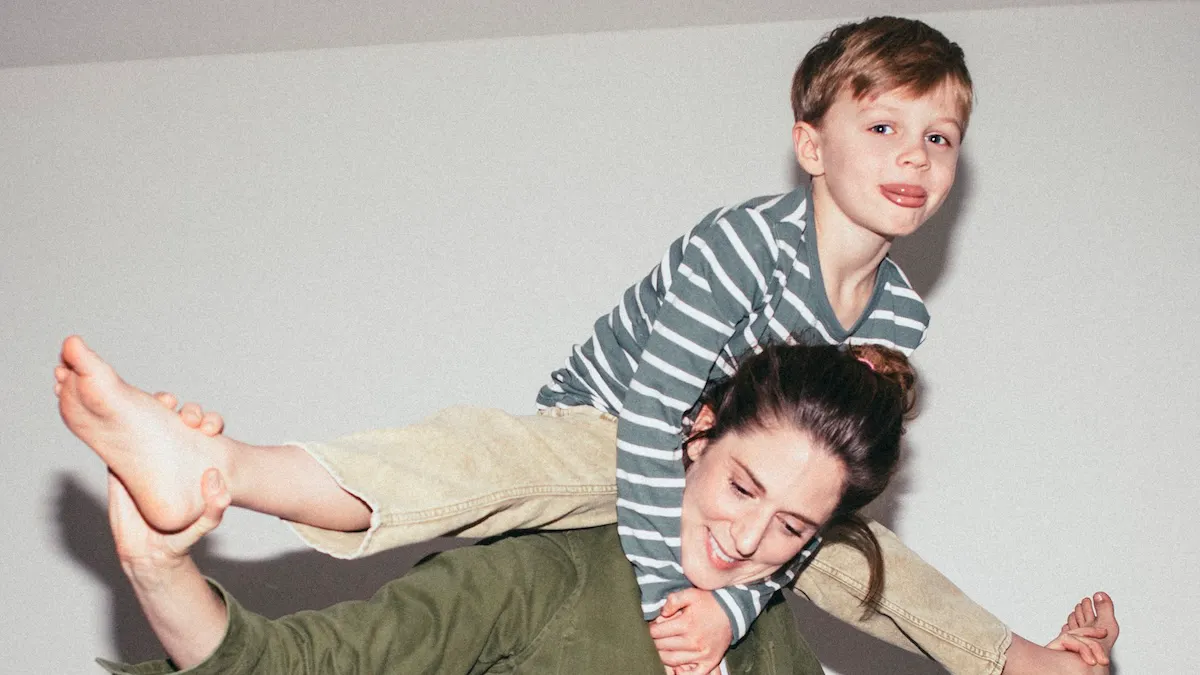
Motherhood looks and feels different at different stages. Right now, for me, it looks and feels like finally being able to pay attention to my tweens’ baseball games and cross country meets instead of wrangling a fussy baby.
In that liminal space — active maternity, but not matrescence — there can and will be real joy if you let yourself acknowledge it.
Here’s some advice, from someone in this transitional stage, for putting yourself in a position to do just that.
When they’re still little, sweat the big stuff but not the small stuff. Have you ever met an otherwise functional adult who can’t tie her shoes or drink from a normal cup? I haven’t. These kinds of readiness milestones come on their own, and it doesn’t really matter all that much when. There’s no need to push. There are, however, things worth pushing on. Being a sort of “tiger mom for behavior” pays enormous dividends because well-behaved, mannerly big kids are a lot of fun, while ill-behaved, boorish ones are mostly a nightmare. Moreover, initiating and following through early on skills such as potty training, reading, socializing, and swimming puts your kid in a position to be independent and sideline you — behaviorally, academically, athletically, and socially. Which is exactly what you want because it’s exactly what’s good for him or her (maternal pangs aside).
Be a cheerleader where you can. So much of the ennui of big kid parenting comes from over-involvement. It’s not just the rides everywhere. It’s the chore and academic scaffolding appropriate for seven-year-olds when kids are 11 and the behavioral concerns appropriate for three-year-olds when kids are seven. When you insist on high standards early, though, you can just sit back and cheer for your kid pretty often. If all the “musts” — such as appropriate behavior, basic manners, reading, and so on — were taken care of years ago, then you can experience your big kid’s wins (and losses) purely as his or her number one fan. In this context, individuation can be quite sweet indeed. In the past six months alone, I’ve watched my oldest son win his school’s “pi” contest, my older two sons win their rec league baseball championship, and my third-born run his first ever cross-country race. It’s sublime.
Introduce them to your favorite things. I have only one rule for those morning read-alouds: It has to be a book I like. Obviously, I am attentive to what my kids will like, too. But as kids get older, you can replace the monotony of “Little Blue Truck” with stories that also engage you. Even though I have boys, I’ve read them most of my “girlie” favorites, from “Little Women” to the American Girl series. This also goes for movies, hobbies, and plenty more. My 11-year-old is a real competitor at Scrabble now. My husband and I have enjoyed rewatching so many of our favorite films through his eyes and his brothers’, as well as introducing them to so many of our favorite local and vacation spots.
Tell them the truth. With older kids, you can have real conversations. You don’t actually have to sugar-coat what happened in the news — or what you think about it. (You should probably inculcate the virtue of tact first, though). You can bring them into the intellectual and moral trust that you share with your spouse to create a family culture of reason and integrity in a wider world that lacks both. And, honestly, that is pretty great, in more ways than one.
***
Elizabeth Grace Matthew writes about books, education, and culture, including on Substack.
This article is part of Upstream, The Daily Wire’s new home for culture and lifestyle. Real human insight and human stories — from our featured writers to you.
More from this network:
Domains for Sale · GOTPeople.org · TheDSAPlatform · The Truth About Socialism
What's Your Reaction?
 Like
0
Like
0
 Dislike
0
Dislike
0
 Love
0
Love
0
 Funny
0
Funny
0
 Wow
0
Wow
0
 Sad
0
Sad
0
 Angry
0
Angry
0

I am just an average American. My teen years were in the late 70s and I participated in all that that decade offered. Started working young, too young. Then I joined the Army before I graduated High School. I spent 25 years in, mostly in Infantry units. Since then I've worked in information technology positions all at small family owned companies. At this rate I'll never be a tech millionaire. When I was young I rode horses as much as I could. I do believe I should have been a cowboy. I'm getting in the saddle again by taking riding lessons and see where it goes.
Premium domains for sale





















Comments (0)