

The Quiet Suburban Shift Turning Safe Communities Into Radical Ground
Premium domains for sale
Freedom Is Back In Style
This article is part of Upstream, The Daily Wire’s new home for culture and lifestyle. Real human insight and human stories — from our featured writers to you.
Freedom Is Back
In Style
Premium domains for sale
***
Americans were shocked to learn that two teens from Bucks County, a wealthy suburb of Philadelphia, were charged in the March ISIS-inspired terrorist attack in New York City. As a Bucks County native, I wasn’t surprised.
Over the past decade, I’ve watched the county change from a peaceful suburb to an ideological battleground where progressives and conservatives regularly clash over culture war issues that are dividing America.
Emir Balat and Ibrahim Kayumi, Bucks County teens charged in the March 7 attempted terror attack, are from desirable communities and were educated at sought-after suburban school districts. Kayumi reportedly resided in a multi-million-dollar house in Newtown, an affluent township located less than a 10-minute drive from where George Washington famously crossed the Delaware River.
Bucks County boasts lush farms, prestigious school districts, and quaint historic towns. It has more than 10,000 acres of public parks where you can get lost in the beauty of nature while being less than an hour’s drive from the center of Philadelphia and its renowned restaurants and museums.
It was an idyllic place to grow up. How did it become a breeding ground for terrorists who hate America?

My kids playing at Tyler Park, a 1,700-plus-acre escape in Bucks County, Pennsylvania, located just 33 miles away from Center City, Philadelphia. (Photo by Meg Brock)
The Philadelphia Suburbs Flip Blue
Philadelphia has been in decline for over half a century. Its population peaked in 1950 when it reached over 2 million residents, and over the next five decades, hundreds of thousands of residents fled. The city’s population bottomed out in 2006 with a low of less than 1.49 million. Since then, it has experienced a small yearly increase in population largely fueled by immigration, according to a Pew report. The analysis noted the population increases came from an influx of foreigners replacing U.S.-born citizens. “From 2000 to 2016,” the report stated, “the number of foreign-born residents rose by roughly 95,000 while the number of U.S.-born Philadelphians fell by 44,500.”
This trend hasn’t stopped. Local news outlet WHYY reported in a March 2025 article that the migration of “foreign-born residents outweighed domestic migration out of the city” and noted, “More than 21,300 individuals immigrated to Philadelphia between 2023 and 2024, compared to 15,300 U.S. born residents who left.”
Today, almost one in five working Philadelphia residents is foreign-born, and there are concerns over how President Donald Trump’s crackdown on illegal immigration will affect the city’s population, according to recent reporting from The Philadelphia Inquirer.
Meanwhile, millennial parents swapped Philly for places like Bucks County to find safer communities and better schools in the suburbs. In the 2010s, 60,000 Philadelphia residents were leaving the city every year, and more than half of them were ages 18 to 34, according to Pew research.
I watched this happen in real time. My generation recognized the city was a fun place to live as a young adult, but its failing schools and rising crime made it an increasingly undesirable place to raise a family. Parents wanted to raise their kids in safety and didn’t want them attending schools where four out of five fourth graders aren’t proficient in reading, and who could blame them?
While parents may have voted against failed progressive policies with their feet, many took their voting habits to the suburbs.
For decades, the Philadelphia suburbs had been Republican strongholds. But in the 2010s, Philadelphia’s four surrounding counties — Bucks, Chester, Montgomery, and Delaware — shifted to Democratic control.
Montgomery County was the first county to flip when Democrat Josh Shapiro, now Pennsylvania’s governor, was elected county commissioner in 2011. Democrats completed their mission in 2019 with local wins that gave them control of Bucks, Chester, and Delaware counties.
To call the wins historic is an understatement. In Montgomery County, Democrats had won control of leadership for the first time in 140 years. In Delaware County, it was the first time they held power since the Civil War.
But there were more dynamics at play than just families fleeing Philadelphia. These wins weren’t only historic, but also strategic. Pennsylvania Democrats had long conquered Philadelphia and, fueled by their despondency over the election of President Trump, set their sights on conquering the suburbs.
Chapters of the radical progressive group Indivisible, an anti-Trump grassroots organization founded in 2016, popped up throughout the Philadelphia suburbs. Grassroots organizations worked alongside the Pennsylvania Democratic Party to channel their “anti-Trump furor” into winning local suburban elections.
Local Republican committees, filled with aging boomers and few under 40, were woefully unprepared for the fight. In 2019, Democrats Diane Marseglia and Bob Harvie defeated Republicans Gene DiGirolamo and Rob Loughery and claimed the leadership majority as county commissioners by the narrowest of margins — just 664 votes in an election with more than 450,000 registered voters. Democrats also won the four other countywide elections.
Harvie is currently running for Congress against a longtime Republican incumbent, Brian Fitzpatrick. DiGirolamo, the Republican elected as the minority commissioner, admitted to being totally shocked by the Republican losses, calling them “devastating” at a public meeting.
One of the biggest stories of the night was the 37% voter turnout — a historically high number for a local, off-year election. The average voter turnout for the previous eight off-year elections was only around 27%. Democrats had put the work in, and it paid off for their party.
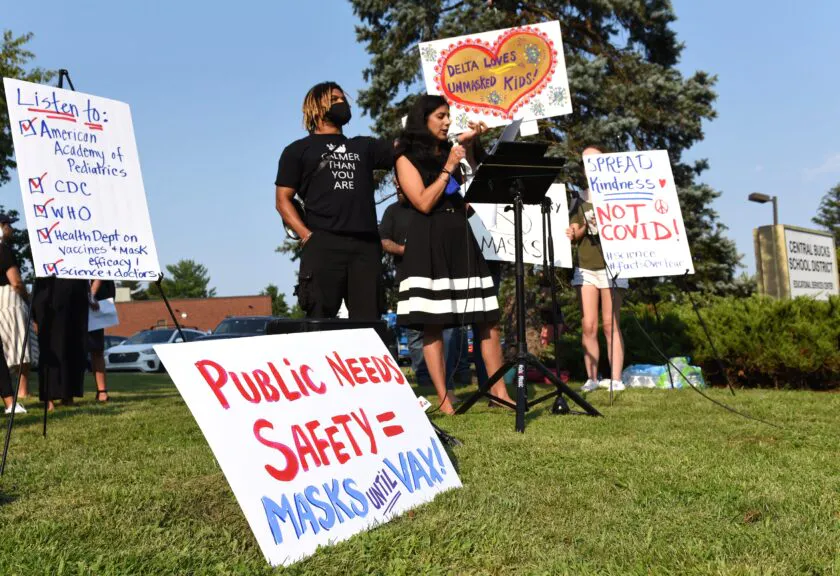
Protestors support a Democrat running for a seat on the Central Bucks School District at a press conference before a contentious school board meeting in July 2021. (Photo by Meg Brock)
Culture Wars Escalate During The Pandemic
America’s brewing ideological divide accelerated to a boiling point in 2020, and Bucks County was no exception.
Democrats Harvie and Marseglia were sworn into office in January 2020 and, though they made personnel changes during their transition into power, they kept the county’s health director, Dr. David Damsker.
Bucks is one of only a handful of counties in Pennsylvania with its own health department. According to Pennsylvania law, the county health director has the authority to determine school mitigation efforts during a disease outbreak.
While Pennsylvania’s Secretary of Health Rachel Levine imposed some of the most extreme COVID-19 mitigation policies in the nation, Damsker took a moderate, data-driven approach to COVID mitigation. He controversially advocated that Bucks County lockdowns end in early May 2020, against the wishes of then-Governor Tom Wolf.
Damsker faced full-blown attacks in June 2020 after he issued reopening guidance for Bucks County schools that recommended a full return to in-person learning and made mask use optional. The guidance said “in-person instruction” was “essential to our children’s emotional well-being, as well as their educational growth and advancement.”
The school guidance caused a sharp division within Bucks County. Many parents were thrilled about a return to in-person learning, while others were horrified. Social media was abuzz with passionate, divisive opinions on Dr. Damsker, masks, and in-person learning.
The Mideastern region president of the Pennsylvania State Education Association published a scathing op-ed in the local newspaper questioning Damsker’s credibility and demanding he change his recommendations.
School board meetings were filled to capacity throughout the 2020-2021 school year as parents argued for and against in-person school, masks, and vaccines, while school board members were slandered and even received death threats over educational decisions.
A political breaking point came in the late summer of 2021 as tensions were again stoked by the emergence of the Delta variant of the coronavirus. That summer, I literally felt the tension when I was physically assaulted by a Democratic township supervisor who struck me from behind with a “Masks Save Lives” sign during a school board press conference. The supervisor was charged with harassment and was later reelected.
Grassroots progressive groups and leaders from the local Democratic Party pressured Harvie and Marseglia to fire Damsker, claiming his school guidance, which did not require students to wear masks, endangered the community.
The school guidance became overtly political when Pennsylvania’s Acting Secretary of Health Alison Beam reached out to Commissioner Marseglia, rather than Damsker, about Bucks County’s school guidance. By the end of the day, Bucks County had changed its school guidance to align with the state’s demands.
Many in the community saw this as an example of Democrats playing politics with children’s education and believed the politicians, rather than the health director, wrote the guidance for political clout — something the commissioners adamantly denied. Suspicions were increased when Damsker, who’d been in the public eye for over a year, suddenly disappeared from the public purview. Many thought he’d been silenced by the Democratic commissioners.
Seeking clarity on what had happened, I began submitting public record requests and asked for records showing who wrote the updated school guidance. Instead of providing clarity, the county weaponized itself against me. The commissioners wrongfully blocked my phone number from calling any county government office, made up a defamatory story about me and published it in the local newspaper, and denied me access to public records.
After months of me fighting for transparency with the Bucks County Law Department (which was led by Joe Khan, who is now Bucks County’s district attorney), the Pennsylvania Office of Open Records ordered the county to fulfill my record requests. Instead of giving me the public records, Khan and the Bucks County Law Department filed the first of five lawsuits against me in June 2022.
After a three-year legal battle, Pennsylvania’s Commonwealth Court upheld a lower court ruling that Bucks County lawyers had acted in bad faith and wrongfully withheld public records and ordered them to pay $3,000 in civil penalties.
Khan was named the 2022 Government Lawyer of the Year by the Pennsylvania Bar Association for his work overseeing the Bucks County Law Department.
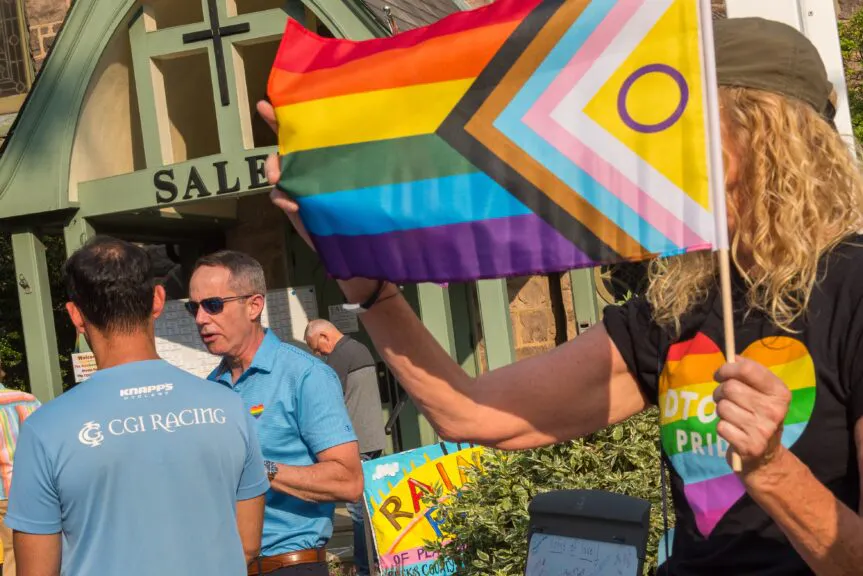
Bucks County Democratic chairman state Senator Steve Santarsiero (right) speaks with Bucks County District Attorney Joe Khan (left) at a rally supporting The Rainbow Room in Bucks County, Pennsylvania. (Photo by Meg Brock)
The Suburban Battle For America’s Future
The battle over Bucks County has continued beyond the COVID era, as reflected in the county’s election results. Bucks County Republicans swept countywide elections in 2021, Democrats swept countywide elections in 2023, President Trump won Bucks County in 2024, and in 2025, Democrats again swept countywide elections, giving them control of every county office.
Democrats are working hard to transform Bucks into an ideological extension of progressive Philadelphia.
In June 2020, for the first time in Bucks’ history, the LGBT pride flag was raised outside of the county administration building. Democratic commissioners celebrated the moment alongside The Rainbow Room, an LGBT youth club for children and adults ages 14 to 21, operated by Planned Parenthood. Social media accounts show the club has taught youth about transgender medical transitions, has celebrated “queer” sex and masturbation, and hosts a yearly queer prom.
Commissioner Harvie and state Sen. Steve Santarsiero attended the queer prom in February 2020. Both have helped secure taxpayer funding for The Rainbow Room, which regularly organizes student rallies for progressive causes.
Harvie and Marseglia proved that local elections can have national consequences in November 2024 when they voted to disregard Pennsylvania’s election laws and count illegal ballots after the 2024 election.
When he took office in January, Bucks County’s newly elected Democratic sheriff immediately terminated the county’s agreement with U.S. Immigration and Customs Enforcement and said the “public safety costs of this ICE partnership are greatly outweighed by any potential public safety benefits,” according to local reporting.
In addition to mirroring the radical social policies of Philadelphia, Bucks County Democrats are embracing its fiscal woes. Bucks County recently announced a countywide tax increase to make up for the county’s $16 million tax deficiency, which leaders blamed on the federal government.
On the surface, Bucks County might still look like an idyllic, moderate community, but it’s being run by radical progressives implementing policies similar to those that drove residents away from Philadelphia.
If you were shocked that two teens could be radicalized by ISIS in an affluent suburb, you haven’t been paying attention to the rapid ideological and population shifts that have occurred in America over the last decade. Leaders who openly disdain their constituents, publicly disregard the law, and focus on pushing extreme ideologies instead of good governance create fertile soil for homegrown radicalism.
Bucks County is a national political bellwether. It serves as a microcosm of what’s happening in major metropolitan areas around the country. Anyone concerned over America’s homegrown terrorists should pay close attention. The ideological battles happening in local suburban elections and school board meetings may very well determine our nation’s future.
More from this network:
Domains for Sale · GOTPeople.org · TheDSAPlatform · The Truth About Socialism
What's Your Reaction?
 Like
0
Like
0
 Dislike
0
Dislike
0
 Love
0
Love
0
 Funny
0
Funny
0
 Wow
0
Wow
0
 Sad
0
Sad
0
 Angry
0
Angry
0

I am just an average American. My teen years were in the late 70s and I participated in all that that decade offered. Started working young, too young. Then I joined the Army before I graduated High School. I spent 25 years in, mostly in Infantry units. Since then I've worked in information technology positions all at small family owned companies. At this rate I'll never be a tech millionaire. When I was young I rode horses as much as I could. I do believe I should have been a cowboy. I'm getting in the saddle again by taking riding lessons and see where it goes.
Premium domains for sale





Comments (0)