

The strange, dark story of how John 3:16 infiltrated American sports
Premium domains for sale
Freedom Is Back In Style
You don't have to be a Christian to know John 3:16.
Freedom Is Back
In Style
Premium domains for sale
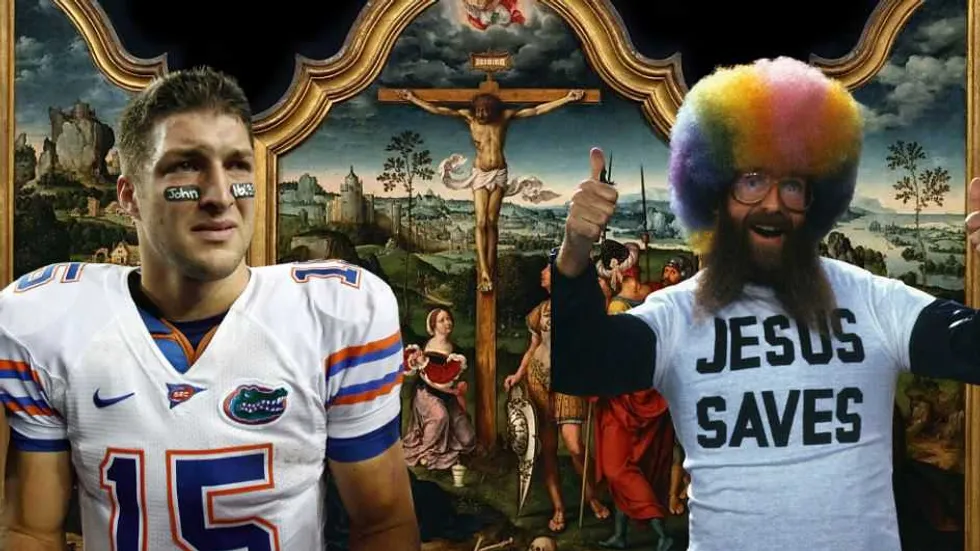
You may not know exactly what the verse says. But if you've watched enough American sports, you've probably seen the citation: on a sign behind the goal posts, beneath Tim Tebow's eyes, or this summer, written on the Pride caps of three San Francisco Giants pitchers.
Convinced that the rapture was imminent, he wanted to warn the world before it was too late.
For decades, six characters and a colon have served as American sports' unofficial Bible verse.
Why this one? The answer begins long before television and eventually involves Martin Luther, D.L. Moody, a rainbow-wigged publicity seeker, Google, a hostage crisis, and a controversy this summer over Bible verses written on baseball caps.
The gospel in miniature
John 3:16 appears during Jesus' nighttime conversation with Nicodemus in the Gospel of John:
"For God so loved the world, that he gave his only begotten Son, that whosoever believeth in him should not perish, but have everlasting life."
Christians noticed early that the verse managed to pack an extraordinary amount of Christianity into a single sentence. Around the turn of the fifth century, John Chrysostom marveled that although John wrote concisely, "each word had much significance." From the verse, he drew God's love for sinful humanity, the giving of the Son, faith, salvation from destruction, and the promise of eternal life.
Martin Luther later became famous for calling John 3:16 "the gospel in miniature." By the 19th century, the verse had become especially important to evangelical preaching. The English evangelist Henry Moorhouse preached on God's love from John 3:16 repeatedly during a visit to D.L. Moody's church in Chicago. Moody later described the experience as transforming his understanding of God's love.
It was hard to compress the Christian message much further than John 3:16.
Then came the perfect way to distribute this message: live television.
Enter the Rainbow Man
Rollen Stewart initially had nothing to say about Jesus. He wanted to be famous.
According to Sam Green’s 1997 documentary, "The Rainbow Man/John 3:16," Stewart discovered the power of television during the 1977 NBA Finals in Portland. Wearing a rainbow-colored Afro wig, he danced for a cameraman filming the crowd and managed to get himself onto the broadcast.
During the 1977 NBA Finals, Stewart discovered that television offered a shortcut to celebrity. There was no need to get cast in anything if he simply went where the cameras were already going and made himself difficult to ignore.
So he put on a rainbow-colored Afro wig and started showing up at major sporting events. He danced for the cameras and learned to anticipate where they would point next.
"Once I saw the red light, I was hooked," he later recalled.
Soon the Rainbow Man was everywhere, and Stewart became surprisingly sophisticated about getting himself into the picture. At football games, he positioned himself between the goal posts, where the field-goal camera would find him. At baseball games, he appeared behind home plate. At the Masters, he maneuvered himself over Jack Nicklaus' shoulder as Nicklaus prepared to tee off.
Best of all, he carried a small battery-powered television. Stewart could stand inside a stadium, watch the broadcast he was attempting to infiltrate, and adjust his position according to what the director was putting on the screen.
He wasn't even much of a sports fan. "I despised sports," he admitted years later. The games were useful because television covered them live.
After the 1980 Super Bowl, Stewart returned to his hotel room depressed. He had spent years trying to become famous and discovered that being famous wasn't doing much for him. He turned on the television, encountered Bible prophecy teacher Charles Taylor, and subsequently became a born-again Christian.
The rainbow wig stayed. But Stewart now had something besides himself to advertise.
John 3:16.
6 characters and a colon
The choice was unusually well suited to what Stewart was doing. Christians had spent centuries treating John 3:16 as the gospel in miniature: In the King James Bible, the verse takes 25 words to move from God's love for the world to the promise of everlasting life. Stewart figured out how to shrink it even further. Forget the verse itself. All he needed were six characters and a colon, large enough to read on television. The viewer could look up the rest.
In 1984, Christianity Today reported that Stewart had displayed his banner at eight football stadiums in five days. He appeared at professional golf tournaments, championship basketball games, the World Series, football bowls, and even the wedding of Prince Charles and Lady Diana.
The fact that many viewers had no idea what John 3:16 meant didn't bother him. It was part of the idea.
"If they don't know what John 3:16 means, most people will eventually try to find out," Stewart told the magazine. "And some will pick up their Bibles and begin reading it."
Television networks charged advertisers enormous sums to reach the audiences watching America's biggest sporting events. Stewart had figured out how to place his message inside the same broadcasts without buying airtime at all.
Live sports made the scheme possible. A network could edit an entertainment program before broadcasting it. It couldn't edit a field goal before showing it. If Stewart got himself behind the goal posts before the kick, by the time the director realized what was happening, John 3:16 was already in America's living rooms.
Eventually, the networks and sports organizations became less cooperative. Camera operators tried to frame Stewart out, while stadiums restricted his banners. By 1986, Christianity Today reported that all but one of the NFL's 28 teams had prohibited them.
At Washington's RFK Stadium, the fight became a federal lawsuit after security prevented Stewart and an associate from displaying John 3:16 banners. Elsewhere, Stewart devised Scripture banners that could be worn like ponchos and exposed by spreading his arms.
"They'd have to undress us to take away our gospel signs," he said.
By then, however, the mysterious citation was becoming part of the scenery of American sports.
Did anybody actually look it up?
There was an obvious question about Stewart's entire enterprise: Did anybody sitting at home actually do what he hoped?
Mike Kerrigan did.
The Charlotte attorney was about 11 when he kept noticing the Rainbow Man during football games. Eventually, he asked his father what John 3:16 meant.
His father didn't know either.
"Let's look," he said. They opened a Bible.
Kerrigan still remembered the moment decades later, when he wrote about it in the Wall Street Journal in 2024. Stewart had predicted that an obscure biblical citation on television might make someone curious enough to find a Bible. In at least one living room, that is exactly what happened.
Unfortunately, Stewart's own story didn't end nearly as happily.
Rainbow's end
His life began to unravel toward the end of the 1980s. His marriage collapsed. His money disappeared. His religious beliefs became increasingly preoccupied with elaborate predictions of an imminent apocalypse.
Television remained his constant companion. Living in cheap Los Angeles hotels, Stewart later described watching as much as 18 hours a day: Christian broadcasters, daytime talk shows, news magazines, reality television, and more preachers at night. He called it being "fed by the media."
Eventually, appearing on television was no longer enough. Stewart began trying to create events that would force television to cover him.
In 1991, authorities accused him of setting off foul-smelling devices at several Southern California locations, including the Crystal Cathedral, Trinity Broadcasting Network studios, and a Christian bookstore.
Then, on Sept. 22, 1992, he took over a room at a Hyatt hotel near Los Angeles International Airport with a gun. Two day laborers escaped. A hotel maid locked herself in the bathroom. Stewart covered the windows with religious messages and demanded a lengthy live press conference. Convinced that the rapture was imminent, he wanted to warn the world before it was too late.
Green's documentary includes an audio recording of Stewart speaking with a police negotiator during the standoff.
"I've watched the cops, you know, cop shows and tried to get a handle on what's going on," Stewart explains.
"Maybe you look at a little bit too much TV," the negotiator replies.
"I watch a lot of it."
After roughly nine hours, police stormed the room and arrested him. Stewart was sentenced in 1993 to three life terms with the possibility of parole.
From the family Bible to Google
Once the Rainbow Man was gone from sports television, the signs persisted.
On Jan. 8, 2009, Florida played Oklahoma for the national championship. Gators quarterback Tim Tebow had spent the season wearing Philippians 4:13 — "I can do all things through Christ who strengthens me" — on the eye black beneath his eyes.
For the championship game, however, he decided to switch to John 3:16. Coach Urban Meyer was horrified. A superstitious man, Meyer wasn't about to tamper with a winning formula. "That verse got us here!" he protested, according to Tebow's later recollection.
Tebow explained that John 3:16 expressed the essence of his Christian faith. Meyer relented.
Florida won the national championship, and Tebow had an advantage Rollen Stewart could only have dreamed of: The cameras were trying to find him.
During the game, viewers began searching the citation online. By the following morning, "John 3:16" had become Google's hottest search term.
Twenty-five years earlier, Stewart had imagined people seeing the citation and going to find a Bible. Well, now they had Google.
The story subsequently acquired an almost suspiciously neat postscript. On Jan. 8, 2012 — exactly three years after the national championship — Tebow led the Denver Broncos against the Pittsburgh Steelers in an NFL playoff game. Denver won on an 80-yard touchdown pass on the first play of overtime.
Tebow had thrown for exactly 316 yards. Because he completed 10 passes, he averaged 31.6 yards per completion.
RELATED: What Fulton Sheen understood about fame that today’s Christian influencers don’t
 Michael Ochs Archives/Getty Images
The verse that wouldn't leave sports
By 2011, the connection between John 3:16 and televised sports was so familiar that a proposed Super Bowl commercial was built around it.
The ad showed football fans watching a game on television. The broadcast zoomed in on a quarterback with John 3:16 written beneath his eyes.
"I'll look it up," one of the fans says, reaching for his smartphone.
Fox declined to air the commercial under its policy against advertisements from religious organizations intended to advance particular beliefs or practices.
The citation continued turning up elsewhere. In 2012, a Texas school district became embroiled in a legal fight over cheerleaders putting Bible verses on the banners through which their high school football team ran onto the field.
And this summer, San Francisco Giants pitcher Landen Roupp employed a version of Stewart's old tactic — with a different Bible verse.
During the team's June 12 Pride Night, Roupp wore a special rainbow-logo cap but wrote "Gen. 9:12-16" across it, partially covering the logo.
Two other Giants pitchers, JT Brubaker and Ryan Walker, also added biblical citations to their caps.
Roupp had chosen the passage in which God establishes the rainbow as the sign of His covenant with Noah, promising never again to destroy the earth with a flood.
The Giants' rainbow logo had acquired an unexpected biblical footnote.
MLB warned the three pitchers not to repeat the inscriptions, explaining that its uniform regulations prohibit unauthorized messages of any kind. The league emphasized that its warning "had absolutely nothing to do with the content of the message."
Roupp was unapologetic. "That's just kind of something I believe in, and I stand firm in that," he told reporters.
There was no indication that Roupp had taken inspiration from Stewart. But the resemblance was striking. Nearly half a century after the Rainbow Man first appeared on television, a baseball player had put another biblical citation in front of the cameras, leaving viewers to discover the verse for themselves.
More from this network:
Domains for Sale · GOTPeople.org · TheDSAPlatform · The Truth About Socialism
What's Your Reaction?
 Like
0
 Dislike
0
 Love
0
 Funny
0
 Wow
0
 Sad
0
 Angry
0

I am just an average American. My teen years were in the late 70s and I participated in all that that decade offered. Started working young, too young. Then I joined the Army before I graduated High School. I spent 25 years in, mostly in Infantry units. Since then I've worked in information technology positions all at small family owned companies. At this rate I'll never be a tech millionaire. When I was young I rode horses as much as I could. I do believe I should have been a cowboy. I'm getting in the saddle again by taking riding lessons and see where it goes.
Premium domains for sale









Comments (0)