

Trump Set To Roll Out Red Carpet For Xi Weeks After Accusing Him Of Election Interference
Premium domains for sale
Freedom Is Back In Style
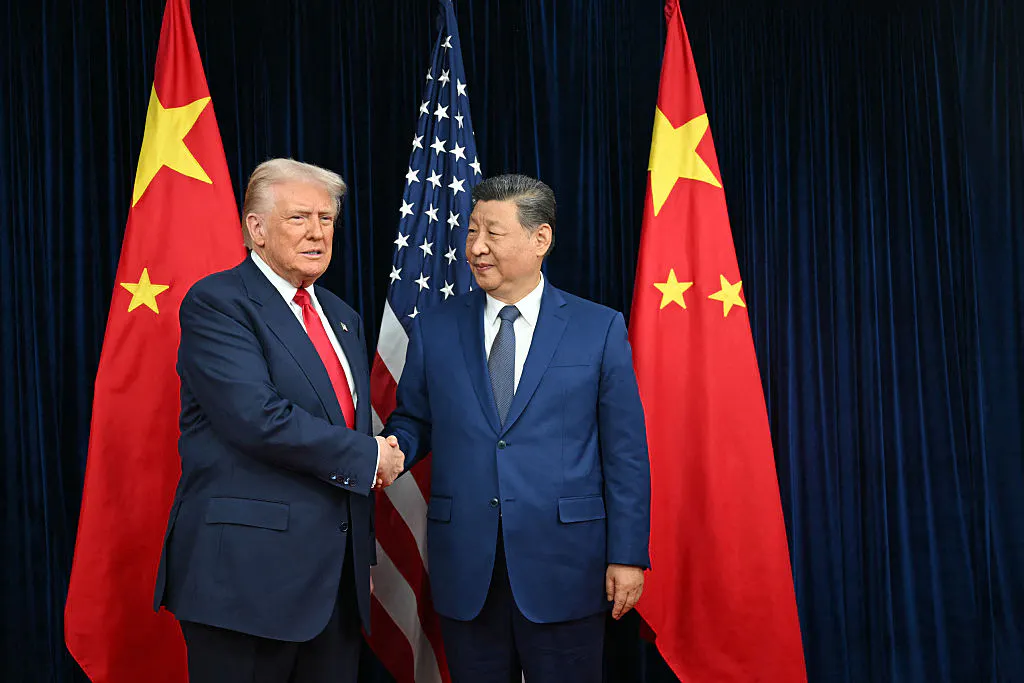
President Donald Trump is set to host Chinese President Xi Jinping at the White House this week, just two months after accusing Beijing of interfering in U.S. elections during a prime-time address.
Freedom Is Back
In Style
Premium domains for sale
Xi is scheduled to arrive in Washington on Wednesday, where he will be personally greeted by Trump at Joint Base Andrews. The visit is expected to include bilateral talks and a state dinner, with trade, artificial intelligence, national security, Taiwan, and the war in Iran among the issues likely to be discussed.
This is the second meeting between the two leaders this year, following Trump’s visit to China in May.
The timing puts a series of unresolved disputes between Washington and Beijing in the spotlight alongside a high-profile diplomatic meeting. The two countries are still negotiating trade issues, including rare-earth exports and technology restrictions, while clashing over China’s relationship with Iran and broader national security concerns.
The visit also comes after Trump delivered a prime-time address in July accusing China of obtaining the personal information of as many as 220 million American voters and engaging in election interference. The White House said the declassified intelligence showed China and its proxies had bought, stolen, or hacked American voter registration data.
In his July 16 address, Trump said Chinese officials had pursued efforts to undermine his political support dating back to 2018, including attempts to influence the 2018 midterm elections and the 2020 presidential election. He said a Chinese policy adopted in 2018 sought to leverage “any domestic and foreign elements opposed to Trump” to reduce his support, force his resignation, or prevent his re-election.
Trump said China also obtained American voter data beginning during the 2020 election cycle.
“Newly declassified documents show that over a period of years starting during the 2020 election cycle, the People’s Republic of China carried out what is believed to be the largest compromise of election data in history — resulting in China’s illicit acquisition of 220 million U.S. voter files,” the president said.
The White House said the compromised information included names, addresses, phone numbers, and political party preferences, adding that U.S. intelligence agencies had learned in 2020 that voter data from 18 states had been bought, stolen, or hacked by China.
Trump also alleged that Chinese activities included an attempt to manufacture illegal ballots for then-candidate Joe Biden. He said raw FBI intelligence from 2020 described the alleged effort and that dozens of CIA and NSA reports concerning China’s targeting of the U.S. election were kept out of the Presidential Daily Briefing.
“The reason they wanted me to lose is because they knew I was wise to them, charged them billions of dollars’ worth of tariffs, and built the strongest military anywhere in the world,” Trump said.
But the election-interference allegations have largely faded from Trump’s public messaging ahead of Xi’s visit, with no consequences imposed on the Chinese Communist Party. Instead, the two leaders are set to focus on the broader U.S.-China relationship, with trade and economic issues high on the agenda.
Trade is expected to be a central issue, with the two sides discussing the continuation of their existing tariff truce, Chinese purchases of American goods, and access to rare-earth minerals.
A key deadline is also approaching: Temporary agreements suspending Chinese export controls on rare-earth products and delaying expanded U.S. export controls on advanced semiconductor chips are both set to expire November 10.
American companies have continued to report difficulty obtaining some Chinese export licenses for rare earths used in specialized magnets, while Beijing has also restricted exports of phosphate, a key fertilizer ingredient, reported NPR.
The two sides will also have to address trade commitments made during Trump’s May visit to China. Beijing agreed to purchase 200 Boeing aircraft, but the deal has encountered obstacles as U.S. restrictions have complicated the delivery of replacement parts for Boeing planes and China’s C919 commercial jet, which still relies heavily on American and European components.
Chinese officials have also reportedly objected to recent Federal Communications Commission restrictions on Chinese-made drones, routers, inverters, and robots, arguing that the measures violate the framework for “strategic stability” established during Trump’s spring visit to Beijing.
Artificial intelligence is another major area of competition. The two countries are seeking to manage AI-related risks while simultaneously competing over advanced technology and semiconductor access. Notably, several high-profile executives from the AI sector are invited to the state dinner with Xi.
Trump did brag about the U.S. being ahead in AI earlier this week.
“We’re leading China in AI. We’re the most sophisticated country in the world and, frankly, I want to keep it that way — because whoever wins AI wins,” he said.
Iran is also likely to feature in the discussions. The Trump administration has repeatedly raised concerns about China’s economic relationship with Tehran, including its purchases of Iranian oil.
China’s foreign minister met with Iranian Foreign Minister Abbas Araghchi on Wednesday and vowed that Beijing is prepared to protect Iran’s “legitimate rights and interests” as the U.S.-Iran conflict continues.
Trump has worked to remain diplomatic ahead of the meeting, dismissing a report this week that Chinese entities provided Iran with satellite imagery before a July missile strike on a U.S. base in Jordan that killed three American troops.
“You know what they say? That China spies on us. I say you’re right, and we spy on them, too,” Trump said.
The state dinner will add another layer of complexity to the visit, with limited seating creating a diplomatic dispute of its own.
When Trump visited China in May, Xi hosted him with a formal welcome and elaborate state dinner. Now, the two leaders are preparing for a similar display of diplomacy in Washington, but the logistics have already created friction.
The White House is planning a dinner with about 100 seats, according to Trump, who continues to stress the need for the planned White House ballroom. Chinese officials have asked for more than half of the available seats, in part so Xi can bring Chinese business executives with him, according to two people familiar with the discussions who spoke to NPR. The request has prompted pushback from the White House.
First lady Melania Trump offered a glimpse of the preparations Thursday, posting a video showing flowers and table settings being arranged for the dinner. “Every detail considered. An experience thoughtfully conceived and exquisitely realized for our distinguished guests,” she wrote.
THE WHITE HOUSE STATE DINNER
Every detail considered. An experience thoughtfully conceived and exquisitely realized for our distinguished guests. pic.twitter.com/MSVh8IY1SA
— First Lady Melania Trump (@FLOTUS) September 17, 2026
Trump is scheduled to address the United Nations General Assembly in New York on Tuesday, September 22, following Brazilian President Luiz Inácio Lula da Silva’s opening address. He is also set to meet with various world leaders, including those of the Gulf States and possibly Israeli Prime Minister Benjamin Netanyahu.
Xi is skipping the U.N. gathering this year and will instead only travel to Washington for his meeting with Trump later in the week.
More from this network:
Domains for Sale · GOTPeople.org · TheDSAPlatform · The Truth About Socialism
What's Your Reaction?
 Like
0
Like
0
 Dislike
0
Dislike
0
 Love
0
Love
0
 Funny
0
Funny
0
 Wow
0
Wow
0
 Sad
0
Sad
0
 Angry
0
Angry
0

I am just an average American. My teen years were in the late 70s and I participated in all that that decade offered. Started working young, too young. Then I joined the Army before I graduated High School. I spent 25 years in, mostly in Infantry units. Since then I've worked in information technology positions all at small family owned companies. At this rate I'll never be a tech millionaire. When I was young I rode horses as much as I could. I do believe I should have been a cowboy. I'm getting in the saddle again by taking riding lessons and see where it goes.
Premium domains for sale









Comments (0)