

Victor Davis Hanson: Rubio’s Athens Speech Could Solve the West’s Identity Crisis
Premium domains for sale
Freedom Is Back In Style
Editor’s note: This is a lightly edited transcript of “Victor Davis Hanson: In His Own Words” from Daily Signal senior contributor Victor Davis Hanson. Subscribe to Victor Davis Hanson’s own YouTube channel to watch past episodes.
Freedom Is Back
In Style
Premium domains for sale
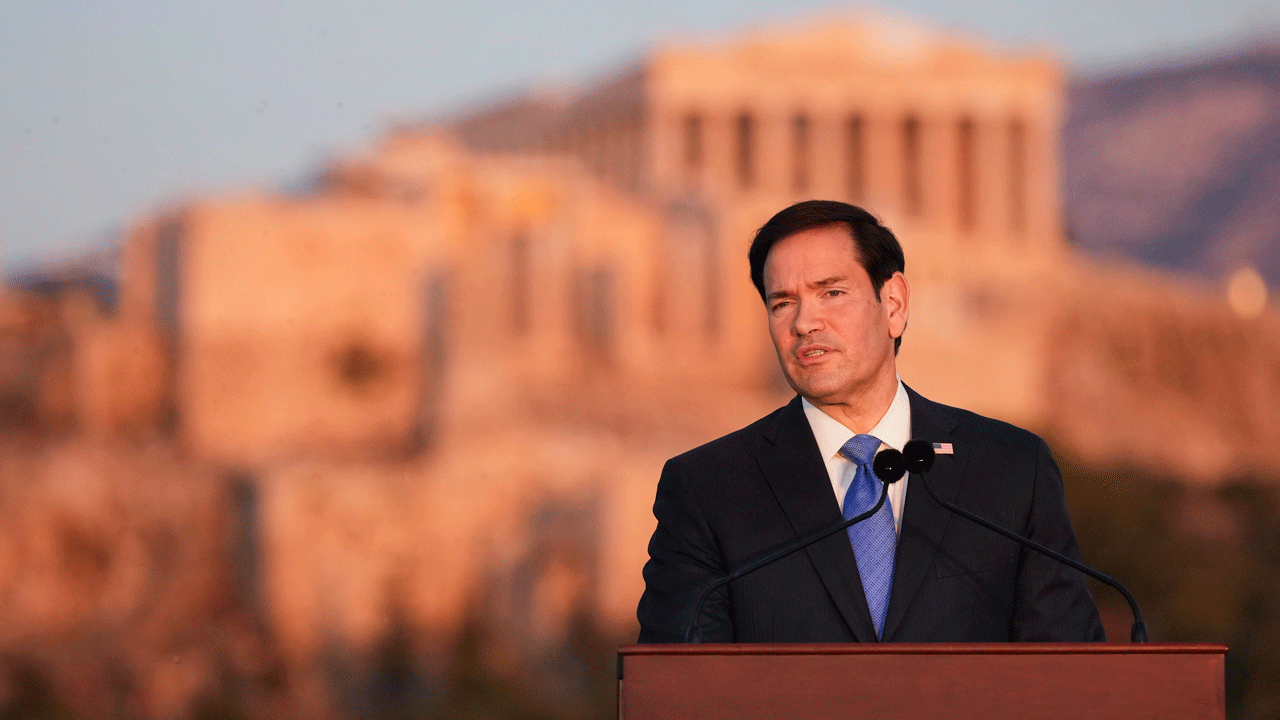
Jack Fowler: Did you see [Marco] Rubio’s speech in front of the Parthenon, and what are your thoughts on it?
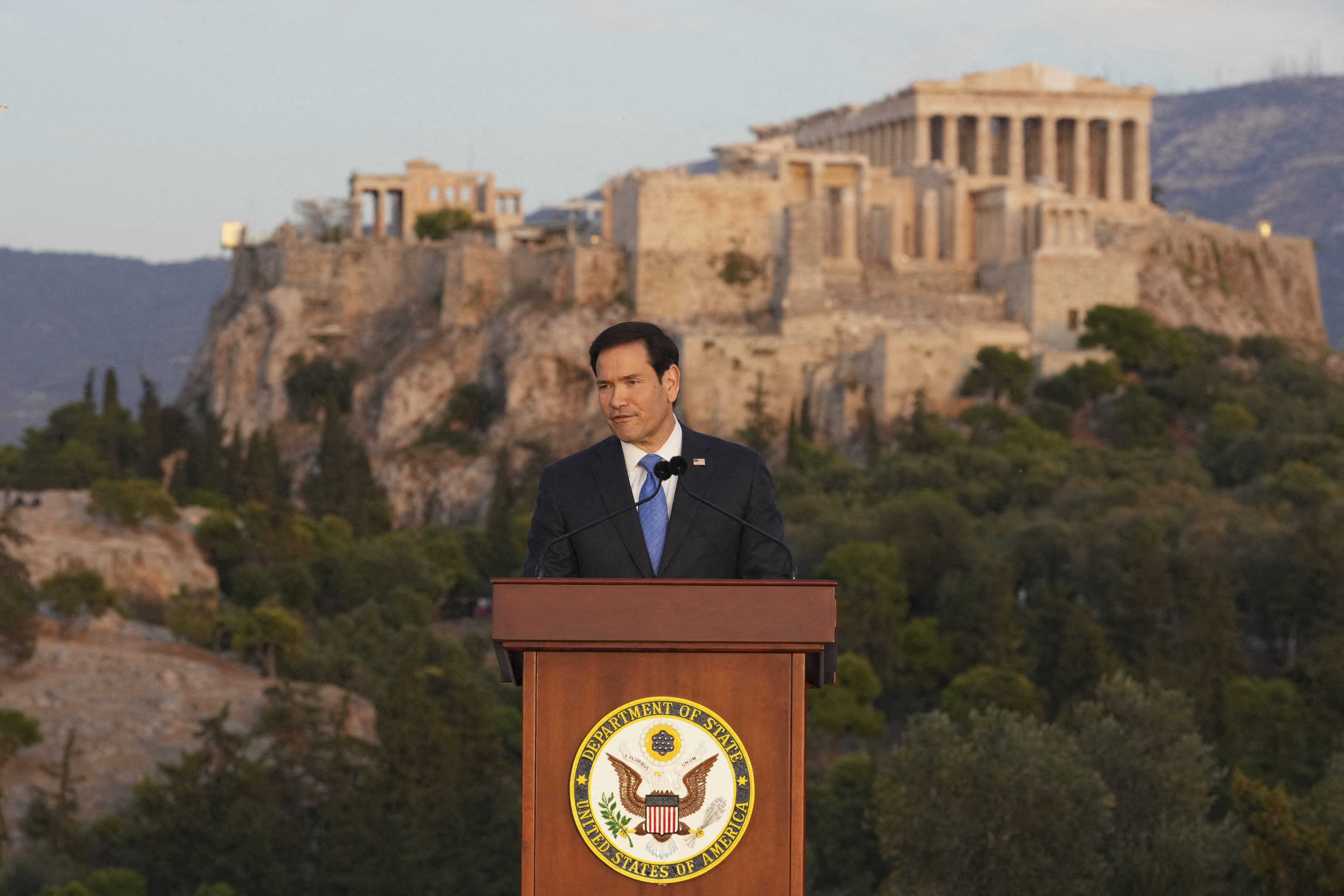
Victor Davis Hanson: Well, it was given on the Pnyx, P-N-Y-X in English, and that’s where the Athenian demos met maybe twice a month, the ecclesia. And it holds about 8,000 people, and the seats are carved into the rock, and then there’s something called the bema where the speaker would address them, and they would look up at the Acropolis, and they could—I should say at the Parthenon—et cetera.
You saw that shot. It was deliberate. So he was taking the stance of Pericles when he, in the second year of the Peloponnesian War, gave the famous funeral oration. So I don’t know who wrote it. I’ve heard different people contributed to it. It was very good, I thought.
The only thing that was startling was the emphasis on thumos. Thumos, T-H-U-M-O-S. We get the thymus gland from it, thymus, and it refers in the Homeric sense. Homeric heroes have something that swells up in them. It’s larger than life.
You know, it’s… I think we would call it manic depression or something, but you feel like you’re enthusiastic. That’s another word for en theos, the God is in you, and it makes you be larger than life. You have a great idea.
It may be what Elon Musk had at one point when he envisioned SpaceX or Tesla, or maybe it’s what [Thomas] Edison did when he wanted to electrify the United States, or maybe it was what Alexander Graham Bell had, or maybe it was what [Gen. Ulysses S.] Grant had at Shiloh when he said, “Lick ’em tomorrow,” even though he had been defeated and humiliated on day one.
So you can’t define it, but it’s often in a martial context.
And the other thing about it is it’s an early Greek manifestation. It appears mostly in Homer. It’s used in the classical period, but it’s in different contexts.
So my point is they were almost telling people, I don’t know if they meant it or not, that we’re all going to be Homeric heroes on the battlefield of Troy, and we’re going to do outstanding things that defy rational explanation. So some classicists said, “Well, it’s not the irrational or the th—”
And there’s a famous classicist, E.R. Dodds, who wrote a book called “The Greeks and the Irrational”, and he has a chapter about it, as I recall. But in any case, they were saying, well, the real legacy is rationalism, Aristotelian rationalism, the Stoics, the Epicureans, the Academy, the Lyceum.
And I have a really good article, I thought it was really good, in the latest issue of The New Criterion about the —
Jack Fowler: It’s exceptional, Victor. I recommend everyone go find it. And if you can buy it as a single article if you need to.
Victor Davis Hanson: It’s basically about the discovery of rationalism or how Greeks thought about things, and that they saw the world as not mysterious.
I thought maybe that had influenced one of the writers because he was saying that they, in the speech, they didn’t see everything as blank or incomprehensible, but they had a rational system—you know, physics, metaphysics, biology, mathematics. They could break down any natural phenomenon or inquiry into a field, and then they would know how to inductively reason to find the answer, and that was what marked the West off from other cultures. But yeah, I thought it was really good.
A lot of people in Europe didn’t like it, but basically, the speech was basically this: We in the West are in a period of ennui or indecision or directionlessness or we’re listless. And our culture is superb. It’s preeminent. And there’s nothing close in the world today. We’re either going to lose the world without the West or we’re going to save it with the West.
And he went through the trajectory from Greece to Rome to the church to medievalism to the Renaissance to the Enlightenment to the British empirical tradition, Scottish Enlightenment, to the United States’ Founders. And it was very good.
And he was trying to say, “Don’t tear down monuments. Don’t change names.” I don’t know if he said change names. I want to stop because [Donald] Trump has changed names. But Trump’s names are not because of somebody’s sin. That’s the difference.
In other words, Trump says we want to name things for America because geographically they’re in or near or proximate in America. And we want to reference them from our point of view, not Mexico’s or Canada’s. But what he meant was don’t destroy things.
There’s a word, damnatio memoriae. Don’t condemn memory and try to erase it. Be confident and accept that we do things very well in the West. And we have universities, and we have the rule of law, and we have constitutionality, and we have free-market capitalism. And right now, we’re in trouble. And we’re not defending ourselves, our fertility, our ideologies. They’re anti-Western. And our enemies and our people within our own borders are trying to overthrow the West. So that was a very controversial thing to say.
Jack Fowler: Victor, Donald Trump. What are my notes here? Yeah.
President Trump said Saturday, that’s yesterday, that it was, quote, “Time for Ukraine to get a new president,” end quote, warning Ukrainian President Volodymyr Zelenskyy to stop attacking Russian oil refineries as the two leaders clashed over a U.S. deal with Moscow. “It’s time for Ukraine to get a new president,” Trump told reporters outside the White House, et cetera.
Well, it’s probably been a long time since they needed to get a new president, but what are your thoughts on that, Victor?
Victor Davis Hanson: Well, what is hurting, what’s causing this? We have 3.4% inflation. It’s lower than 5.1%, but it would be much, much lower. It would be as if we were back in the first term where the average inflation rate was 1.9.
And the reason is not just that we’re paying, you know, here in California, we paid yesterday $7 a gallon. But it’s diesel fuel, which is the fuel that runs the whole economy in the sense of trucking. Everything involving trucking is it’s essential to the whole country. And when you’re paying in California $8.50 a gallon and maybe nationwide $6, it’s an untenable situation.
So I understand why he was upset because Russia is one of the largest suppliers of—not so much oil, but they do, of course, but refined diesel fuel. And when you take out, when you know they’re making a fortune, and I understand why Zelenskyy’s doing it. He’s hitting the diesel refineries because the world is short diesel fuel, and the Chinese need it, the Europeans need it, and Russia is supplying it. And the United States wants the price down, and obviously, if the Russian refineries were at full capacity, the price of diesel fuel would go down.
That said, he’s in a war for his own survival, and the Russians almost every single day are hitting things. That said, we’ve given them $140 billion, and they won’t survive without U.S. continued aid.
So, Donald Trump, basically, when you put all of those conflicting, incompatible interests together. He is saying privately… I mean, you’ve been reading. Privately, he said hit anything else, but just for right now, do not hit the diesel refineries because it’s killing the United States—the Western economy. And Zelenskyy said, yes, but it’s also fueling the war machine that’s killing my people.
And then Trump obviously would have said, okay, but you wouldn’t be there if we hadn’t supplied you more than almost anybody. And then Zelenskyy would reply and say, but I’m fighting against a common enemy of the West, and it’s your interest that Putin’s expansionist policies have been stymied by the heroism of the Ukrainians, and back and forth.
And so I can see why there was concern, but I don’t think it’s wise to conduct foreign policy like that.
The other problem is that when we see our allies at war, I guess Ukraine is an ally, and there are periodic elections. We and the British don’t cancel elections. So we do two things. In a major existential war, we bring in a bipartisan war cabinet. That’s why Churchill brought in [Neville] Chamberlain, and he brought in people, [John] Bevan, from the Labour Party.
Jack Fowler: Clement Attlee, who was the Labour leader.
Victor Davis Hanson: Churchill had no sympathy for him. He had sympathy for Chamberlain, the Conservative, but Bevan he liked.
And my point is that even, you know, [Franklin] Roosevelt brought in two or three cabinet members who were Republicans. And then we had an election when the war started in ’39. We had an election in ’40. We had an election in ’44, right at the height of the war. Churchill had an election in July and was thrown out of office when the Pacific War was still raging.
After the Oct. 7 massacres and the Gaza thing, the Biden administration put pressure, and they despise Netanyahu, to bring in all elements of the Israeli political system, and he brought in people who were former and future opponents of him in his war cabinet.
But not Zelenskyy.
We publish a variety of perspectives. Nothing written here is to be construed as representing the views of the Daily Signal.
What's Your Reaction?
 Like
0
Like
0
 Dislike
0
Dislike
0
 Love
0
Love
0
 Funny
0
Funny
0
 Wow
0
Wow
0
 Sad
0
Sad
0
 Angry
0
Angry
0

I am just an average American. My teen years were in the late 70s and I participated in all that that decade offered. Started working young, too young. Then I joined the Army before I graduated High School. I spent 25 years in, mostly in Infantry units. Since then I've worked in information technology positions all at small family owned companies. At this rate I'll never be a tech millionaire. When I was young I rode horses as much as I could. I do believe I should have been a cowboy. I'm getting in the saddle again by taking riding lessons and see where it goes.
Premium domains for sale










Comments (0)