

Washington blocked Polestar. So why are Chinese-built robotaxis on American streets?
Premium domains for sale
Freedom Is Back In Style
On the latest episode of “The Drive,” my co-host Karl Brauer and I discussed something that should concern anyone who has ever climbed into a driverless car.
Freedom Is Back
In Style
Premium domains for sale
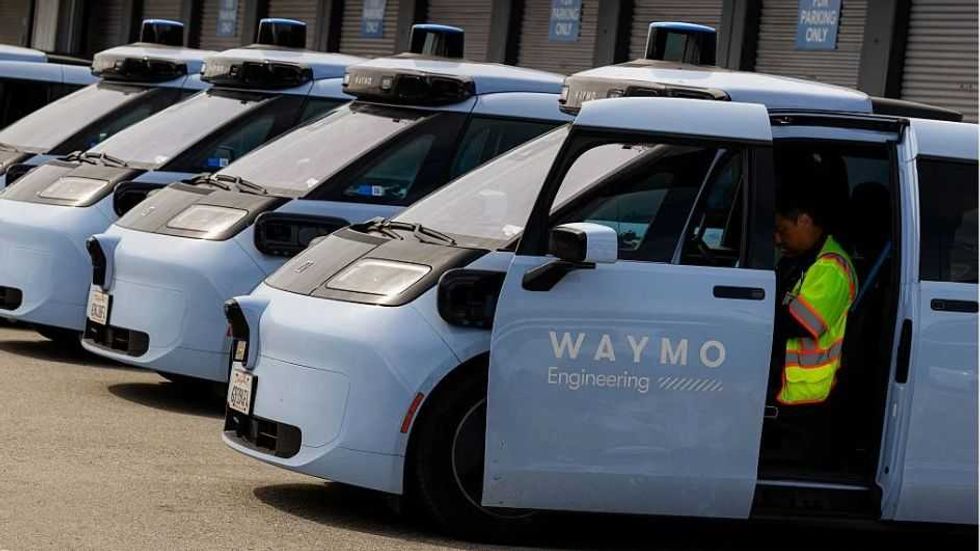
Waymo, the autonomous ride-hailing company owned by Google's parent company, Alphabet, is putting Chinese-built vehicles on American streets.
Regulators should be able to explain exactly why Waymo's Chinese-built vehicles are different — and what testing supports that conclusion.
These aren't experimental cars hidden away on a test track. Waymo's new Ojai robotaxi, built on a platform supplied by Chinese automaker Zeekr, is already carrying passengers.
Now, there's nothing inherently wrong with a car being built overseas. Americans have been buying foreign-made vehicles for decades.
But China presents a different set of concerns. Washington has spent years warning about the national security risks associated with Chinese connected-vehicle technology. And that raises a question: If Chinese automotive technology is considered dangerous enough to restrict, why are we allowing Chinese-built vehicles into America's growing driverless fleets?
Karl put it rather bluntly. “How about a Chinese computer driving you?”
Well, there's an important distinction. The vehicle may be built in China, but Waymo says the computer doing the driving is American. Whether that is enough to settle the security question is another matter.
Chinese car, American brain
Waymo's Ojai is based on a vehicle manufactured by Zeekr, which belongs to China's Geely Holding Group. Zeekr supplies the underlying electric vehicle. Waymo installs its own autonomous driving technology, including the cameras, sensors, computing equipment, and software that allow the car to navigate without a human driver.
According to Waymo, the vehicles arrive from China without connectivity hardware or autonomous-driving sensors. The company installs its own equipment in Mesa, Arizona.
Waymo says it does not share American passenger data, vehicle information, or autonomous driving technology with Zeekr. Nor, according to the company, does Zeekr receive Waymo's source code, algorithms, or artificial intelligence models.
Those are significant assurances, but they leave an obvious question: Who independently verifies that the entire vehicle, including its underlying electronic components, is secure?
The Polestar problem
Consider what happened to Polestar.
In June, the U.S. Commerce Department's Bureau of Industry and Security denied the electric vehicle maker authorization to sell vehicles in the United States beginning with the 2027 model year.
Polestar can continue selling its remaining earlier-model inventory and servicing the vehicles of existing customers. But under the current ruling, it cannot introduce new 2027-model-year vehicles into the American market.
Why? Federal restrictions on connected vehicle technology associated with countries considered national security threats.
Polestar is headquartered in Sweden, but it is controlled by interests associated with China's Geely group and its founder, Li Shufu. And Geely also owns Zeekr, the company supplying Waymo's robotaxis.
Think about that. One Geely-linked automaker has been blocked from selling future models in America over connected vehicle security concerns. Another is supplying cars for Waymo's growing robotaxi fleet.
There is an important difference between the two. Polestar uses connected technology that falls under federal restrictions. Waymo says it replaces the relevant systems with American-developed hardware and software.
But a modern car is more than its navigation system or the computer that drives it. Electronic control units manage everything from braking to battery performance, and those components communicate with one another. Securing the autonomous driving system is one thing. Making sure the underlying vehicle is secure is another.
That is why independent inspection of the complete vehicle matters.
Only connect
During our discussion, I recalled an experience at an international automotive test event.
I was preparing to drive a Chinese-made vehicle when a representative from Volvo approached and asked to ride along. Before we started, he told me to turn off my phone's Wi-Fi and Bluetooth.
I asked why.
He explained that the vehicle could automatically attempt to connect with my phone, making it easier to access features such as contacts, messages, and navigation.
Sure enough, when we started the car, a notification appeared indicating that it couldn't connect to my phone.
Now, automatic phone connectivity isn't unique to Chinese vehicles. American, European, Japanese, and Korean cars offer similar conveniences. But the experience reminded me just how easily we allow our cars access to information that once stayed on our phones.
Think about what a connected vehicle may know: where you travel, when you leave home, where you work, and which destinations you visit regularly. Depending on the vehicle and the permissions you grant, it may also interact with your contacts, messages, and other personal information.
Most of us barely think about these permissions any more. We just want the navigation to work and our music to play.
But an autonomous vehicle adds another layer of complexity. It depends on sophisticated cameras, sensors, computers, and communications systems to operate. Who controls that information? Where does it go? And who can access it? Those questions deserve answers regardless of which country manufactured the vehicle.
Closing the door
Washington has already taken steps to restrict connected vehicle technology linked to China and Russia.
In January 2025, the Commerce Department finalized rules restricting certain connected vehicle systems and components. The restrictions begin applying to certain software in model-year 2027 vehicles, with additional hardware restrictions scheduled for model year 2030.
But two senators from opposite parties believe those protections don't go far enough. Michigan Democrat Elissa Slotkin and Ohio Republican Bernie Moreno introduced the Connected Vehicle Security Act of 2026, which would go farther by restricting vehicles manufactured in China, rather than focusing only on Chinese-controlled connected technology.
The bill passed the Senate Commerce Committee in July and has attracted broad bipartisan support. But an effort to fast-track it through the full Senate stalled in September over an objection from Kentucky Republican Rand Paul.
The sticking point is a provision that would restrict automakers with more than 15% Chinese ownership. Mercedes-Benz, despite being a German company with American factories, has nearly 20% Chinese ownership through passive investors. Paul argued that the bill could unfairly prevent Mercedes from selling cars in the United States.
Moreno has acknowledged the problem and said he is working on changes to protect companies such as Mercedes-Benz and Volvo. With no agreement reached before the Senate's election recess, the legislation will have to wait until lawmakers return in November, according to the Associated Press.
For Waymo, the existing rules remain in place. Its Chinese-built robotaxis can continue operating provided they comply with federal connected vehicle requirements.
Politicians aren't the only ones concerned by this. Missy Cummings, an autonomous vehicle researcher at George Mason University, has called for independent examination of the vehicles to establish what equipment is actually inside them.
In an October 29 report by Phoenix-based television news outlet Arizona's Family, Waymo said its finished robotaxis contain no Chinese software or connectivity and that Zeekr cannot communicate remotely with the vehicles or send software updates. The company also said its vehicle platforms undergo rigorous security audits.
But the report did not establish whether the complete Chinese-built vehicle had undergone independent hardware security testing or whether the results of any such examination had been made public. That seems like a question worth answering. If the vehicles are as secure as Waymo says, independent verification would offer additional reassurance.
RELATED: 6 modern car technologies that make driving worse
 Bill Pugliano/Getty Images
Convenience has a cost
I understand the attraction of autonomous cars. For someone who can't drive because of age, disability, or some other limitation, a reliable robotaxi could provide tremendous independence. For everyone else, there is the convenience of getting where you need to go without worrying about parking or finding a designated driver. Those are real benefits.
And this isn't exclusively a China problem. American automakers and technology companies also collect enormous amounts of vehicle and driver data. Consumers deserve clear explanations of what is collected, how long it is retained, and who can access it.
But when vehicle components have connections to a country the U.S. government considers a national security threat, the questions become more serious. I'm not suggesting that Waymo has been caught sending Americans' personal information to China. There is no evidence presented here establishing that.
What worries me is whether the safeguards are sufficient — and whether anyone independent of Waymo has thoroughly verified them.
If Washington considers Polestar's Chinese connections serious enough to block its future vehicle sales, it owes American drivers a clear explanation of why Waymo's Chinese-built robotaxis meet the government's security standards.
Maybe Waymo has solved the problem by installing its own technology. But shouldn't we verify that before putting thousands more of these vehicles on American streets?
Because when you climb into a driverless car, you're trusting more than the computer behind the wheel. You're trusting everyone who helped build it.
More from this network:
Domains for Sale · GOTPeople.org · TheDSAPlatform · The Truth About Socialism
What's Your Reaction?
 Like
0
 Dislike
0
 Love
0
 Funny
0
 Wow
0
 Sad
0
 Angry
0

I am just an average American. My teen years were in the late 70s and I participated in all that that decade offered. Started working young, too young. Then I joined the Army before I graduated High School. I spent 25 years in, mostly in Infantry units. Since then I've worked in information technology positions all at small family owned companies. At this rate I'll never be a tech millionaire. When I was young I rode horses as much as I could. I do believe I should have been a cowboy. I'm getting in the saddle again by taking riding lessons and see where it goes.
Premium domains for sale




















Comments (0)