

Wendell Berry’s Prophetic Voice Echoes In A Placeless America
Premium domains for sale
Freedom Is Back In Style
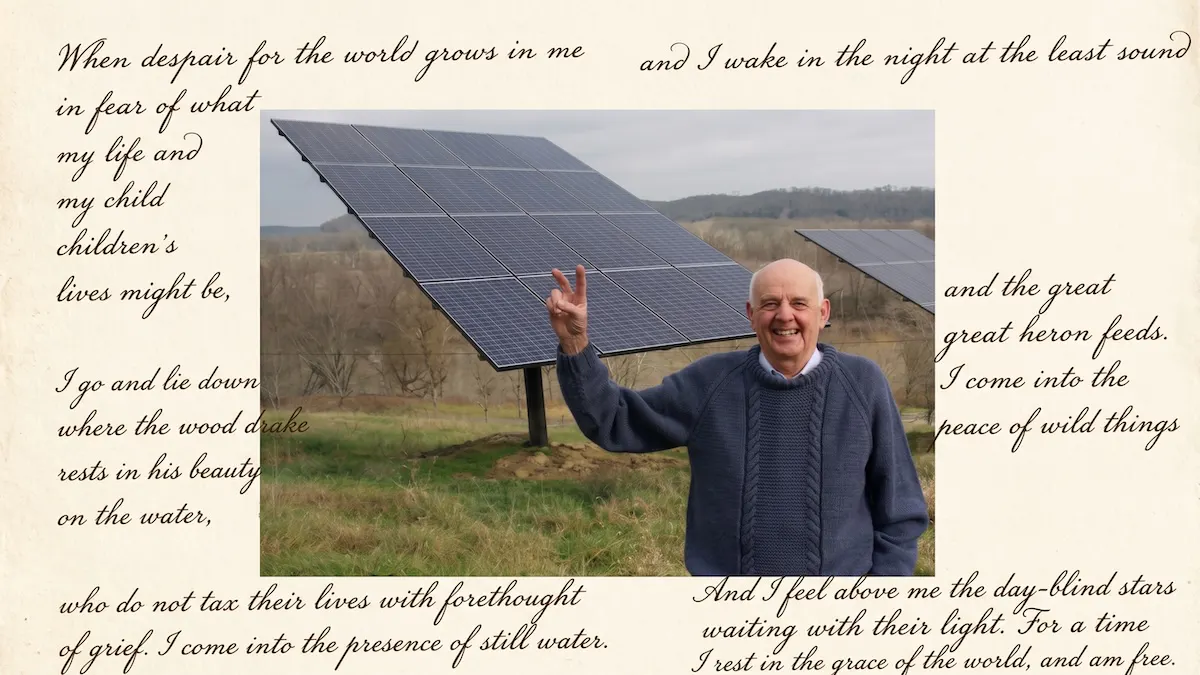
To read Wendell Berry is to become painfully aware that history has taken a turn, and not for the better.
Freedom Is Back
In Style
Premium domains for sale
The Kentucky author, who died Monday at age 92, was one of the great men of American letters. He was a prolific novelist, poet, and essayist whose ideas rankled people of every political stripe.
Meeting him changed my life.
After reading his novel “Jayber Crow” and his long essay “Life Is a Miracle” during a college seminar, a group of us planned an expedition to the University of Louisville to hear him speak. I recall his calm demeanor and firm handshake but, to my regret, little else.
What I do know is that when I came back to campus, my track coach was not pleased I had ditched practice to go meet an author of middling fame.
Facing punishment, I quit the team and spent the time I would have dumped into running digging into the library stacks to read the rest of his work.
What I found stirred me. One of Berry’s great themes is how societal and economic pressure separate us from our ancestors. In the fictional 20th century Kentucky town of Port William, where Berry set his novels, the center holds — until it doesn’t.
Like William Faulkner, Berry set all of his novels in this one little fictional place. Families like the Feltners, the Coulters, the Beechums, and the Catletts moved to the rural hamlet generations before and have been improving the land and living off it for generations. But technology and opportunity break the chains that bind over time.
His short novel “Hannah Coulter,” a jewel of a book, shows this most clearly. After Hannah and her husband work their backsides off bringing a forlorn farm back to life, their children head off for college. Their daughter becomes a school teacher in Louisville, their agriculturally minded son becomes an ag professor instead of a farmer, and another son becomes a technology executive in California.
Hannah wanted them to become more educated than she was, but in the process she lost them. When her children return, they no longer fall into the old habits of hard work and joyful rest. After giving her kids an outdoor childhood, she watches her grandchildren scroll on iPads. No one comes back to take over the family farm, and Hannah lives on in a dilapidating house, sifting through her memories.
It was quite a message to receive while at college suffusing myself with the delusion that I was much smarter than my parents. But “Hannah Coulter” is the story of 20th century America in miniature. Your grandparents or great-grandparents lived off the land and had a deep connection to their home. They paid down the mortgage as fast as they could, feared debts of any kind, and made do with what they had. They skrimped and saved to educate their children, and, once they were educated, they lost them to the future.
If you’re from a small town like me, the pull toward opportunity and bigness is simply too strong to resist. If you really want upward mobility, you can’t go home again.
And so educated Americans have become placeless, disconnected from the facts that led to their existence.
In “Life Is a Miracle,” Berry makes a distinction between “boomers” and “stickers.” The boomers will move on from everything they’ve known toward opportunity, and the stickers refuse to leave.
The boomers are easy enough to understand. Tales of men and women seeking fame and fortune by jetting off to the cement canyons of New York City or the arid hills of Los Angeles are numerous. Berry spent his career explaining the stickers, and because I admired him, I wanted to be a sticker too.
So enthralled was I by his book of essays “The Unsettling of America” that I spent one of my college summers as a farmhard. I earned about $2 an hour, slept on the enclosed porch of a tumbledown old house without so much as a fan to cool me, and ate all the organic fruits and vegetables we grew on the 200-acre farm.
Thinking I could follow in his footsteps as a farmer-poet, I learned the seasons for each crop, how to weed, harvest, and maintain fences. I also learned how to milk cows without getting kicked and feed pigs without getting gored.
I spent so much time bent over weeding and harvesting that I immediately got a “farmer’s tramp stamp.” That’s when your lower back gets deeply sunburned from your shirt riding up. If you’ve never had one, you may not be a real man. If Berry never did, it was because he kept his shirt tucked in.
The other farmhands and I celebrated each harvest. When blackberries came in, we ate ourselves sick. When snap peas were ready, we had a good-ole picking party. That summer on the farm gave me a sense of what life was like in Port William. Sunlight defined our days, cool water never tasted better, and I slept like the dead.
And every Wednesday and Saturday we loaded up the fruits of our labor and sold them to Ann Arbor’s crunchy elite.
But I couldn’t stick. I had to finish my degree, get married, then move from big city to big city for ever bigger and better journalism jobs.
Even if you’ve read all of Berry, his vision is hard to live out.
And yet, Berry’s vision of an old world passing away in favor of the new gives glimmers of hope. Hannah Coulter, one of literature’s most tender voices, faces the facts of her farm’s decline with the simple prayer of “thy will be done.”
She and the others sticking in Port William would prefer that the circle be unbroken, but she sees some divine providence in all this progress. The world we knew is passing away before our eyes, but so are we.
When I think about Berry’s writing, I think of the conservation of woodlots and ponds, of strip mining and erosion, of the moral fiber a well-run farm requires and the beauty of marriage.
But mostly I think about my children, who will come of age into a world so unlike this one, full of new temptations and struggles. I worry about the places they will make their homes, about whether my grandchildren will be a car ride or a plane ticket away.
But amid all those worries, I remember Hannah’s refrain that God is acting his will in this world, and for that reminder I must thank the great author of the miniature and profound, Wendell Berry.
***
Mark Naida is editor of Michigan Enjoyer.
This article is part of Upstream, The Daily Wire’s new home for culture and lifestyle. Real human insight and human stories — from our featured writers to you.
More from this network:
Domains for Sale · GOTPeople.org · TheDSAPlatform · The Truth About Socialism
What's Your Reaction?
 Like
0
Like
0
 Dislike
0
Dislike
0
 Love
0
Love
0
 Funny
0
Funny
0
 Wow
0
Wow
0
 Sad
0
Sad
0
 Angry
0
Angry
0

I am just an average American. My teen years were in the late 70s and I participated in all that that decade offered. Started working young, too young. Then I joined the Army before I graduated High School. I spent 25 years in, mostly in Infantry units. Since then I've worked in information technology positions all at small family owned companies. At this rate I'll never be a tech millionaire. When I was young I rode horses as much as I could. I do believe I should have been a cowboy. I'm getting in the saddle again by taking riding lessons and see where it goes.
Premium domains for sale






















Comments (0)