

What I Saw At The Scientology Founder’s Museum
Premium domains for sale
Freedom Is Back In Style
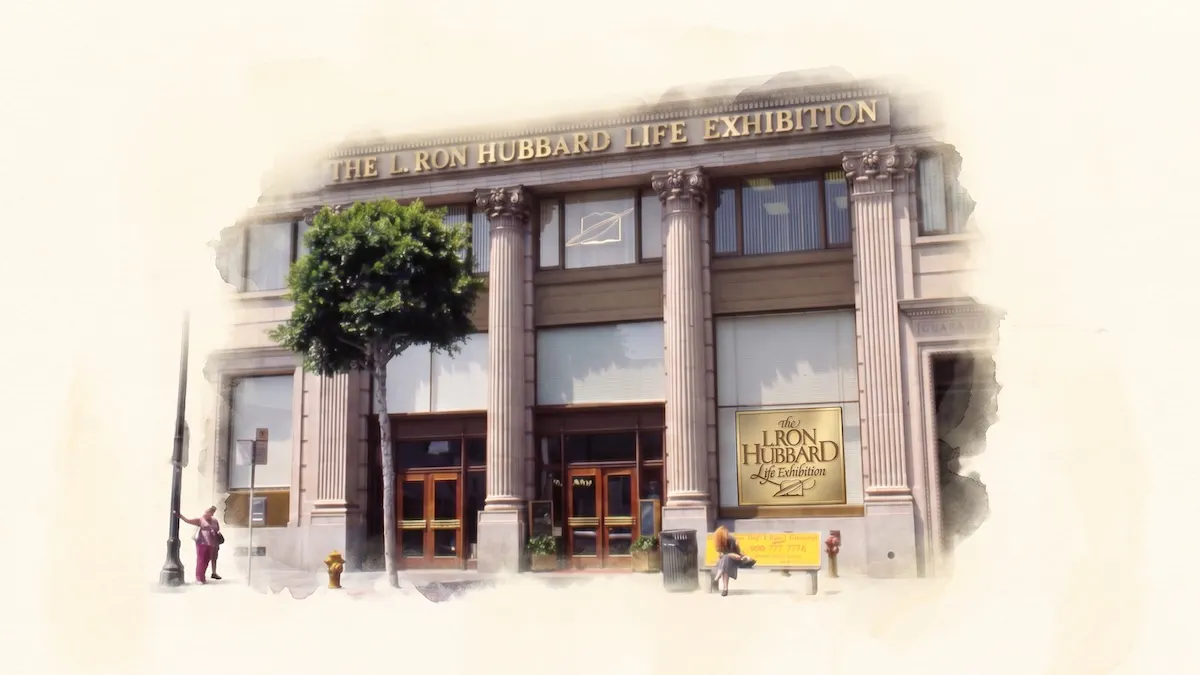
My phone vibrated — an email from the L. Ron Hubbard Life Exhibition. Can you come at 2 p.m.? It was 1:45 — I broke into a jog. Earlier, I’d passed the building along the Hollywood Walk of Fame. I recognized the gold bust in the lobby as the famous author — cast with a smile as if expecting an audience. A wide smile. He seemed too happy. I’d booked a private museum tour of the notorious “religion” known as Scientology, widely regarded as a cult.
Freedom Is Back
In Style
Premium domains for sale
Huffing, I made it back with seconds to spare. The doors were still locked.
“One second!” A muffled voice called from within. A wavy-haired brunette rushed around a counter and unlocked the door.
“Can I help you?” She asked with a German accent.
“Hi, I’m here for the tour!” I said.
“Fantastic! Our two o’clock. I’m Elsa,” she said, eyes unblinking as she let me in.
Behind her was a bookshop where every shelf was devoted to the same author, Hubbard, except for a stack of annual anthologies. The Writers of the Future winners. Each year, thousands submitted shorts and competed for a cash prize along with a coveted spot in print. Judges for the contest included Orson Scott Card and, while living, Frank Herbert.
“It’s a great opportunity for new writers!” Elsa said, “Last year’s winners are meeting here this week! They do a workshop with the judges!”
“So… Orson Scott Card is in the building?” I asked, and Elsa shrugged with a telling smile. “Is he a member?”
“Oh no, but we work with all talents regardless of status. And that’s a good introduction to the tour! Scientology, despite misconception, is not theological. It’s an applied study of the sciences!”
I held back asking about Xenu (by their cosmology, Space Satan), as the bulk of the museum was hidden behind a wall and Hubbard’s golden bust. Many YouTubers and journalists have attempted interviews, short-lived for their inability to hold back probing questions like, “Why is Earth a galactic gulag?” or, “What happened to Shelly Miscavige?” Instead, my approach would be to experience the tour as the church intended. I had full faith in my discernment, and some faith I would not be abducted.
Elsa swiped an ID card, and a set of large double doors opened. Behind them, the maze-like interior opened inward. Framed photos of a young Boy Scout surrounded a built-in projector screen. Elsa gestured to a theater seat, and I sat.
“We always start the tour with our introductory presentation,” Elsa said, then pulled a switch that dimmed the lights. The projector turned on, and a video played along with inspirational music. Rolling text appeared over a gold background: “As any understanding of a religion includes an understanding of its founder, we present a brief chronology of Scientology founder Ron Hubbard.”
It went on to explain that the intent was also to dispel common misconceptions and ended with: “For here was a man who forever maintained that to know life one must live life…”
Cornfields and maps shifted in sepia. A narrator explained Hubbard was born in 1911 in Nebraska. At 12, he entered the Boy Scouts and was chosen to meet then-president Calvin Coolidge. A year later, he became “the youngest Eagle Scout in history.”At 16, Hubbard went overseas, traveling to “a land steeped in mystery,” or Asia. He also saw “wonders beyond any known scientific explanation.” I held a laugh as these were not detailed and the narrator just moved on.
Hubbard allegedly returned to the United States, enrolling in George Washington University, where he studied nuclear physics. Then came WWII. Hubbard was recommended, not drafted, to become a lieutenant in the Navy. He would command two vessels, succeed in battle, and suffer combat wounds. At the VA hospital in Oak Knoll, California, Hubbard cured himself. A few years later, he solidified his techniques and drafted the precursor to Scientology: the 1950 book “Dianetics.”
It was a bestseller, and Hubbard led a series of fan gatherings where participants relived their past lives. The Church of Scientology was born (not stated, but established 1954) and spread internationally.
The narrator becomes grave: Hubbard died in 1986. Then he finishes with, “What kind of man could have founded the only major religion of the twentieth century? … A man such as L. Ron Hubbard.” A photo fades in, Hubbard smiling with one hand on his cheek. The music reaches climax, and the projector shutters off.
Before resuming the tour, allow me to fact-check. L. Ron Hubbard was likely not the youngest Eagle Scout (there are not comprehensive records of Scout ages from the time period), though he did meet Calvin Coolidge at a meet-and-greet. He did travel to Asia but journaled that it was “trashy.”
He attended George Washington University but flunked entry-level atomics before dropping out. He was a Navy lieutenant in charge of two ships but was removed from both commands. He was not wounded in combat but was a patient at Oak Knoll after the war. “Dianetics” was a bestseller, and Scientology does carry some traits of a major religion. But it is not the only one established in the 20th century. Contenders include: the Nation of Islam, Falun Gong, Jehovah’s Witnesses, Rastafari, and, according to its members, the Church of Satan.
We then journeyed around a corner to a newspaper stand featuring titles like Cosmic, Astounding, Unbelievable, and Beyond. There were life-size sculptures depicting Hubbard’s stories. An orange alien with a threatening hunch stood over a device. Across from him was a caveman reaching for it. Next to this was another scene, a ’50s-era cockpit with two semi-humans sitting at the controls.
Elsa explained the vignettes were from Hubbard’s most popular books. The alien and the caveman were from “Battlefield Earth” (1982), and the others were villain-protagonists from “Mission Earth” (1985-87). In front of the displays, each book sat beneath enclosed glass.
“Beautiful, right?” Elsa said. “I’m reading the series right now, book seven.”
“Any good?”
“It’s…” she looked up, searching, “…you have to read them, and then you have to re-read them.”
“And then, read them again?”
“Exactly!” We shared a knowing smile. Then she gestured to follow.
Elsa slid backward into a small theater. A pressed curtain wrapped around an extended stage. I sat in the front row as Elsa vanished behind me. The lights dimmed. The curtain pulled apart. Reveal: a giant sculpted volcano. A symbol? Or a hint to deeper truth? Speakers blared and the volcano “erupted” with red and orange lights like I’d angered it.
A projector screen rose from the floor. Light struck, and suddenly I was watching what felt like an early commercial for antidepressants.
The same narrator asked, “Are you unhappy?” followed by a woman, “Does your life lack meaning?” Similar questions rattled off as shadow-people blurred past. Finally, the narrator said, “In this video, you will learn the secrets of Dianetics, and how to apply them to the betterment of your life.” Then the projector clicked off, the screen descended, and the curtains reclosed around the stage.
“What?” I asked out loud. Where were the secrets? Why would the last line be an obvious lie? The volcano — was that it? I waited for Elsa to return.
“Now I’m going to take you to one of our most exciting exhibits!” Elsa said, beelining for a stairwell.
I ran after, and we climbed to the second floor balcony. A massive display of what I’d call Geiger-toasters. Some like deco-radios. A few antiques sported the name Hubbard Electrometer.
“These are the e-meters, aren’t they?” I asked.
“What have you heard about these?” Elsa asked, a tone sharper.
This was the first I’d slipped — showing I knew more than I’d let on. The e-meter was a somewhat pointless device that measured resistance to electrical flow. By holding two metal handles, a person would complete the circuit.
A church member called an auditor would calibrate the device during sessions. They ask questions like a therapist or interrogator with the intent of releasing spirit demons called Engrams from your mind (and we still haven’t gotten to Space Satan). As Lex Fridman summarized while in conversation with ex-auditor Aaron Smith-Levin, “It’s a real device you can calibrate to probably get an outcome that you want.”
“I’ve heard about these just from college here in LA,” I said, and Elsa eased.
“Why don’t you take the handles?”
I followed her instruction and she pointed to the wriggling arrow.
“With this technology, I can tell what you’re thinking — more or less.”
“You’re an auditor?” I asked, and she nodded, gleaming. Arrow far right.
“It’s a rewarding experience, especially when you’re a high-enough level, because then two auditors can read each other at the same time —” Elsa inhaled sharply; she’d said more than intended. I didn’t push the topic, but this was the first I’d heard of dual auditing (add it to the wiki).
Elsa must have read my mind (more or less) because she clicked the e-meter off. Then turned to the next exhibit.
“I think you’ll like this. You seem very industrious.”
Next was the least creative display in the entire museum: a glass case containing seven large books breaking down how L. Ron Hubbard thought corporations should be run. Behind the case, a metal plaque showcased hundreds of company names that used his “Efficient Management System.” Names you would recognize.
“What is this?”
“L. Ron Hubbard not only wrote epics and explored science; he tackled the problem of management. Each volume represents a key department in any business. All seven must work in tandem.”
“Where are you in the hierarchy?”
“I’m in division one, dealing with public relations.”
“You like it?”
“I did not enjoy division three.”
“Oh?” I said, and she did not expand.
In all fairness, I have no clue if this is legitimate. Redditors have described the system as “diabolically ruthless,” which the ardent capitalist might desire. One can learn the Efficient Management System via purchase of the volume set, or by attending the School for Administration here in Los Angeles. Management experts can also be hired to impose the system upon your underlings.
This shrine to capitalism was the last second-floor exhibit, so I followed Elsa back down the stairs. We arced left and found ourselves in a cartoonishly extensive hallway, each wall filled with bookshelves. At the end, two monolithic wooden boards covered in framed awards hung on the wall.
“This is my favorite part,” Elsa said, and trumpets blared.
The panels pulled apart, revealing yet another pair of monolithic boards: certificates, diplomas, plaques. Three more pairs opened before revealing the same photograph of L. Ron Hubbard from earlier. He was middle-aged, smiling with his hand on his cheek, eyes full of joy.
“Can I get a picture with him?” I asked.
“Oh — it’s going to close in a second, so we have to be quick!”
I posed, and Elsa clicked the button on my phone’s camera app. Moments later, the music cut, the monoliths reset, and the tour ended.
On return to the lobby, I expected pressure to buy a book. YouTubers have captured such behavior. But Elsa didn’t push. I was almost offended. When I asked, she beamed, recommending the “church favorite,” “Final Blackout” (1940). It chronicled the rise of a charismatic lieutenant in war-ravaged England. Elsa invited me back whenever I liked.
“It’s been a pleasure,” I said as the door closed. It had been four hours, and I had numerous texts from friends asking if I was alive. I smiled, then didn’t respond.
Amusing, elaborate — a fine experience for a weekday afternoon. Given the length and free admission, tourists might consider buying a book. It’s a cheap souvenir for LA, a testament to survival, and most aren’t about Space Satan. We never did get to him, though the volcano was a highlight. For the curious, I say, chance the rabbit hole! Enjoy the museum built around one man’s ego and some of his science fiction. As for Elsa, I never did gauge her — if she truly believed in Hubbard’s revelations.
I looked back through the plate glass, at his bust. I’d run a mile to get past him, seen through his grandeur, and left with his story. He was still too happy. A crack in his facade, maybe — but cast in gold.
***
Erby Char is the pseudonym of a writer and audio producer whose work ranges across culture, technology, travel, and the strange fringes of modern life. He also writes fiction and designs games. You can follow him on X @ErbyCharWrites.
This article is part of Upstream, The Daily Wire’s new home for culture and lifestyle. Real human insight and human stories — from our featured writers to you.
More from this network:
Domains for Sale · GOTPeople.org · TheDSAPlatform · The Truth About Socialism
What's Your Reaction?
 Like
0
Like
0
 Dislike
0
Dislike
0
 Love
0
Love
0
 Funny
0
Funny
0
 Wow
0
Wow
0
 Sad
0
Sad
0
 Angry
0
Angry
0

I am just an average American. My teen years were in the late 70s and I participated in all that that decade offered. Started working young, too young. Then I joined the Army before I graduated High School. I spent 25 years in, mostly in Infantry units. Since then I've worked in information technology positions all at small family owned companies. At this rate I'll never be a tech millionaire. When I was young I rode horses as much as I could. I do believe I should have been a cowboy. I'm getting in the saddle again by taking riding lessons and see where it goes.
Premium domains for sale






















Comments (0)