

Where Did All of California’s Students Go?
Premium domains for sale
Freedom Is Back In Style
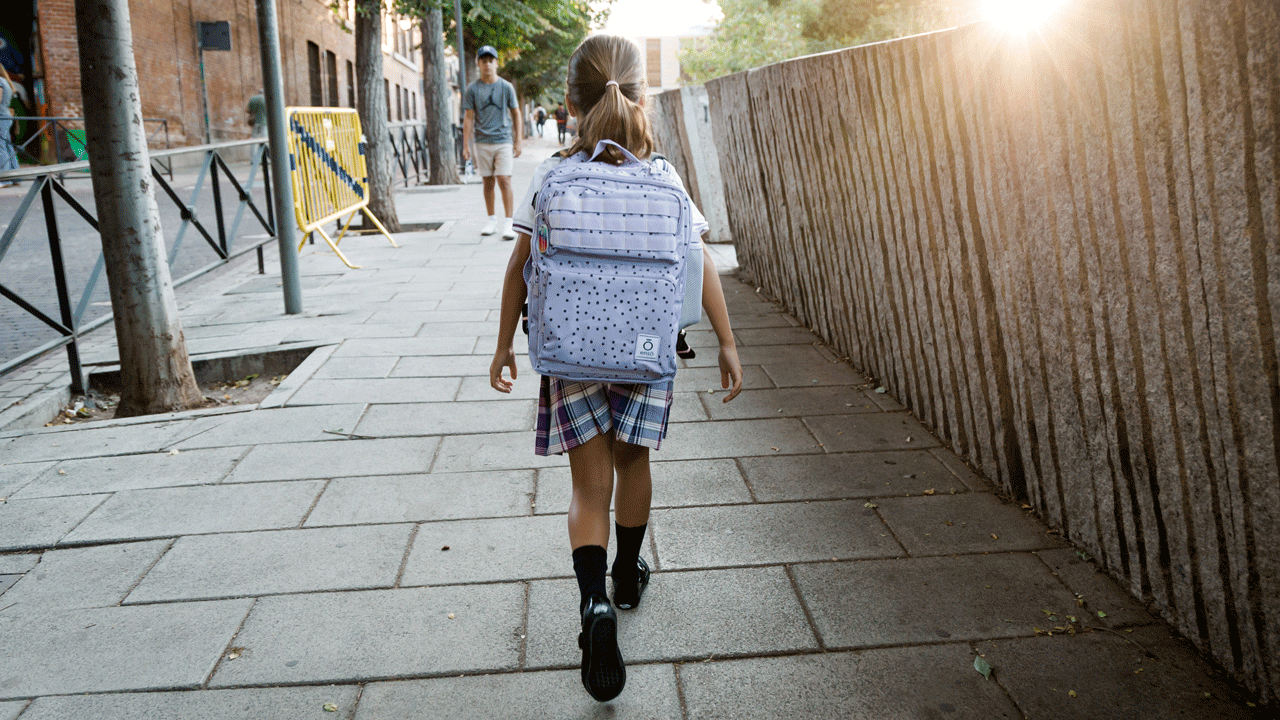
Between falling birth rates, net out-migration, and the aftermath of COVID-19, California is running out of students.
Freedom Is Back
In Style
Premium domains for sale
According to a recent Public Policy Institute of California report, K-12 enrollment statewide has dropped 8% since 2015 and is expected to continue declining over the next decade.
Julien Lafortune, senior fellow at the Public Policy Institute of California, told the Daily Signal that the decline has been substantial.
“A decade ago, [California had] 6.2 million students. Now, this past year is just about 5.7 million students. That’s almost half a million fewer students in public K-12.”
Lafortune described the demographic shift as “almost like a cascade,” with each successive group of children entering California schools smaller than the one before it.
For California teachers, the enrollment decline is more than just a statistic.
One Southern California elementary school teacher who chose to remain anonymous told the Daily Signal that she was personally affected by the shift after being switched from kindergarten to a higher grade at the last minute due to low enrollment.
“From my perspective, I think part of what we’re seeing is that fewer young people are having children, especially with the cost of living and housing prices being so high. There also seems to be a shift in priorities among people in their 20s, where many are choosing to focus on themselves, travel, careers, and enjoying their 20s before starting a family. That eventually translates into fewer 5-year-olds entering elementary schools.”
The Southern California teacher also said she believes concerns among some parents about politics in the classroom have led them to consider alternatives, including homeschooling or moving out of state.
“Overall, I think the combination of fewer births and changing attitudes toward family and education is going to continue having a noticeable impact on elementary school enrollment,” the elementary school teacher said.
In another Public Policy Institute of California report, “Examining Trends in California’s Birth Rates,” Lafortune and his co-authors found that California’s fertility rate has fallen well below the level needed for a population to replace itself.
“The total fertility rate in California has dropped from 2.21 children per woman in 2007 to 1.48 in 2023, well below the replacement level of 2.1 necessary to keep a population from declining.”
Migration has also played a role. Nearly 10 million Californians have moved to other states since 2010, and California currently has the nation’s largest net domestic outflow.
The implications extend beyond California schools facing potential downsizing. A shrinking younger population could eventually mean fewer workers supporting a growing older population, potentially straining the state’s economy and contributing to labor shortages.
If California’s population continues to lag behind growth in other states, Lafortune said, the state could eventually lose congressional representation.
And Lafortune does not expect the trend to reverse anytime soon.
“A lot of this is slow-moving and continuous, and I think with the declines in birth rates that we’ve seen, it’s definitely not something that looks like it’s going to reverse.”
“This is kind of a new reality for a lot of school districts,” Lafortune said, “just managing the fact that … next year there’ll be even fewer kids.”
More from this network:
Domains for Sale · GOTPeople.org · TheDSAPlatform · The Truth About Socialism
What's Your Reaction?
 Like
0
Like
0
 Dislike
0
Dislike
0
 Love
0
Love
0
 Funny
0
Funny
0
 Wow
0
Wow
0
 Sad
0
Sad
0
 Angry
0
Angry
0

I am just an average American. My teen years were in the late 70s and I participated in all that that decade offered. Started working young, too young. Then I joined the Army before I graduated High School. I spent 25 years in, mostly in Infantry units. Since then I've worked in information technology positions all at small family owned companies. At this rate I'll never be a tech millionaire. When I was young I rode horses as much as I could. I do believe I should have been a cowboy. I'm getting in the saddle again by taking riding lessons and see where it goes.
Premium domains for sale





















Comments (0)