

Why Christians Typically Vote Republican Isn’t Rocket Science

Premium domains for sale
Freedom Is Back In Style
November 3 midterms are quickly approaching.
Freedom Is Back
In Style
Premium domains for sale
One important thread in election analysis will be evangelical Christians’ voting patterns.
If Election Day follows recent trends, evangelicals will likely vote overwhelmingly for Republicans (as Pew Research is reporting). According to Pew, white evangelicals are unique in their loyalty to the Republican Party at present, as maybe the most supportive constituency of the Republican coalition. Should that observation be a source of judgment on evangelicals? Are we cheap dates?
It’s worth asking since the question is a source of profound public conversation among journalists and academics: Why do evangelicals, and white evangelicals in particular, perpetually vote for Republicans?
Is it because the Bible says to vote for Republicans? No.
Is it because there’s something about the modern Republican Party that inherently makes it “God’s Party”? No.
Is it because Christians are craven political obsessives who make deals with political devils to accumulate more power? No.
Is it because we come to politics first and then find a theology to justify it second? In opposition to virtually all elite narratives that insist this is the case, the answer is also “no.”
Is it to usher in an impending theocracy in America and revoke civil liberties? No.
Is it a form of identity politics? Yes, invariably, simply because any group that votes collectively for a particular party is also guilty of identity politics. To some degree, all politics is identity politics. Politics concerns the maximizing of interests. I don’t mean this in a Hobbesian way, where what matters is selfishness against others. We are not just bargaining amid different interest groups; the various groups are advancing what they believe is a vision for how society ought to be ordered. Christians are humans like anyone else in these considerations, and so our social ideals and interests — disagree with them if you want — are just as justified as any other constituency that chooses to vote for Democrats. But, if I may be so bold, from my perspective, if Christians were to wield political influence, it wouldn’t look like the Handmaid’s Tale’s Gilead; it would protect life at all stages, promote intact families, build social cohesion, foster high-trust moral climates, and uphold public decency. Christians genuinely believe their vision for society benefits not just Christians but everyone, as law reflects and directs to what is right, true, and good. We do not see ourselves making a sectarian argument on topics like these. We are making a justice claim that all people of goodwill open to reason must evaluate.
But the purpose of this essay is not to theorize about hypotheticals; I want to clarify and dispel all the wild and malevolent conjectures about why it is that evangelicals tend to vote for Republicans.
The calculus isn’t difficult: Evangelicals who take the Bible seriously find more resonance in the current Republican platform, imperfect as it is. That’s really it.
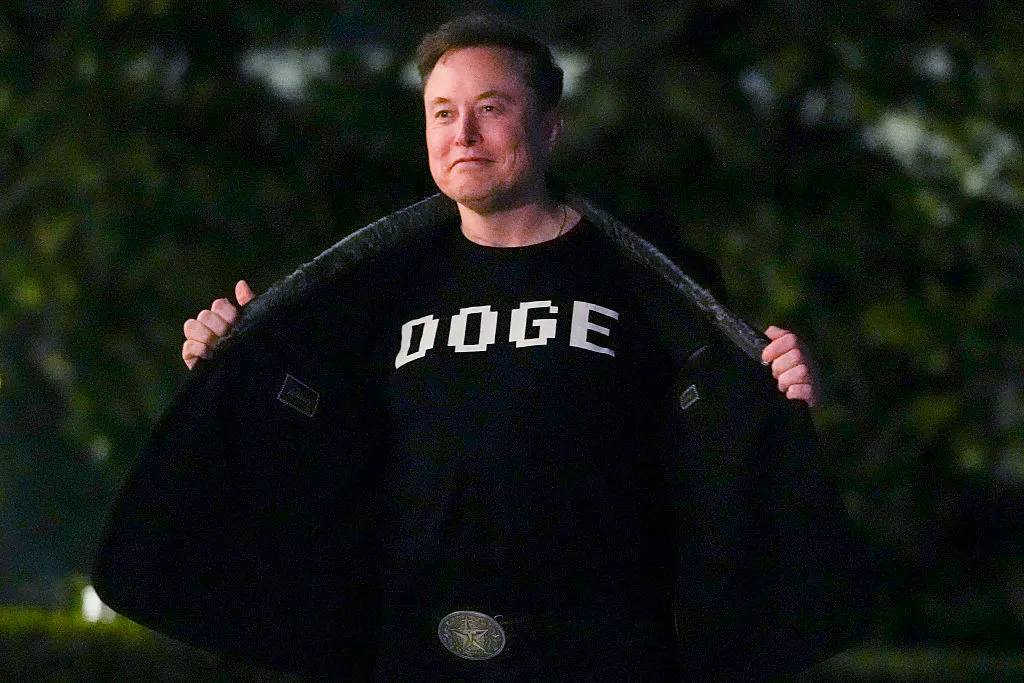
Where one political party displays an openness to the values that evangelicals hold dear — the idea that religion matters in shaping such concepts as rights, justice, and morality; that human beings have dignity at all stages of their existence; and that human nature is fixed and not endlessly “fluid,” well, then you can expect votes to predominate within the party that shares the concerns of its voters or at least sympathizes with it more than the alternative. This is not difficult stuff to understand. We’re not doing Elon Musk-level physics here with flying cars.
It is worth digging a little deeper into the stark moral positions of the two major parties.
Evangelicals — because of their reading of the Bible — believe in the dignity of the human person. That means many things. But fundamentally for evangelicals, it means every person has a right to live. Democrats’ enthusiastic embrace of abortion — which evangelicals find abhorrent — makes voting for their party a nonstarter for the vast majority of evangelicals. The same applies to the sanctity of marriage. Evangelicals, by biblical conviction, passionately believe marriage is intended to be the lifelong covenant union of one man and one woman. It serves as the most basic unit for stabilizing society and securing the best outcomes for all. The modern Democratic Party not only repudiates this notion, but it brazenly denies the linkage of sex and gender. For our part, evangelicals find this fundamental rejection of biblical and biological reality both morally repugnant and intellectually unserious. Consider also the Democrats’ efforts to restrict religious liberty. Over the past decade, the Democratic Party has mainstreamed progressive cultural efforts to treat our views as outside the boundaries of polite society.
Now, one may argue that evangelicals’ political concerns are short-sighted and they should focus more on things like poverty relief, but in the minds of evangelicals, a party that prides itself on intentionally destroying what they regard as fundamental to society’s well-being is a complete non-starter. Evangelicals not only hold these beliefs, but they do so with deep conviction, which is why they vote in large numbers to support their views. Even as evangelicals look on at the imperfection of the Republican Party on some of these issues, they observe a vast asymmetry in how the two parties treat them.
On matters like poverty relief, the distinction between categories matters. Christians can legitimately disagree among themselves and broader society about the minimum wage, immigration policy, tariffs, and how to structure health insurance. Those are questions of prudence. There’s an ends/means calculation. On those issues, I genuinely believe we share the same end (human flourishing) but disagree on the means to get there and what that vision precisely is. Even if Christians and non-Christians have competing visions of what human flourishing means, fairmindedness demands that I ascribe noble intentions to the same end (even if I disagree). The calculation changes on things like abortion. That topic concerns who belongs to the human community. Christians can be wrong about tax brackets and still vote faithfully because the Bible does not give exact clarity on tax policy. They can also care about how prices and affordability affect their neighbor. It’s a wholly different calculation to support a party that views killing innocent human beings as a constitutional right. For many evangelicals, abortion is the moral gate that the candidate must get through before they are evaluated on other topics.
To put this at its simplest: While the modern Republican Party does not share all of my values, it does not hate my values, or at least hates them less than the modern Left does.
To make this point, consider that in September, the political scientist and demographer Ryan Burge put out the following post on X: “I can’t count the number of times I’ve been asked, ‘Why did so many white evangelicals vote for Donald Trump?’ But I’ve never been asked, ‘Why did so many white evangelicals vote for Mitt Romney?’ The reason is that they vote for Republicans.”
Burge makes a great point: Evangelical coalescence around the Republican Party isn’t driven by some cartoonish personality cult. It’s about values. Though Burge may argue that evangelicalism is now more a political category than a theological one, I explain voter activity along moral lines.
To make his point, he put out a provocative chart: From 2008 to today, evangelicals and white evangelicals vote overwhelmingly Republican. This was true for the quiet Christianity of John McCain and Mormon Mitt Romney. This was also true before 2008, especially in the George W. Bush era. Since the escalating culture wars of the 1970s and the rise of the Moral Majority in the 1980s that saw evangelical voters elect Ronald Reagan, evangelicals have found a political conduit for enacting their agenda — or at least resisting progressivism — through the Republican Party. It might not be an overstatement to suggest that without evangelical voters, the modern Republican Party would have no chance at governing.
Now, admittedly, there are risks here. An unhealthy co-dependency can form, where the two come to rely on one another, and each takes advantage of the other without asking too much of the other. Such a quid pro quo is a real problem to watch for, especially right now, as the modern Republican Party under President Donald Trump has unquestionably weakened the party’s pro-life commitments (while, honesty demands saying, amassing historic victories for the pro-life cause). In effect, if the modern Republican Party can just come to expect the votes of evangelicals, rather than working to earn it, then evangelicals become just another patron constituency. Another way to interpret this, though, is to argue that evangelicals have played politics smart — they’ve recognized that political success is often incremental, with setbacks and victories, so they’ve hooked themselves to the one party that most favorably advances their interests. American culture has doubtlessly secularized, but ask yourself how much worse off things could potentially be had evangelicals stayed politically disorganized. Though the lines are not always upward, consider this: Over the last decade, religious liberty has won victory after victory. How did that happen? By the Supreme Court, whose appointments sitting presidents make. Evangelicals played politics smart, and our religious liberty jurisprudence is stronger than it has ever been (a reality that benefits people of all faiths, not just Christians).
All of this raises the question of how Donald Trump factors into this equation. If anyone has followed intra-evangelical spats over the last decade, one will quickly see that lines have fallen along how various shades of evangelical temperaments respond to Trump.
I hate to disappoint the cultural despisers who build whole careers despising evangelicals and imputing to them the worst imaginable motivations, but there is no obsequious devotion to Donald Trump in particular. That some evangelicals are problematically beholden to Trump is still a weak explanation for evangelicals supporting Republicans generally. Even as the Trump era begins to wane, whoever emerges next, we should expect evangelical support for Republicans to continue barring some unforeseen realignment. But even the Pew report cited above reinforces the fact that evangelicals are not unquestioning voters. From January 2025 to today, Trump’s job approval rating among evangelicals has dropped from 78% to 58%. Evangelicals can walk and chew gum at the same time: We can want the President to do more while also recognizing that the alternative is judicial activism, abortion-on-demand, transgenderism in public schools, and a narrowing of religious liberty.
Burge’s research reinforces something I have written at length about: Biblical Christianity has structural resonances that, at least today, code on the political right.
In 2024, I wrote an entire essay for National Review making this argument. What counts as “conservative” has a lot of overlap with traditional Christian categories — objective morality, an emphasis on the “little platoons” of civil society such as the family, and a belief in human depravity that calls for limited government. Those “conservative” values find the most welcome home in the modern Republican Party.
Now, admittedly, this is all circumstantial, not permanent. By that, I mean labels and party platforms can change. The Bible does not.
To put it differently, the Bible is simply not a Leftist manifesto by Leftist accounts. Some, like the theological progressive James Talarico, would dispute that, but if Scripture addresses the nature of morality, moral responsibility, human dignity, creation order, the scope and limits of government, and a particular account of flourishing, then by sheer circumstances of the current moment, people will vote accordingly where such views concentrate or are at least treated with greater hospitality. But the Talarico situation is an interesting test case because one might be tempted to think that, since Talarico talks a lot about Jesus, he would be an evangelical favorite. He’s not. He’s a progressive who uses distorted Bible verses to support his preferred progressive policy. It’s great to have candidates talk about Jesus, but the implications matter: whether they’re invoking Jesus accurately. Politically, I need a candidate who tells the truth about who counts as my neighbor more than I need them to be my Sunday school teacher.
Now, coalitions could change over time as labels and parties shift. But it’s a simple observation of human action that when a political party aligns more closely with the source of authority that guides a people’s moral outlook (such as the Bible), it’s not surprising that vote density clusters around that party. Theology shapes a voter’s conception of the good. Once that conception of the good is understood, politics aims to see that conception enacted. The same is true of the modern Left, now largely secular, which bases its account of authority and flourishing on maximizing autonomy and expressive individualism. In other words, progressivism operates under its own authority and wages cultural war to drive out dissenting authorities that challenge it. Nature abhors a vacuum, and some moral vision will structure society. The question is whose? That’s where politics enters in.
If you want to challenge my thesis or wish for a less partisan version of Christianity, the way forward would be for the modern Left to abandon its attack on the most rudimentary principles held dear in biblical Christianity — the good of religion, religious liberty, human dignity, the immutability of the sexes, and the family. If it did, I would expect a more dispersed political makeup. Until the modern Left ceases its attacks on the worldview of Genesis 1-2, the constant hectoring of evangelicals as slavishly devoted to one party or one person will continue to ring hollow. I do not vote for liberals because I am a conservative first; I do not vote for liberals because I view liberalism as more parasitic to historic, biblical Christianity than the alternative. Because my account of Christianity informs how I believe society should be organized, it only makes sense to work prudently within the mechanisms that can advance those ideals.
And what of the objection that if all evangelicals were truly united around their Bibles and not their politics, then white and non-white evangelicals would all vote the same? Doesn’t that difference suggest this is really a partisan issue — not a theological one? This is a particularly pressing question given that black Protestants vote more for Democrats. What explains the split?
One answer is that many black Christians’ loyalties were forged in the civil rights era. In that era, one party — the Democrats — was viewed as the vanguard of racial equality. In the eyes of many black Christians, Republicans have not done enough to earn their trust. This supports my point above: Different constituencies weigh different factors and interests when voting. Black Christians weigh history alongside the same moral concerns that white evangelicals share. While I do find even more entrenched partisanship among the black church, if the argument I made above about voting in one’s interest holds, black evangelicals have the same right as I do (even if I have respectful criticisms of what I think are ethical miscalculations in how some black Christians abet a party that diametrically opposes their worldview elsewhere). This is my whole point: Voting loyalty is a byproduct of perceived allyship on issues voters consider most important. Partisanship is incomplete as an explanation. The better question is what drives the partisanship. Whether black or white, politics is the weighing of priorities. To be clear, skin color and social location are not decisive factors: One group can be genuinely right or wrong in how it weighs its priorities when evaluated against Scripture.
Now, before I end this column, it is worth stressing: The current GOP-evangelical arrangement is a marriage of convenience. Speaking for myself and what I assume are many other evangelicals, there’s nothing eternally binding me to the Republican Party. They do have to earn it. Moreover, labels and party identities change. If a new party arises in the future where evangelicals feel more welcome, you can expect them to migrate there. Or, in what seems unimaginable right now, if there were a day when the Democrats were not the party of secularism, sexual liberation, and socialism, and reversed course from their current assault on reality, then evangelicals might find themselves voting for them more than they do right now. In fact, it would be more desirable if politics were not divided along such stark theological and moral lines. But that’s where we are in our current climate. We should long for a day when the greatest debates in American politics are questions of tax policy and healthcare, not whether human beings have worth and can be discarded as medical waste.
But until that better day, don’t be surprised that evangelicals vote for Republicans.
***
Andrew T. Walker, Ph.D., is Dean of the School of Theology at The Southern Baptist Theological Seminary and Professor of Christian Ethics and Public Theology. He is a Fellow with The Ethics and Public Policy Center and the Managing Editor of WORLD Opinions. You can follow him on X: @AndrewTWalker.
More from this network:
Domains for Sale · GOTPeople.org · TheDSAPlatform · The Truth About Socialism
What's Your Reaction?
 Like
0
 Dislike
0
 Love
0
 Funny
0
 Wow
0
 Sad
0
 Angry
0

I am just an average American. My teen years were in the late 70s and I participated in all that that decade offered. Started working young, too young. Then I joined the Army before I graduated High School. I spent 25 years in, mostly in Infantry units. Since then I've worked in information technology positions all at small family owned companies. At this rate I'll never be a tech millionaire. When I was young I rode horses as much as I could. I do believe I should have been a cowboy. I'm getting in the saddle again by taking riding lessons and see where it goes.
Premium domains for sale


















Comments (0)