

Why Is the Archdiocese of Washington Less Protective of Religious Liberty Than Maryland?
Premium domains for sale
Freedom Is Back In Style
For some, questions of religious liberty seem abstract. For us and our families, they are deeply personal.
Freedom Is Back
In Style
Premium domains for sale
I (Arina) taught at an Archdiocese of Washington (ADW) school for a year, the very school where my young son was later accepted for admission. As Catholics committed to raising him in the faith, my husband and I assumed he would attend. Instead, we ultimately declined his acceptance because the Archdiocese does not recognize religious objections to its vaccination policy, even though the state of Maryland does. We enrolled him in a secular private school that respects Maryland’s religious exemption and our sincerely-held convictions.
My experience is not unique. My co-author, Jay Richards, has faced similar choices with his family.
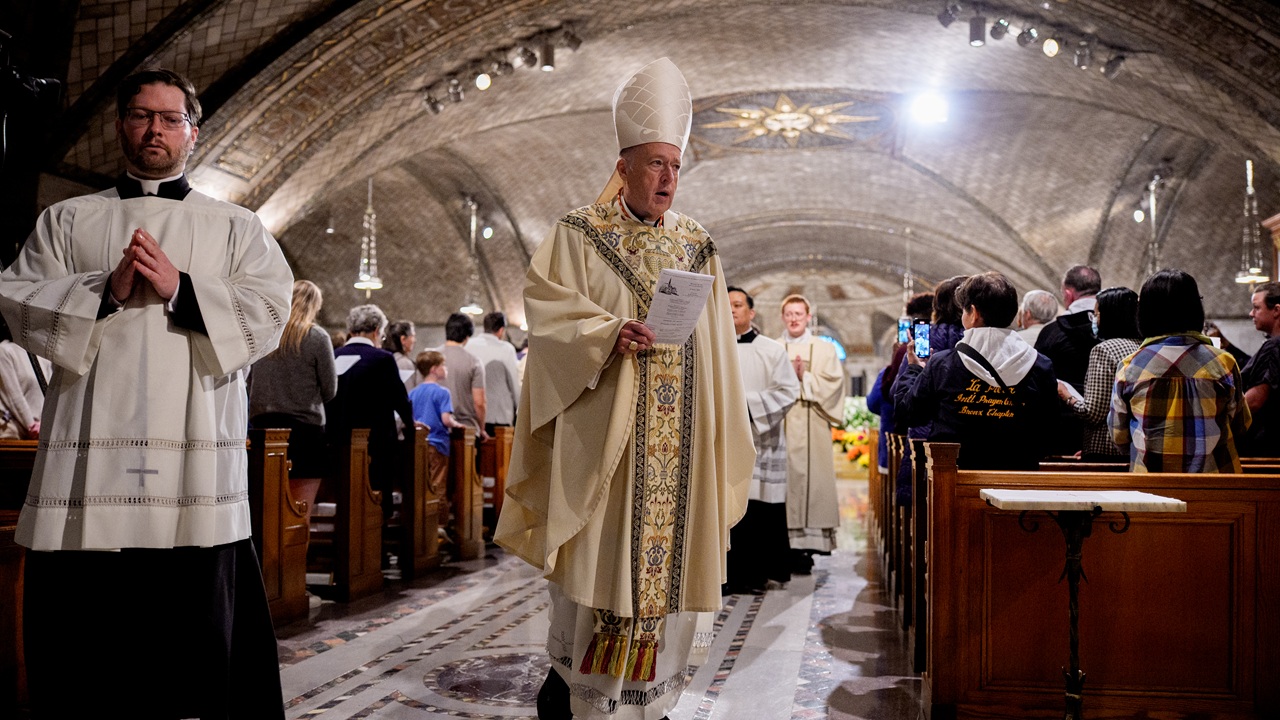
Catholic schools exist to help parents fulfill their God-given responsibility to educate their children in the faith. They should be among the strongest defenders of parental rights, religious liberty, and the primacy of conscience. Yet on childhood vaccination, ADW has adopted a position more restrictive than the state of Maryland itself. That irony should concern every Catholic.
Maryland Respects What ADW Does Not
The Maryland Department of Health provides a Religious Objection section on its Health Immunization Certificate, and except during a declared emergency or epidemic, the exemption remains valid. Maryland has concluded that protecting public health and respecting religious liberty are not mutually exclusive.
ADW concluded otherwise. Rather than using Maryland’s standard form, the Archdiocese adapted it and removed the Religious Objection section. It compels compliance with Maryland’s vaccination requirements but denies the very accommodation Maryland law provides.
ADW is an outlier among neighboring Catholic dioceses. The Archdiocese of Baltimore follows Maryland law, requiring schools to accept the state’s religious exemption form. Its policy manual provides that “in the case of religious objection or medical contra-indication, form DHMH 89 must be submitted and kept on file and be approved by the school.” Baltimore goes a step further: “it is the position of the Archdiocese of Baltimore that immunization is not required in order to participate in religious education classes.”
Likewise, the Diocese of Arlington follows Virginia law, which recognizes religious exemptions to school immunization requirements.
Even the District of Columbia offers religious exemptions to school immunization requirements.
Why does this one Catholic diocese have less respect for religious conscience than the civil government, and less than neighboring Catholic dioceses?
The Church’s Own Teaching
The irony is especially striking because the Church has repeatedly affirmed both the legitimacy of conscientious objections to certain vaccines and the duty of Catholics to make those objections known.
In its 2005 document “Moral Reflections on Vaccines Prepared from Cells Derived from Aborted Human Fetuses,” the Pontifical Academy for Life wrote that parents and physicians “should take recourse, if necessary, to the use of conscientious objection with regard to the use of vaccines produced by means of cell lines of aborted fetal origin” and “should oppose by all means (in writing, through the various associations, mass media, etc.) the vaccines which do not yet have morally acceptable alternatives.”
The Congregation for the Doctrine of the Faith reaffirmed these principles in “Dignitas Personae” (2008). Its 2020 “Note on the Morality of Using Some Anti-COVID-19 Vaccines” reiterated that “vaccination is not, as a rule, a moral obligation and that, therefore, it must be voluntary.”
The “Catechism of the Catholic Church” teaches that parents have the “first responsibility for the education of their children” and the duty to provide for their physical, spiritual, intellectual, and moral well-being (CCC §§2221–2231). Decisions concerning a child’s health, medical care, and moral formation belong first to parents, who bear ultimate responsibility before God.
Catholic schools exist to assist parents in fulfilling that vocation, not to replace their prudential judgment or compel them to violate sincerely-held convictions. Ironically, Maryland recognizes this principle more readily than one of the nation’s largest Catholic dioceses.
Parents Bear the Responsibility
Many faithful Catholic parents are not opposed to vaccines in general but have legitimate moral and prudential concerns about specific vaccines or vaccination schedules. Some object because certain vaccines are derived from or tested using aborted fetal cell lines. Others have studied the issue carefully and believe that they’re responsible for making weighty medical decisions for their children as individuals, not as wards of the state or public health abstractions.
Moreover, since the National Childhood Vaccine Injury Act of 1986, vaccine manufacturers have enjoyed a liability shield for any vaccine placed on the recommended schedule. So, American parents have plenty of reason for caution when it comes to childhood vaccines.
The question is especially timely given the changing national conversation surrounding childhood vaccines. Earlier this year, the federal government initiated a comprehensive review of the childhood immunization schedule. This underscores an important point: vaccine recommendations involve scientific and medical judgment that evolves as evidence develops. They are recommendations, not immutable articles of faith.
Parents, not schools, carry the ultimate responsibility before God for safeguarding their children’s health and well-being. That includes weighing the advice of trusted physicians, considering their family’s medical history, assessing the risks and benefits of various interventions, and ensuring those decisions are consistent with their sincerely-held religious beliefs. Catholic education should support that responsibility, not replace it.
A Costly Time to Alienate the Faithful
This debate comes at a tough time for Catholic education. Across the country, schools face declining enrollment and financial pressures. Yet some of the families in the Archdiocese of Washington most committed to Catholic education instead choose homeschooling or secular private schools because their own Church refuses to accommodate their convictions.
Despite raising these concerns in a detailed letter to the Archdiocese in February 2025, one of the co-authors of this piece has not received even an acknowledgment of correspondence. As a result, our family’s tuition is going elsewhere. We are not alone. We have spoken with other families in the Archdiocese who have formed a coalition to challenge ADW’s ill-conceived vaccine policy.
The solution is neither novel nor radical. Maryland, Virginia, and the District of Columbia have already shown that public health and religious liberty can coexist, and the Archdiocese of Baltimore and the Diocese of Arlington have shown that Catholic schools can respect parental conscience while complying with state law.
We urge ADW to adopt a religious accommodation that is, at a minimum, consistent with Maryland and District of Columbia law. Doing so would reaffirm the Church’s longstanding commitment to parental rights, conscience, and religious liberty while welcoming, rather than alienating, the very families upon whom the future of Catholic education depends.
For an in-depth discussion on vaccines between the authors, tune in to the Bioethics Babe episode on this topic.
More from this network:
Domains for Sale · GOTPeople.org · TheDSAPlatform · The Truth About Socialism
What's Your Reaction?
 Like
0
Like
0
 Dislike
0
Dislike
0
 Love
0
Love
0
 Funny
0
Funny
0
 Wow
0
Wow
0
 Sad
0
Sad
0
 Angry
0
Angry
0

I am just an average American. My teen years were in the late 70s and I participated in all that that decade offered. Started working young, too young. Then I joined the Army before I graduated High School. I spent 25 years in, mostly in Infantry units. Since then I've worked in information technology positions all at small family owned companies. At this rate I'll never be a tech millionaire. When I was young I rode horses as much as I could. I do believe I should have been a cowboy. I'm getting in the saddle again by taking riding lessons and see where it goes.
Premium domains for sale











Comments (0)