

Why Nidal Hasan’s Execution Demands A Public Witness
Premium domains for sale
Freedom Is Back In Style
Capital punishment rarely makes the news for long. Until the last two weeks.
Freedom Is Back
In Style
Premium domains for sale
Public controversies around the death penalty originally arose as a response to the botched execution of convicted murderer Christa Pike. In a column I wrote for National Review, I criticized the way that the modern state practices capital punishment — both in its inefficiency and its dubious attempts to sanitize the procedure into something resembling an outpatient procedure. In that same column, I made what I thought was the audacious call to reintroduce public executions. I did not anticipate that, in the same week, public execution would quickly become a public conversation.
But here we are, nonetheless, in last week’s news from the Pentagon that the convicted traitor, terrorist, and murderer Nidal Hasan would be publicly executed by firing squad via livestream on December 3.
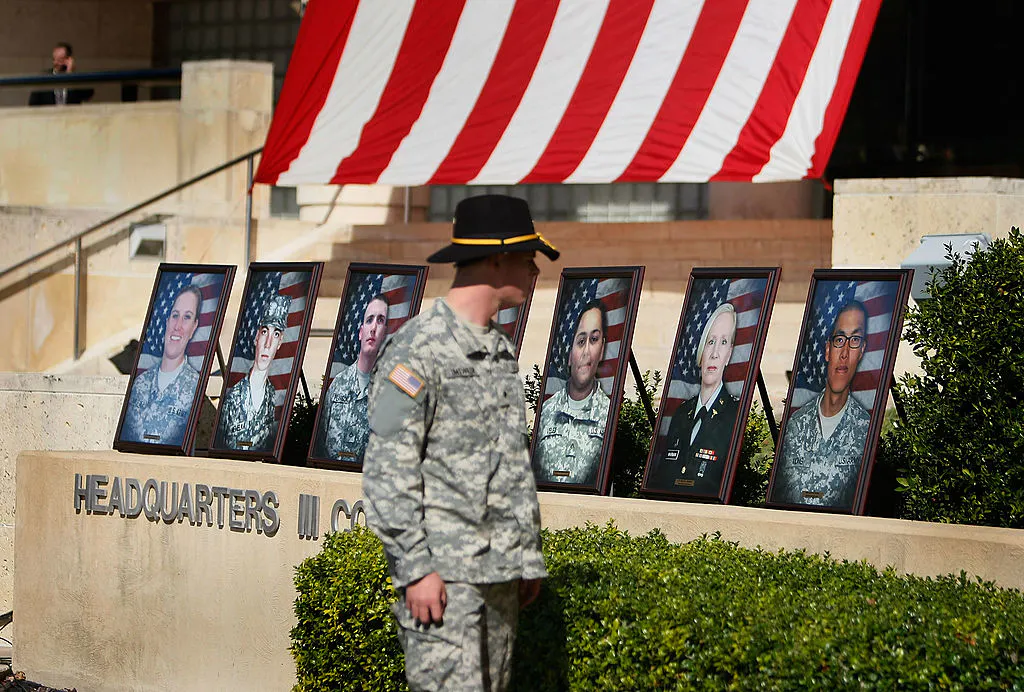
Hasan is the culprit in the 2009 Fort Hood mass shooting that killed 13 service members. News reports indicate that he has expressed no remorse and wished he had died as a martyr. Obviously, we are dealing with a special type of recalcitrance here, one that hardly justifies treating him as a sympathetic figure in any possible light (insert the ridiculous sob stories online of the U.S. executing a man in a wheelchair — a condition resulting from injuries sustained in stopping the attack). He is a traitor and murderer and deserves the full sweep of the state’s sword (Rom. 13:4). The “Sword” in question is an instrument of death, not a costume one sees at Medieval Times.
For reference, the last public execution was in 1936 in Owensboro, Kentucky. Hasan’s military execution by firing squad would be the second execution by firing squad since World War II.
I will lay my cards out clearly: I am strongly for Hasan’s public execution. I am indifferent as to whether the livestream component is right or wrong. I believe people of good will exist on both sides and can make strong arguments for or against. If the live-streaming component were reversed, I wouldn’t be upset, as I think it’s permissible — not obligatory.
But public outcry that reduces public execution to a “spectacle” vastly undervalues the magnitude of Hasan’s offense. It is true that concerns about the macabre, bloodlust, and prurience are real. It is right and good to warn against turning a public execution into an experiment in unbridled machismo. No one should derive joy or entertainment from watching another human die, even if the conditions are just. A public execution is a solemn act of restitution, not a spectacle.
To those making accusations that public executions are a “spectacle,” I would simply warn them against committing “chronological snobbery” that C. S. Lewis warned against — the mistaken idea that the present age is more enlightened than previous times. To that, I would simply say, our society is no more morally enlightened than biblical times, where execution was public (Lev. 24:14; Num. 15:35–36; Deut. 17:5; 21:21; 22:24) and done so that “all Israel shall hear and fear and never again do any such wickedness as this among you” (Deut. 13:11) — in other words, deterrence. To pick and choose Old Testament maxims, like treating the foreigner justly, only to then turn your back on practices that the same Old Testament grounds in the retributive justice principles of natural law (Gen. 9:5-6), is simple partiality. The Bible does not permit being just and compassionate in one situation and then endorsing injustice or vindictiveness elsewhere. If the Bible endorses public execution in some general way, it is not intrinsically immoral. Moral seamlessness underlies the full biblical canon, even as we interpret moral principles carefully. A humble posture would ask why civilizations before us all practiced something that we now consider barbaric and, further, assess whether the therapeutic nature of punishment that now views the condemned as “patients” to be “healed” has not eclipsed what punishment is really for — balancing the scales of justice for the sake of public safety and the common good.
The argument here is not that the Bible demands public execution today in the exact form or that the witness of history is infallible. Claiming so confuses Israel’s law-covenant with the modern nation-state and views history alone as its own moral justification. Just because something has been practiced does not mean it must be practiced today; it should prompt us to ask deeper questions about why such execution methods were used. History does teach, and we are obligated to learn the right lessons. At the same time, anyone who believes we can dispense with the principles of human dignity, public justice, public accountability, and deterrence ignores timeless principles the Bible and modern statecraft continue to rely upon (Rom. 13:1-7).
Even so, concerns about what the event could become do not negate the legitimate public interest in witnessing justice carried out — and in the public reckoning and assuagement that follows. Hasan’s crime was public in nature and requires public satisfaction.
The condemned in focus in this case is no ordinary murderer. He committed both treason and terrorism, making his crime an offense against the body politic on a scale beyond that of an ordinary murder. A soldier sworn to defend the nation who turns against it by murdering those likewise called to its defense has committed an offense of such a horrific kind that I am not troubled by giving its punishment greater symbolic weight in the public mind. If that means a livestream, so be it.
Whether I watch it or not, I believe there are good reasons for the livestream. I would argue on jurisdictional grounds. Because I believe capital punishment should be public, who should view the execution should be determined by the political community’s own interests. In other words, Tennesseans should have the ability to see a Tennessean murderer executed.
Now, scaling that argument upward allows us to see that a murderous rampage against the U.S. military exists on a federal scale. This shows that the military serves the nation’s defense, not a single state, and thus citizens across the country have a right — not an obligation — to view the execution if they choose. Hasan’s terrorism was a symbolic act against the citizens of the United States.
We all have friends and family members who could have been stationed at Fort Hood that day. Hasan’s victims could have been any of our loved ones, regardless of what state they are from.
When I talked about this with friends, I ran a different hypothetical. I asked my friends: Would you have the same revulsion at seeing the public execution of Osama bin Laden? Even my friends against the livestream component paused and recognized that the sense of justice at seeing bin Laden executed changes how one evaluates the appropriateness of Hasan’s execution. The question lingers: If your sense of justice and national pride would not flinch at watching Navy SEALs double-tap bin Laden, why then recoil at a similarly-situated event like Hasan’s execution? Ask yourself whether political optics and tribal instincts are skewing what the common good permits and justice demands. Ask yourself whether modern canons of “decency” (a “decency” that licenses, for example, the unjust taking of unborn life) possess the moral consistency to act with moral outrage in questions of public execution while we kill the unborn and increasingly permit the aged and ill to kill themselves. We are hardly the moral exemplars we believe ourselves to be.
In plain terms, Nidal Hasan is just another version of Osama bin Laden. Yes, Hasan’s crime is on an order of magnitude much smaller, but it is the same violent Islamism that motivates.
It is Hasan’s crime that, I think, justifies considering a larger-scale public execution. As a friend commented to me, “If a murder harms not just the victim and the victim’s family but also the society as a whole whose norms were violated, then the trial and punishment should be public in some way.” My friend is right. The victims are the soldiers whose lives were taken as well as the family members whose loved ones were taken from them. But this episode has a quiet victim to consider: the public. Traitorous and terrorist actions expand the public interest component of this situation. A public execution like this is a communal act of solidarity that punishes wrongdoers who not only undermine the common good but, in this case, try to subvert the state itself.
Now, what we should be on guard against is the video of the execution becoming yet another opportunity for virality. It is one thing to confine an execution to a time and place where someone would have to drive to observe it, and another to turn the event into frictionless, monetized clickbait. Even though the force is justified here, I believe the act itself — as it is — is something children should not see. To that end, I do believe the government should do what it can to communicate sobriety if it pursues the live-stream option. This is not an occasion for video game-like voyeurism.
In considering what public execution is, we should keep something in the back of our minds already: All executions in the United States are already public. Today, witnesses attend executions at a prison’s death chambers. In Hasan’s coming public demise, the moral calculus does not shift in kind, only in the scale of visibility. To watch an execution is not to see a “spectacle,” but an act of justice.
***
Andrew T. Walker, Ph.D., is Dean of the School of Theology at The Southern Baptist Theological Seminary and Professor of Christian Ethics and Public Theology. He is a Fellow with The Ethics and Public Policy Center and the Managing Editor of WORLD Opinions. You can follow him on X: @AndrewTWalker.
More from this network:
Domains for Sale · GOTPeople.org · TheDSAPlatform · The Truth About Socialism
What's Your Reaction?
 Like
0
Like
0
 Dislike
0
Dislike
0
 Love
0
Love
0
 Funny
0
Funny
0
 Wow
0
Wow
0
 Sad
0
Sad
0
 Angry
0
Angry
0

I am just an average American. My teen years were in the late 70s and I participated in all that that decade offered. Started working young, too young. Then I joined the Army before I graduated High School. I spent 25 years in, mostly in Infantry units. Since then I've worked in information technology positions all at small family owned companies. At this rate I'll never be a tech millionaire. When I was young I rode horses as much as I could. I do believe I should have been a cowboy. I'm getting in the saddle again by taking riding lessons and see where it goes.
Premium domains for sale




















Comments (0)