

Woodrow Wilson’s Vision of ‘Progress’ Was at Odds With Human Nature
Premium domains for sale
Freedom Is Back In Style
Welcome to the seventh in our series “Landmark Speeches in American History.” We are celebrating America’s 250th anniversary with articles by prominent authors about how some of the greatest speeches in our history—by celebrated orators like Ronald Reagan, Abraham Lincoln, and Martin Luther King Jr.—honored the vision of our founding document, the Declaration of Independence.
Freedom Is Back
In Style
Premium domains for sale
Today’s federal government employs over 2 million people. It is composed of over 400 agencies that often combine legislative, executive, and judicial powers. These agencies regulate nearly all areas of life from cradle to grave. We may take this arrangement for granted, but it is far from what the Founders envisioned. For them, the federal government was meant to have a limited range of power. And these powers were to be assiduously separated, checked, and balanced by the constitutional system they crafted.
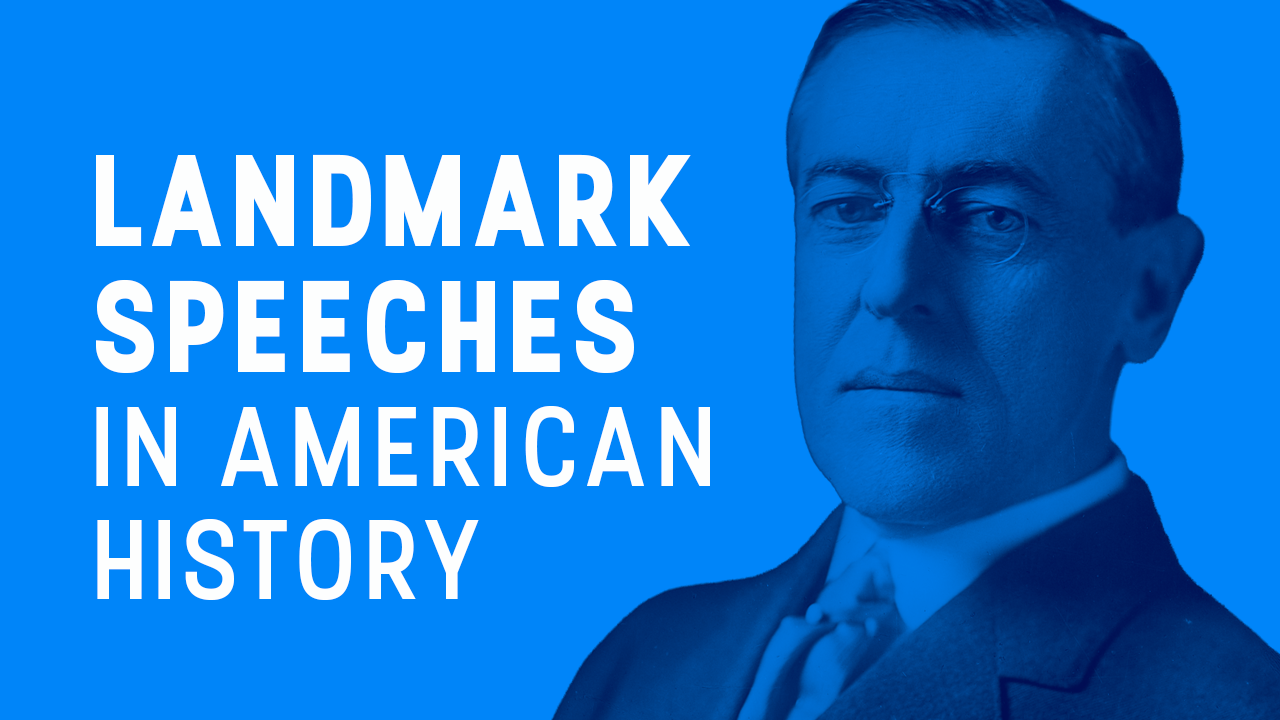
How did we go so far astray? The progressive era marks a key turning point. Woodrow Wilson, foremost among progressives, offered a candid vision of a new form of government in his 1912 presidential campaign speech.
In this speech, which would later be published under the title “What Is Progress?”, Wilson argued that government should be adapted to the latest theory of Darwinian evolution. “Living political constitutions must be Darwinian in structure and in practice,” Wilson explained. “Society is a living organism and must obey the laws of life, not of mechanics; it must develop.”
According to Wilson, the Founders’ political theory was modeled upon the prevailing scientific theory of their day: Newtonian physics.
“They were scientists in their way … those fathers of the nation. [Thomas] Jefferson wrote of ‘the laws of Nature’—and then by way of afterthought—’and of Nature’s God,’” he states. “Politics in their thought was a variety of mechanics. The Constitution was founded on the law of gravitation.”
If the Founders’ system of government was based upon outdated scientific models, then we should update it according to new scientific breakthroughs if government is to remain effective.
Hence Wilson’s request:
“All that progressives ask or desire is permission— in an era when ‘development,’ ‘evolution,’ is the scientific word—to interpret the Constitution according to the Darwinian principle; all they ask is recognition of the fact that a nation is a living thing and not a machine.”
If society is a living organism, then government should not be constrained by mechanisms like checks, balances, and so forth. “No living thing can have its organs offset against each other, as checks, and live,” said Wilson. It should be able to grow, adapt, and act as a coordinated whole.
Darwin’s theory, strictly speaking, didn’t have much to say about social and political life—though many apply natural selection to cultures with various degrees of plausibility. Wilson and other progressives adapted Darwin’s theory of natural selection to “artificial selection,” which suited their own ends. This was the idea that humans can control their environments such that they shape society and human nature. And human nature is seen as plastic, so there are no built-in limits to what we can do or become.
The Founders would’ve seen this proposal as naïve and reckless. Aside from some passing mentions, they were not relying on Newtonian physics in crafting the U.S. Constitution. They were relying on millennia of tradition and experience, reflections on human nature, and more recent historical memory of Britain and Colonial America.
When Jefferson and the Founders appealed to the “laws of nature”, they were not speaking simply of physical laws like gravity as Wilson suggests. They were appealing to a moral order—a standard of justice that can be known by reason and that tells us crucial facts about what humans are.
For all their differences, the Founders generally agreed humans are “rational animals” endowed with intellect and will. But as revelation and observation show, we are also fallen. Passions often override our reason. Too much power can corrupt even the noblest of men.
This is why the Founders crafted the form of government they did. The seemingly “mechanical” Constitution arose from a sober view of human nature. “Ambition must be made to counteract ambition,” as James Madison observed.
Wilson dismisses this understanding of human nature and with that the need for constraints upon government. As the Declaration of Independence states, governments exist to secure certain unalienable rights. These rights derive from certain unchanging features about man and from our status as created beings.
But just as he rejects fixed constitutional limits, Wilson also reinterprets the declaration as an ever-evolving program of action.
The declaration, he argues, is of no use “unless we can translate its general terms into examples of the present day….” It is “not a thesis for philosophers, but a whip for tyrants; not a theory of government, but a program of action.”
For Wilson, the only enduring principle in the declaration appears to be the contest between freedom and tyranny. And that is historically contingent. The relevant questions, then, are:
“What is the special form of tyranny we now fight? How does it endanger the rights of the people, and what do we mean to do in order to make our contest against it effectual? What are to be the items of our new declaration of independence?”
In other words, the declaration is a permission slip for government to address present-day injustices and pursue new ideals and aspirations. While the Founders believed government exists to secure certain preexisting rights, Wilson’s government exists to create new rights and expand its scope to secure them.
Taken together, Wilson’s reinterpretation of the declaration and his dismissal of the Constitution’s checks and balances points toward a much more expansive national government. If rights are evolving, and government must evolve to secure them, then limits placed on government begin to look more like obstacles than safeguards.
Beneath the appeals to Darwinism vs. Newtonian theories is a deeper conflict over human nature and the purpose of government. Wilson saw the purpose of government as administration by experts who could keep up with social progress. The Founders, by contrast, recognized the need for constraints within government, stemming from certain unchanging features in human nature.
For them, just government was not so much a matter of scientific or technical expertise as it was of prudence—the highest virtue of the statesman.
Wilson notes that some will insist on clinging to old political forms and ways of life. These “stand-patters,” as he calls them, don’t know a “procession is under way.” “The world has a habit of leaving those behind who won’t go with it,” he states. “The world has always neglected stand-patters.”
The world does go on, but looking back on this procession should show that some things remain the same. Humans remain fallible creatures, capable of virtue but prone toward vice. Too much power in the hands of one or a few is always bound to corrupt.
Wilson may have justified expanding the government to combat tyranny. But the form it produced—effectively a “fourth branch” of government in which offices combine legislative, executive, and judicial powers—is what Madison described as “the very definition of tyranny.”
Contrary to his intentions, Wilson’s speech should prompt us to cling even more steadfastly to the perennial truths that lay at the heart of the Declaration of Independence and the Constitution. As we celebrate the 250th anniversary of this nation, we should take pride in being the “stand-patters” Wilson bemoans.
More from this network:
Domains for Sale · GOTPeople.org · TheDSAPlatform · The Truth About Socialism
What's Your Reaction?
 Like
0
Like
0
 Dislike
0
Dislike
0
 Love
0
Love
0
 Funny
0
Funny
0
 Wow
0
Wow
0
 Sad
0
Sad
0
 Angry
0
Angry
0

I am just an average American. My teen years were in the late 70s and I participated in all that that decade offered. Started working young, too young. Then I joined the Army before I graduated High School. I spent 25 years in, mostly in Infantry units. Since then I've worked in information technology positions all at small family owned companies. At this rate I'll never be a tech millionaire. When I was young I rode horses as much as I could. I do believe I should have been a cowboy. I'm getting in the saddle again by taking riding lessons and see where it goes.
Premium domains for sale























Comments (0)