

You Spent Too Much On Your Wedding
Premium domains for sale
Freedom Is Back In Style
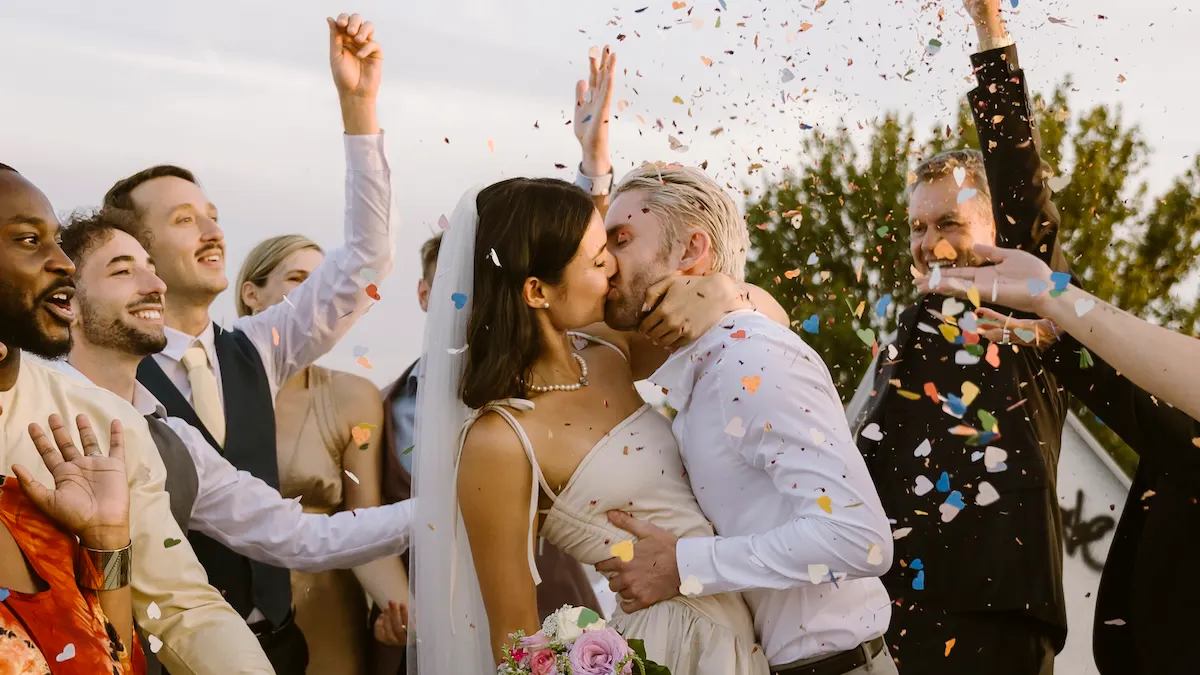
“Traditional is totally out,” proclaims Olivia Grayce, a Columbus, Ohio, wedding planner. Today’s weddings, Grayce says, are meant to be a couple’s “showcase.” Couples should only invite the “people they love most” and should prioritize “customization and individualization,” she said. They should also, it goes without saying, spend a lot of money.
Freedom Is Back
In Style
Premium domains for sale
The average American couple now spends $36,000 on their wedding. That’s more than double what they’d have spent in 1990. The ballooning price tag is not simply due to inflation or tariffs; the American wedding industry has been steadily growing for decades, sitting now at an estimated $65 billion annually.
There are several factors at play, including the fact that people are getting married older and that marriage is skewing toward the higher-educated (and therefore wealthier).
But weddings have a way of revealing a culture’s values. If Grayce’s perspective is any indication, our weddings have become extravagantly expensive because we’ve made them into something they didn’t used to be. Sociologist Brad Wilcox with the Institute for Family Studies says we’ve turned weddings into a status symbol, a “signal of success rather than a ritual that ushered young adults into adulthood.”
A “showcase,” as it were.
For a decade, marriage researchers such as Wilcox have cautioned against this shift. They note a landmark study from Emory University in 2014 that found a correlation between expensive weddings and higher divorce rates. Following hundreds of couples over several years, researchers concluded that couples who spent more than $20,000 on their wedding (equivalent to about $28,000 today) were more than three times more likely to divorce than couples who spent $10,000 or less ($14,000 today). A more expensive engagement ring was also correlated with higher divorce risk.
Researchers hypothesized then that it was a stress issue: more money, more problems, basically. But as the entire wedding process has become commercialized — from the professionally photographed proposal to the choreographed walk from the reception to the Uber — the price tag itself points to a bigger issue.
The problem is we’ve objectified our weddings into a blunt instrument of self-expression. Ironically, that seems to have cheapened our idea of marriage itself.
Wedding photographers Abby and Michael Smithers recently shot a wedding with a prequel.
“They wanted to do a breakfast picnic just the two of them,” Abby recalled. “Up on the hill at their venue, to just share their private vows.” Later that afternoon, the couple had the standard event: big ceremony with family, photos and more photos, a cocktail hour, dinner reception.
It used to be that the vows themselves — made, crucially, in front of family and friends —were the wedding. But now, at least for this couple, the big event was something else entirely.
American weddings are much less religious than they used to be. More occur outside of a church than in one, and most are officiated by someone outside the clergy. Receptions have become far more elaborate and expensive than the ceremony. More couples pay for their own weddings now, which means parents are probably exerting less influence over everything from the guest list to the size of the budget itself — as well as the level of allegiance to tradition.
“People still seem to want all the symbolism of the marriage ceremony, but they’ve dispensed with most of its old meaning,” says sociologist Andrew Cherlin, a professor of public policy at Johns Hopkins who has studied marriage trends since the 1970s. “The older meaning was to evoke religion as a way of blessing a couple’s union … and to have two families be involved in unifying.”
Indeed, many modern American weddings communicate a much different meaning than fidelity or family. Couples are hiring “content creators” to drive the “editorial direction” of their wedding. Photographers no longer capture just the wedding and reception; they’re hired for the proposal, the engagement party, and the staged “getting ready” the morning before the wedding. Brides can’t just ask their friends to serve as bridesmaids; they must do it with elaborate gestures and gifts marketed specifically for the occasion.
The sheer number of accessories and clothing upon which one can find the word “bride” imprinted (for a price) is a masterclass in entrepreneurship. Couples are commissioning ice sculptures and painters to live-sketch the ceremony as it is happening. These aren’t just Taylor and Travis; they’re your pushing-upper-middle class friends. Capitalism has absolutely risen to the occasion of the modern American wedding.
Trina How, a young bride who recently wed her husband in Charlottesville, Virginia, told me she had to instruct her photographer to take photos of her entire family at her wedding, even if the photos weren’t the right “aesthetic” for her social media reels. Many wedding videographers include in their packages the option for an edited theatrical trailer for the wedding, as well as 30-second and three-minute footage cuts for couples to post as reels on their social media.
“Having a magnificent wedding is a way of signaling to your peers, to your family and friends, that you’re a successful person,” Brad Wilcox said.
If he’s right, weddings are no longer the “cornerstone,” as he put it, of adult life. They’ve become a social “triumph.” And a triumph calls for a much, much bigger party. There’s nothing wrong, surely, with wanting beautiful photos of your wedding. But at what point does this preoccupation with aesthetics start to feel suspect? Is it possible some young couples aren’t getting engaged entirely because they’ve chosen to enter a committed marriage, but because they want to have The Party?
Consider another, darker trend that’s hit the marriage economy: divorce parties. (They’re exactly what they sound like). Isn’t this another side of the same coin? If all life is a personal branding opportunity, all relationships eventually become another facet in the kaleidoscope of your #aesthetic. Turning our major rites, including matrimony, into status symbols has inevitably cheapened them — no matter how expensive the dress was.
There is one exception to the relationship between wedding cost and marriage duration. Indian weddings are notoriously elaborate and expensive, often involving multiple days of parties and rites. Indian families come from all over the world to see their loved ones marry. The guy rides in on a white horse. And yet the Indian divorce rate is among the lowest in the world, at around 1.5% (although some data suggest many more couples separate without officially divorcing in order to avoid the stigma). For Indian Americans, the divorce rate is not much higher.
But Indian weddings are also notoriously family-oriented. Indeed, research suggests that the size and level of involvement of a couple’s family and community is a much better indicator of their marriage’s success than the extravagance or frugality of their wedding.
It’s intuitive that couples with more involved families and friends have a bigger network of support when troubles come. But a deeper, tighter community also implies accountability. A couple who promises to stay together through an unknown future in front of their entire family, who’ve maybe spent days (in the case of Indian weddings, which often last a week) and thousands of dollars on this very event, no doubt feel a deeper sense of duty than couples who insisted their day is their own personal “showcase.”
That’s probably why so many of us feel vaguely gross about all the “bride” merch and people throwing around the words “editorial direction” in reference to their wedding. The ceremony can be as extravagant and bespoke as a couple wishes it to be. But marriage is still, first and foremost, a commitment. The strength of any given marriage is rooted first in the couple’s commitment to commitment itself.
Wedding vows — at least the traditional ones, I don’t know what people say at their private Pinterest vow picnics — say “for better or worse” precisely because we can never really know which one it will be. The point is promising anyway, and you can do that for very little coin. Maybe, if the fanciest wedding you’ve been to really is the weakest marriage you know, it’s because the couple didn’t value that part enough.
***
Maria Baer is a contributing writer at the Institute for Family Studies and co-host of the Breakpoint podcast with The Colson Center for Christian Worldview.
This article is part of Upstream, The Daily Wire’s new home for culture and lifestyle. Real human insight and human stories — from our featured writers to you.
More from this network:
Domains for Sale · GOTPeople.org · TheDSAPlatform · The Truth About Socialism
What's Your Reaction?
 Like
0
Like
0
 Dislike
0
Dislike
0
 Love
0
Love
0
 Funny
0
Funny
0
 Wow
0
Wow
0
 Sad
0
Sad
0
 Angry
0
Angry
0

I am just an average American. My teen years were in the late 70s and I participated in all that that decade offered. Started working young, too young. Then I joined the Army before I graduated High School. I spent 25 years in, mostly in Infantry units. Since then I've worked in information technology positions all at small family owned companies. At this rate I'll never be a tech millionaire. When I was young I rode horses as much as I could. I do believe I should have been a cowboy. I'm getting in the saddle again by taking riding lessons and see where it goes.
Premium domains for sale





Comments (0)