

3-D Printed Helicopters And Self-Repairing Carriers? America’s Navy Tests Wild New Technology

Premium domains for sale
Freedom Is Back In Style
Consider scenario one: American assets overseas are under attack and must quickly mobilize a response, but the necessary aircraft carriers cannot deploy until crew members obtain key parts needed for the mission. A mission that should have begun immediately is delayed indefinitely.
Freedom Is Back
In Style
Premium domains for sale
Now consider scenario two: immediately following an initial attack, the American response is launched. Aircraft carriers deploy on a moment’s notice because they have the capability to build new parts on the way to their destination.
General George S. Patton always said, “A good plan, violently executed now, is better than a perfect plan next week.” Even when his men were figuring things out as they went — and things occasionally got a bit messy — there was always a clear advantage to moving forward quickly.
Solving the above problem was recently a key subject at RIMPAC, the largest international military maritime training exercise in the world. A biennial naval exercise, RIMPAC sees some 30 ships and 30,000 service members — in coordination with more than two dozen countries — stress test new technology in the context it would operate under in the real world.
One of those technologies is 3-D printers. They aren’t new to the world, but ones capable of manufacturing everything from water filtration systems to helicopter parts are new to aircraft carriers.
Morgan Bower, hub director for FLEETWERX, the “innovation hub” working to bring this new tech to the U.S. military, said it’s all about connecting small business innovators with an often slow-moving Pentagon bureaucracy.
“We try to make it a little easier for technology and money to flow in both directions, to help small businesses and government work together to make development work for everyone,” Bower told The Daily Wire.
“FLEETWERX,” according to its website, “Is an innovation hub established in 2023 through a Partnership Intermediary Agreement between DEFENSEWERX (DWX) 501(c)(3) and the Naval Postgraduate School (NPS). FLEETWERX cultivates a dynamic environment designed to create purposeful collisions between innovators through ecosystem building and neutral facilitation. By uniting Government, Industry, and Academia, we bring together people to advance solutions for critical issues facing the operator.”

Photo courtesy of FLEETWERX
“When you engage in these exercises, you’re always learning things — taking things out of the lab and putting them in the field,” Bower explained. “We are always looking for what goes right, obviously, but sometimes things go wrong, and the things that go wrong can be the bigger lesson and more important than what goes right. It’s great to identify that problem when it’s a matter of tens of thousands of dollars rather than millions — and early in the process.”
He cited an example from RIMPAC in which planes landing on the deck of the aircraft carrier created vibrations that caused lasers in the metal printers to misalign just slightly — something that never could have been tested in the lab — and the designers were able to recalculate and adjust for the additional vibrations.
And in one case in which something went right, a part from the carrier’s water filtration system broke — and the onboard 3-D printers were able to manufacture a new one without waiting for a traditional resupply.
Another area that was tested at RIMPAC was the use of unmanned surface vessels for supply runs.
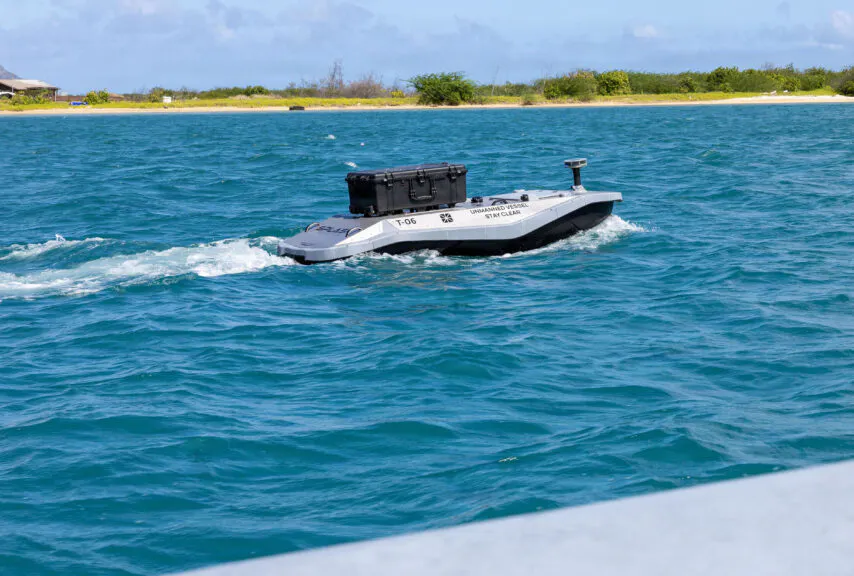
Photo courtesy of FLEETWERX
Using unmanned vessels — particularly in rough maritime conditions or through dangerous areas — limits the number of personnel at risk when undertaking any given mission. The success of test runs like these could ultimately lead to unmanned vessels taking on the role of “escort” vehicles in particularly dangerous areas such as the Strait of Hormuz.
The main goal is to streamline the development process so that the maritime military services have access to the best possible technology — and while the Naval Postgraduate School is broadly considered to be the “research” wing of the joint forces, they don’t always have a good bead on where the best innovators are and what they might be building. FLEETWERX is making that connection.
More from this network:
Domains for Sale · GOTPeople.org · TheDSAPlatform · The Truth About Socialism
What's Your Reaction?
 Like
0
Like
0
 Dislike
0
Dislike
0
 Love
0
Love
0
 Funny
0
Funny
0
 Wow
0
Wow
0
 Sad
0
Sad
0
 Angry
0
Angry
0

I am just an average American. My teen years were in the late 70s and I participated in all that that decade offered. Started working young, too young. Then I joined the Army before I graduated High School. I spent 25 years in, mostly in Infantry units. Since then I've worked in information technology positions all at small family owned companies. At this rate I'll never be a tech millionaire. When I was young I rode horses as much as I could. I do believe I should have been a cowboy. I'm getting in the saddle again by taking riding lessons and see where it goes.
Premium domains for sale
























Comments (0)