Dem Dark Money Group Accused Of Breaking Campaign Finance Laws To Fund Blue Wave

Premium domains for sale
Freedom Is Back In Style
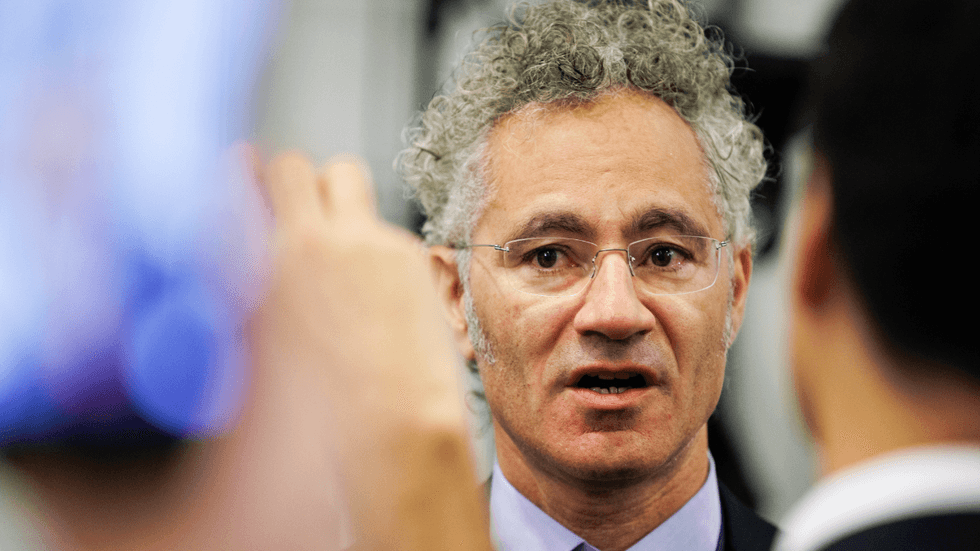
A dark money group that funneled nearly $20 million into political committees backing Democrat candidates during the 2026 midterm elections faces accusations that it concealed the identities of its donors in violation of campaign finance law.
Freedom Is Back
In Style
Premium domains for sale
The Campaign Legal Center, a nonprofit campaign finance watchdog, filed a complaint with the Federal Election Commission alleging that United Futures Inc. operated as a straw donor, allowing wealthy individuals or other undisclosed contributors to secretly finance Democrat super PACs in multiple states. The watchdog says the alleged scheme deprived voters of information about who was funding political efforts ahead of Election Day.
United Futures contributed $19.7 million to political committees over a six-week period between August 24 and October 8, according to the complaint. The money supported Democrat candidates in Kansas, Alaska, and Mississippi, as well as independent candidate Dan Osborn in Nebraska.
The allegations are particularly significant in Kansas, where Democrat Adam Hamilton won a U.S. Senate seat in a state that had not elected a Democrat to the chamber since 1932. United Futures contributed millions to Vote Kansas, a political committee that helped finance canvassing and voter mobilization efforts on Hamilton’s behalf.
The Campaign Legal Center argues that United Futures was created specifically to conceal the people actually supplying the money. The nonprofit was incorporated in Delaware on August 12 by Alana Mounce, a Democrat political operative who previously worked for the Democratic National Committee, President Joe Biden’s White House, and Kamala Harris’s 2024 presidential campaign.
Just 12 days after its formation, United Futures began making multimillion-dollar political contributions. The complaint says the organization had no discernible business activity, website, social media presence, or apparent fundraising operation that could explain how it obtained nearly $20 million so quickly.
Instead, the watchdog alleges, undisclosed contributors transferred money to United Futures, which then passed it along to super PACs while appearing to be the original source of the contributions.
The complaint also alleges that at least four political committees knowingly participated in the arrangement: United Futures PAC, Mississippi Forward PAC, Vote Kansas, and 49th State PAC. The committees were incorporated in Delaware within days of one another, shared mailing addresses and campaign finance compliance services, and received all or virtually all of their funding from United Futures.
“It is therefore utterly implausible that these super PACs did not know the identities of the true contributors providing funds to UFI for the purpose of financing their electoral influence efforts,” the complaint states.
Federal campaign finance law requires registered political committees to disclose the direct sources of contributions over $200. Super PACs may accept unlimited contributions, but they cannot knowingly accept money given in the name of another person or organization to conceal the actual donor.
The complaint also raises questions about the reporting practices of United Futures PAC, a separate political committee established by Mounce. The watchdog alleges that the PAC failed to disclose millions of dollars in contributions it made to other political committees, including $6.25 million to People Over Politics Action Fund and $1.3 million to BOLD America.
Those committees reported receiving the contributions, while United Futures PAC did not report making them, according to the complaint.
The Kansas operation offers a closer look at how the money was deployed. Vote Kansas reported receiving a $3.2 million contribution from United Futures shortly after registering with the FEC. The committee spent money on canvassing services, software, and communications consulting, and reportedly employed approximately 15 staffers. Some of its workers also appeared on the payroll of Hamilton’s Senate campaign.
The group’s activities included voter mobilization efforts at Hamilton events, where volunteers wore Vote Kansas stickers. The complaint questions whether some of the committee’s reported operating expenditures may have been coordinated with federal candidates, which would raise separate campaign finance concerns.
The allegations also carry political irony for Hamilton, who campaigned against the influence of wealthy donors and undisclosed political spending. His campaign website criticized dark money as a force that drowns out ordinary voters and makes elected officials beholden to special interests.
A lawyer representing United Futures said the allegations were false.
“The allegations in the complaint are false and we look forward to addressing them through the F.E.C.’s process,” Lindsay Nathan told The New York Times. Hamilton’s campaign has not publicly commented on the allegations at the time of publication.
The complaint now faces an uncertain path at the FEC, which has only two of its six commissioner seats filled. The commission generally requires four votes to take enforcement action, potentially limiting its ability to investigate or resolve the allegations in the near term.
More from this network:
Domains for Sale · GOTPeople.org · TheDSAPlatform · The Truth About Socialism
What's Your Reaction?
 Like
0
 Dislike
0
 Love
0
 Funny
0
 Wow
0
 Sad
0
 Angry
0

I am just an average American. My teen years were in the late 70s and I participated in all that that decade offered. Started working young, too young. Then I joined the Army before I graduated High School. I spent 25 years in, mostly in Infantry units. Since then I've worked in information technology positions all at small family owned companies. At this rate I'll never be a tech millionaire. When I was young I rode horses as much as I could. I do believe I should have been a cowboy. I'm getting in the saddle again by taking riding lessons and see where it goes.
Premium domains for sale














Comments (0)