

30 Years Later, Welfare Reform’s Biggest Legacy May Be Stronger Families, Architect Says
Premium domains for sale
Freedom Is Back In Style
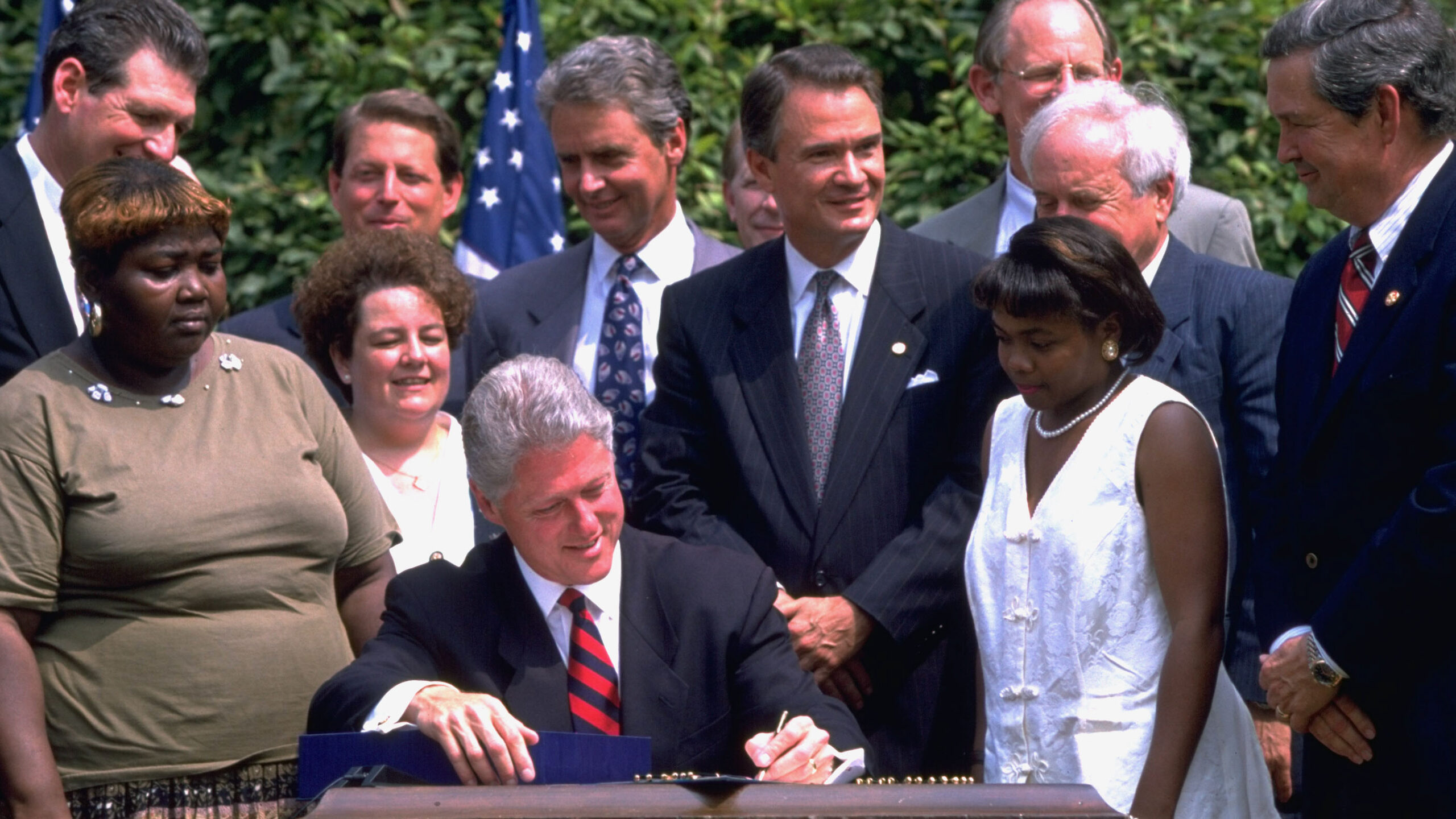
The welfare reform bill signed 30 years ago may have made its greatest impact on marriage and family structure, said the reform’s architect.
Freedom Is Back
In Style
Premium domains for sale
“It was one of the greatest successes of modern conservatism on domestic policy,” Robert Rector, a senior research fellow at The Heritage Foundation, told the Daily Signal.
“We anticipated after the success, Republicans would reform Medicaid and food stamps,” Rector continued. “Instead, they just stopped at welfare reform.”
The Personal Responsibility and Work Opportunity Reconciliation Act of 1996, signed into law by President Bill Clinton, caused a steep reduction in welfare dependence; increased employment; and a huge drop in child poverty among single parents, Rector noted.
Impact on Marriage and Children
In 1963, before President Lyndon Johnson’s “War on Poverty,” illegitimacy was at 7%; in the 1990s, pregnancies outside of marriage reached 30%. “Even the Washington Post was panicking about this,” Rector said.
“Welfare had become a lifestyle choice,” Rector said.
He noted that an increasing number of teen girls from low-income nonmarried homes dependent on welfare became unmarried teen moms themselves and remained on welfare for 20 years.
“Putting a time limit and a work requirement on a benefit makes it less attractive,” he said.
A Heritage Foundation study from 2023 that Rector authored looked at the trends for marriage, nonmarital birth rates, and abortion before and after welfare reform.
In 1970, 85% of children lived in two-parent homes. By 1996, that declined to 68%. After welfare reform, that number stabilized. Had it continued on the same trajectory, it would have been 53% in 2021, the study shows.
The reform showed the teen birth rate per 1,000 women ages 15-19 reached 53.5% in 1992, but fell to 26.5% by 2017, while the teen abortion rate fell from 29% in 1992 to 7.6% in 2017. The study found a similar decline for all nonmarital pregnancies among women ages 15-44.
Marriage would decrease the likelihood of abortions, as 35% of nonmarital pregnancies end in abortion, while just 3% of married pregnancies end in abortion, the study notes.
Last year, President Donald Trump signed the One Big Beautiful Bill Act that similarly included work requirements for recipients of Medicaid and food stamps, as well as anti-fraud provisions.
Rector’s Impact
Rector drafted the legislation that became part of the “Contract with America,” which House Republicans campaigned on in 1994. Rep. Jim Talent of Missouri and Sen. Lauch Faircloth of North Carolina, both Republicans, sponsored the bill.
Interestingly enough, Clinton helped put the issue on the agenda in his 1992 campaign.
“Clinton talked about ending welfare as we know it, but the Democrats in Congress weren’t interested, and most of his administration wasn’t interested,” Rector said.
Though he added, “A Democratic president used stronger rhetoric than Republicans use today,” which he said “emboldened Republicans” to accept welfare reform in the 1994 campaign.
The Aid for Families with Dependent Children, or AFDC, created in the 1960s, included a provision that a low-income mother who married the employed father of her children would lose nearly all welfare benefits.
The 1996 bill replaced AFDC with Temporary Assistance for Needy Families, or TANF, which had a work requirement imposed and a five-year time limit on benefits.
Rector gained recognition for his influence on the landmark reform, receiving a 1996 front-page profile in The Wall Street Journal for his impact on the bill.
“He had more influence on the shape of welfare legislation than anybody else outside of Congress,” said Ron Haskins, then-staff director of the House Ways and Means Human Resources Subcommittee.
Rector noted that opponents inadvertently contributed to the success of the reform.
“Activists opposed to reform said people would be thrown off assistance and would starve. Some recipients believed this and immediately responded by going to work.”
More from this network:
Domains for Sale · GOTPeople.org · TheDSAPlatform · The Truth About Socialism
What's Your Reaction?
 Like
0
Like
0
 Dislike
0
Dislike
0
 Love
0
Love
0
 Funny
0
Funny
0
 Wow
0
Wow
0
 Sad
0
Sad
0
 Angry
0
Angry
0

I am just an average American. My teen years were in the late 70s and I participated in all that that decade offered. Started working young, too young. Then I joined the Army before I graduated High School. I spent 25 years in, mostly in Infantry units. Since then I've worked in information technology positions all at small family owned companies. At this rate I'll never be a tech millionaire. When I was young I rode horses as much as I could. I do believe I should have been a cowboy. I'm getting in the saddle again by taking riding lessons and see where it goes.
Premium domains for sale























Comments (0)