

America Is About To Send Astronauts Farther From Earth Than Ever Before
Premium domains for sale
Freedom Is Back In Style
For the first time in more than 50 years, NASA is preparing to send astronauts back toward the Moon — marking a dramatic step in a new era of human space exploration.
Freedom Is Back
In Style
Premium domains for sale
Freedom Is Back
In Style
Premium domains for sale
The Artemis II mission, scheduled to launch April 1 at 6:24 p.m. EST from Florida’s Kennedy Space Center, is set to carry four astronauts on a ten-day journey around the Moon and back. It will be the first crewed mission to travel to the Moon since Apollo 17 in 1972 and will pave the way for future moon landings using NASA’s Orion deep space capsule.
If successful, this mission will bring humans further in space than ever before and travel approximately 252,000 miles from Earth — about 4,000 miles farther than the record set by Apollo 13 in 1970.
The mission will offer a view of the Moon’s far side that has so far been unseen by the human eye. Earlier crews flew past it in darkness, but this time, about 21% will be illuminated, giving astronauts a rare chance to see the hidden surface for themselves. From Orion, the Moon will appear like a basketball at arm’s length, with Earth shining nearly 250,000 miles away, according to NASA.
Unlike the Apollo missions, which orbited much closer to the lunar surface, Artemis II will pass between 4,000 and 6,000 miles above the Moon, providing the entire lunar disk view with an opportunity to see regions near both poles, according to NASA.
The four astronauts selected for Artemis II bring a mix of experience and historic firsts.
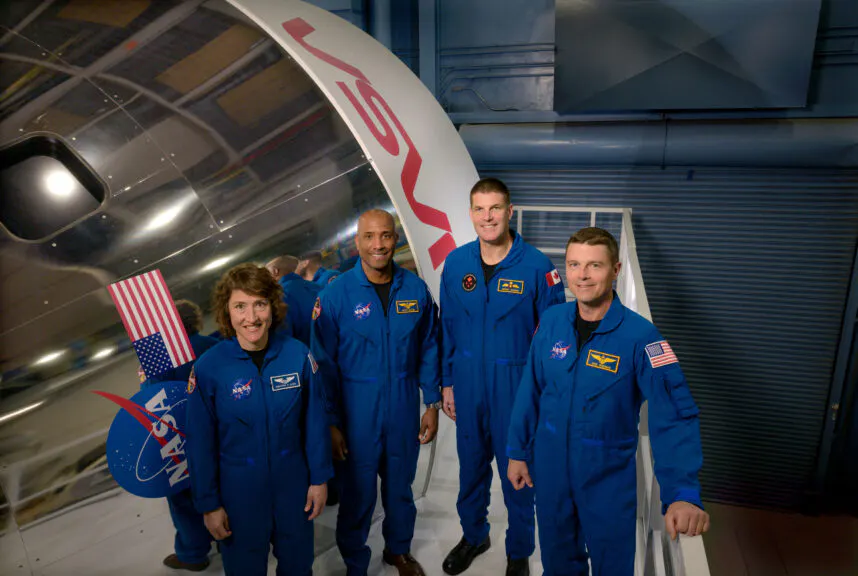
Left to right: Mission Specialist Christina Koch, Pilot Victor Glover, Mission Specialist Jeremy Hansen, and Commander Reid Wiseman. (NASA/James Blair)
Commander Reid Wiseman, a former Navy test pilot, previously spent 165 days aboard the International Space Station (ISS), where he conducted more than 300 experiments and set a record for 82 research hours in a single week.
Pilot Victor Glover, also a Navy aviator, flew on the Crew-1 Dragon mission to the ISS and was selected as an astronaut while serving as a legislative fellow in the U.S. Senate for the late Sen. John McCain. If the mission proceeds as planned, he will become the first black astronaut to travel around the Moon.
Mission specialist Christina Koch holds the record for the longest continuous spaceflight by a woman, having spent 328 days aboard the ISS. Her experience also includes scientific work in both the Arctic and Antarctic. If successful, she will become the first woman to travel to the Moon.
Canadian astronaut Jeremy Hansen will be making his first spaceflight and will become the first Canadian to travel beyond Earth’s orbit.
While Artemis II plans to travel around the moon, it is primarily a test mission to try out the Orion and other equipment. Astronauts are prepared for several different scenarios that may include not going around the moon if tests are not successful.
“This is a test mission,” Wiseman told reporters. “We might come right back home. We might spend three or four days around Earth. We might go to the Moon. That’s where we want to go — but we are ready for every scenario.”
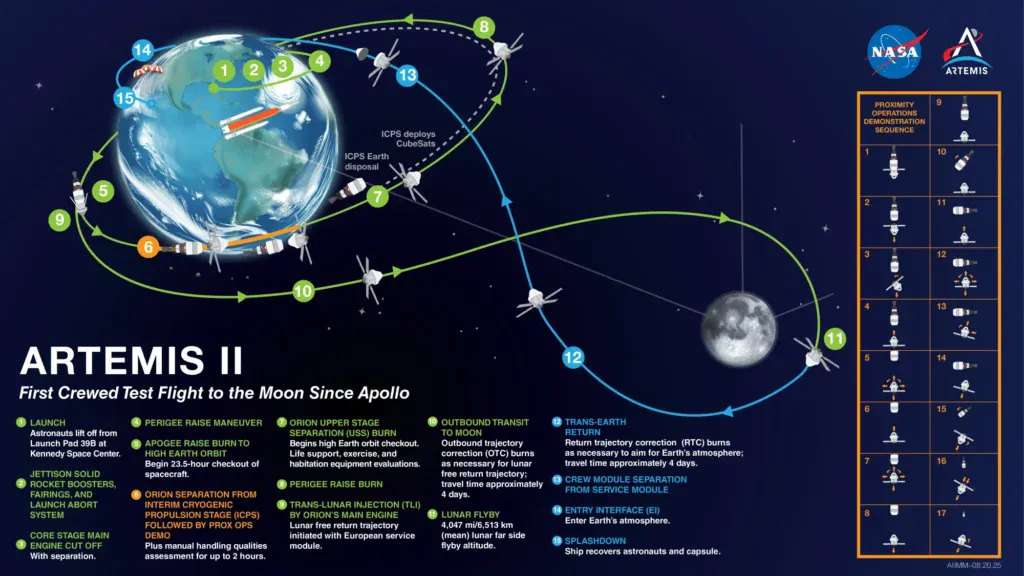
After liftoff aboard the 5.7-million-pound Space Launch System rocket, the crew will reach orbit in just about eight minutes, traveling at speeds of about five miles per second. They will then spend roughly 24 hours orbiting Earth while conducting critical checks of Orion’s life support systems to ensure it can provide breathable air, water, and basic human necessities.
(NASA)
“We’ve got to test everything,” Wiseman explained. “Can it scrub carbon dioxide? Can it keep us alive? Can we drink water? Can we go to the bathroom? All those basic human functions — we need to verify them before heading to the Moon.”
If all systems are working properly, Orion will perform a translunar injection burn to escape Earth’s orbit and begin its four-day journey to the moon.
After looping around the far side, the spacecraft will begin its return using a fuel-efficient “free-return” trajectory, relying on the natural gravitational pull of the Earth-Moon system rather than heavy propulsion. This mirrors the emergency return to a free-return trajectory used by Apollo 13 in 1970 after an oxygen tank explosion. The crew had to execute a critical engine burn to move from their landing course back onto a “figure-eight” path that would naturally swing them around the Moon and safely back to Earth with minimal further engine use.
While on the other side of the moon, the crew will lose communication with the Earth for 30-50 minutes.
The mission is expected to conclude with a splashdown in the Pacific Ocean on April 10, where recovery teams will retrieve the crew from the capsule and transport them via a helicopter airlift to a U.S. Navy amphibious transport dock.
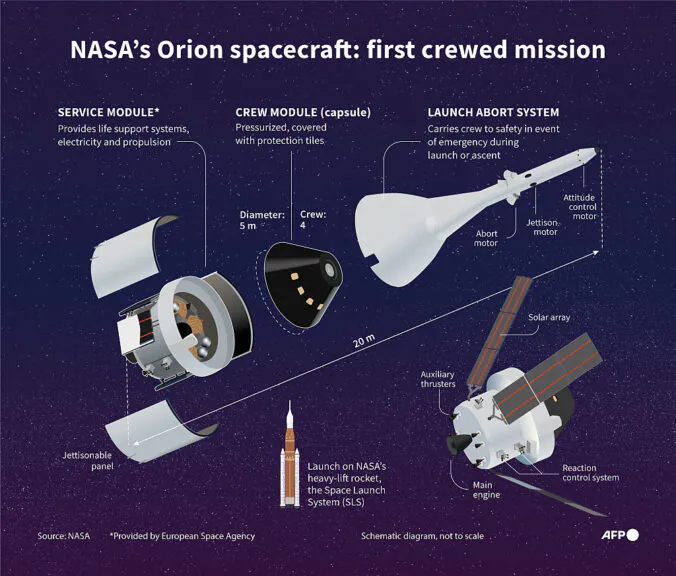
Infographic on NASA’s Orion spacecraft. (Graphic by Gal ROMA and Anibal MAIZ CACERES / AFP via Getty Images)
Artemis I, launched in 2022, was an unmanned test mission of the Orion spacecraft that revealed unexpected wear to its heat shield during reentry. NASA has since conducted extensive analysis and testing to address the issue ahead of future crewed flights.
While the original Space Race was shaped by Cold War rivalry, today’s push comes amid competition with China, which announced plans to land astronauts on the Moon by 2030.
The next Artemis flight, scheduled for 2027, aims to test lunar landers developed by SpaceX and Blue Origin, with a goal of landing astronauts on the Moon as early as 2028.
As the International Space Station is scheduled to retire by the end of 2030, NASA is also exploring plans to build a base near the lunar south pole and establish a sustained human presence.
“This time, the goal is not flags and footprints,” NASA Administrator Jared Isaacman said. “This time, the goal is to stay. America will never again give up the Moon.”
What's Your Reaction?
 Like
0
Like
0
 Dislike
0
Dislike
0
 Love
0
Love
0
 Funny
0
Funny
0
 Wow
0
Wow
0
 Sad
0
Sad
0
 Angry
0
Angry
0

I am just an average American. My teen years were in the late 70s and I participated in all that that decade offered. Started working young, too young. Then I joined the Army before I graduated High School. I spent 25 years in, mostly in Infantry units. Since then I've worked in information technology positions all at small family owned companies. At this rate I'll never be a tech millionaire. When I was young I rode horses as much as I could. I do believe I should have been a cowboy. I'm getting in the saddle again by taking riding lessons and see where it goes.
Premium domains for sale





















Comments (0)